Beginner Guitar
For a child who is a beginning string player, making music can be BAFFLING. There are so many things going on!

Learning how to play guitar seems almost intuitive for beginner guitar players who have taken piano lessons.
But to a child encountering music training for the first time with a guitar in hand, using left and right hands independently, strumming rhythmically, learning what a chord is, reading notes and understanding their relationship to the guitar strings is a process shrouded in mystery.
LET ME HELP.
Check out this page for EASY guitar songs and exercise sheets to demystify this process for your students.
Jump to:
Guitar Worksheets
From guitar chord fretboards small, large, and SUPER large, to flashcards and blank tablature, there are many tools here for your students!
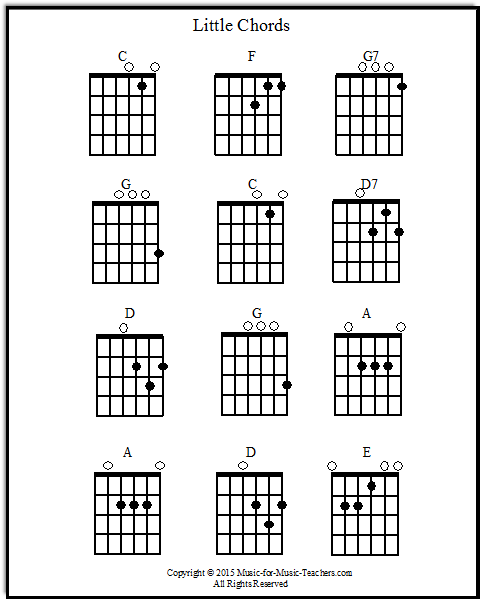
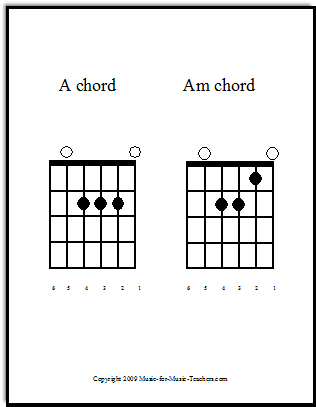
Guitar chord charts for beginners! "Little" chords, some requiring only one finger.
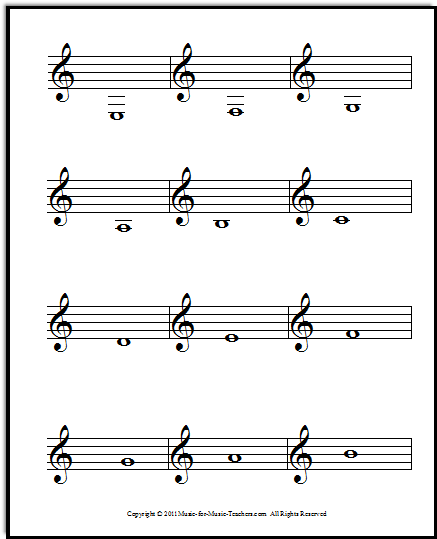
Get your guitar student used to looking at notes on the treble staff with flashcards!
And more! See all the Guitar Worksheets HERE
Very Easy Guitar Tabs
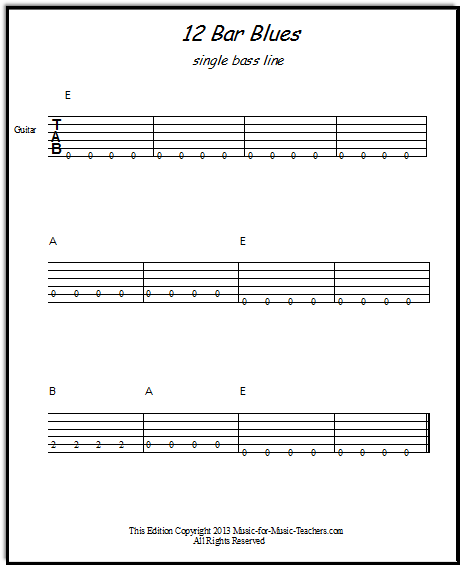
An intro to this concept for your beginning guitar students.
Several different pages, starting with just a bass line.
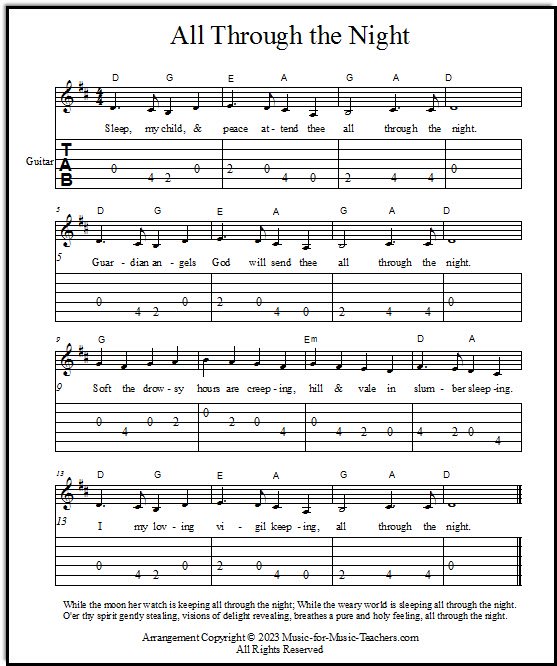
With all the different chords, this may look like a complicated song, but just look at the tablature! 0, 2, or 4 are all that are used.
Easy-peasy. And it is a very pretty song.
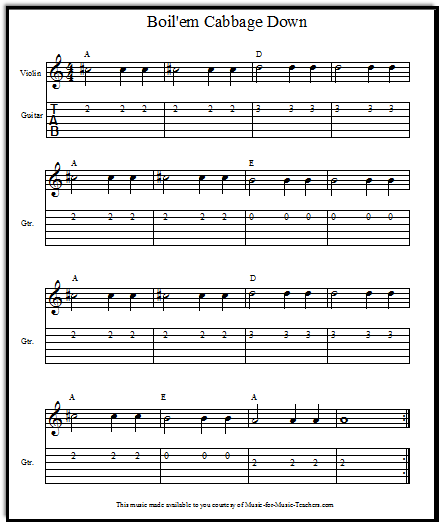
Boil'em Cabbage Down beginner guitar song
Both the simple flat-picking melody & the A-D-E chords are important for beginners.
After Pizza Please, this is the song I use to inculcate the "Down, Down-Up" picking pattern into my young students.
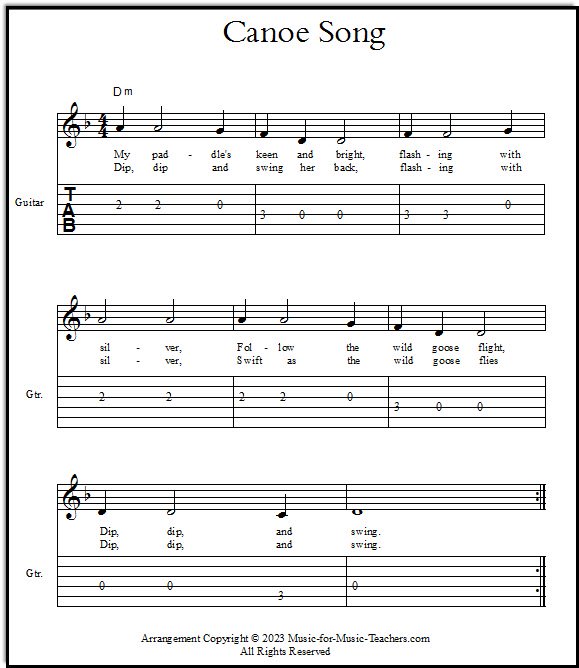
A very easy guitar tab with a driving melody, and just one chord! Kids like this song from Canada.
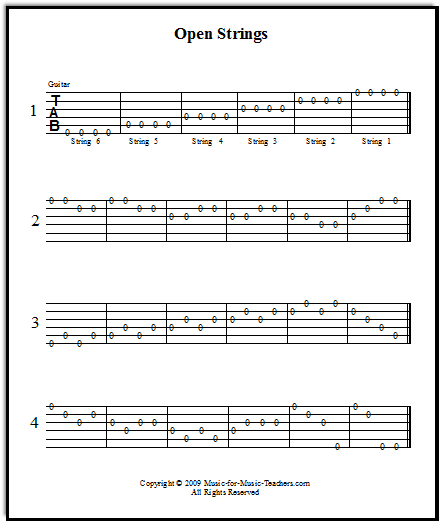
These 4 exercises help kids figure out where the strings and frets are, and may be your student's favorite "song" for a couple weeks!
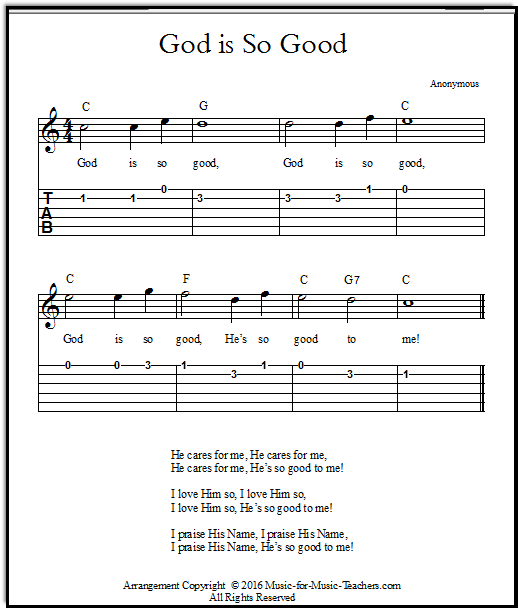
God is Good, or God is So Good!
Whether playing tabs or chords, this sweet melody is very easy!
Yes, the F chord is hard, but let your beginners use a "baby F" chord: just 1, 2, or 3 strings.
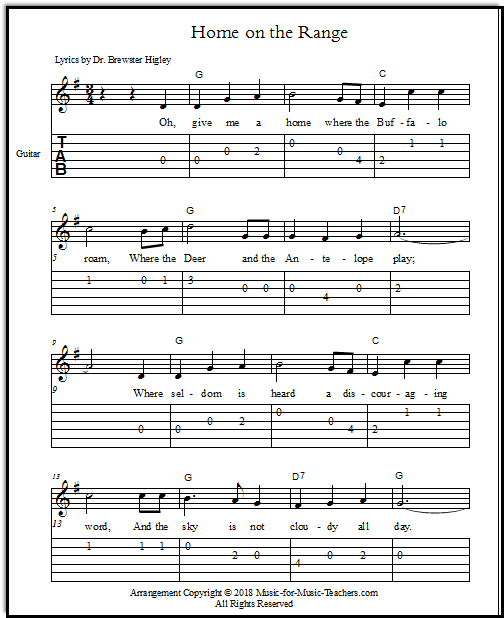
Home On the Range free guitar tabs & chords
This is the easy arrangement, which can use "baby chords".
On this page is also a much fancier arrangement, which uses chords G, G7, C, Cm, D, D7, A7, B, and Em.
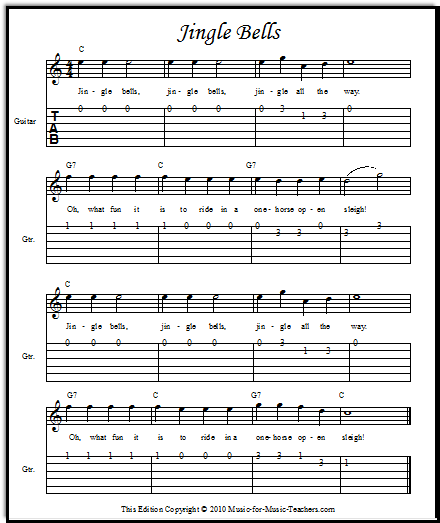
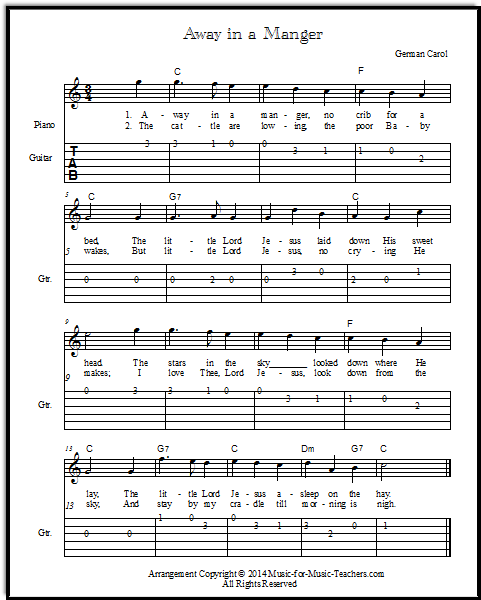
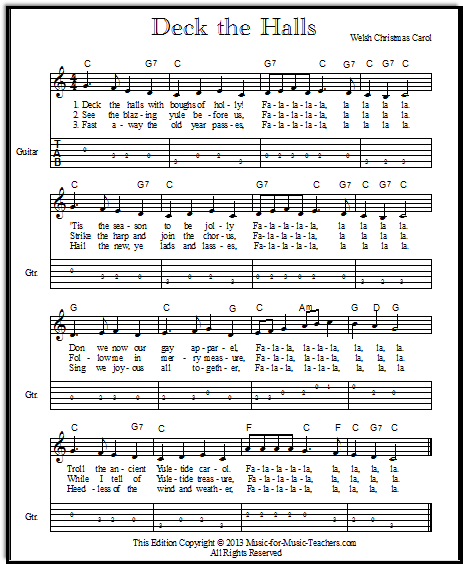
Everyone should learn to play this little Christmas song, and thankfully for beginners, it is simple!
This arrangement uses just two chords, but a second arrangement found on this page uses four chords!
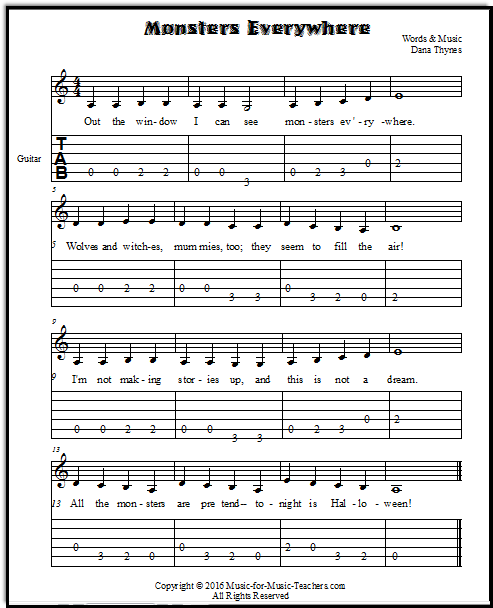
Monsters Everywhere Halloween guitar sheet music
A spooky -but-not-too-scary Halloween song with fun lyrics.
The melody creeps slowly from fret to fret.
Very easy.
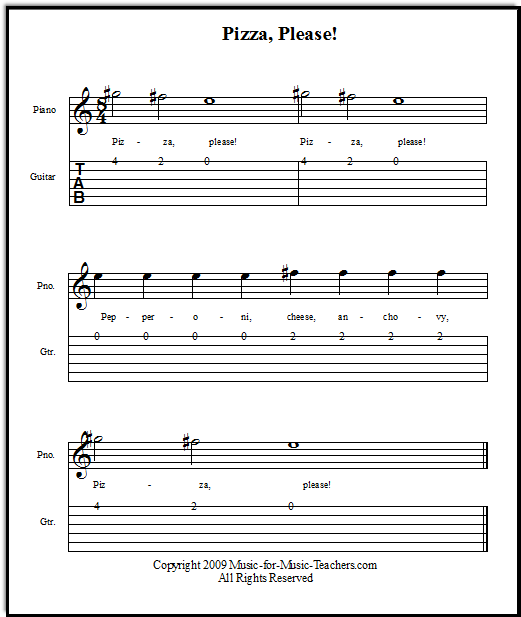
Pizza Please (the Hot Cross Buns melody!)
Older beginners will say, "We played this in band!", and indeed, this is one of the world's EASIEST songs for beginners.
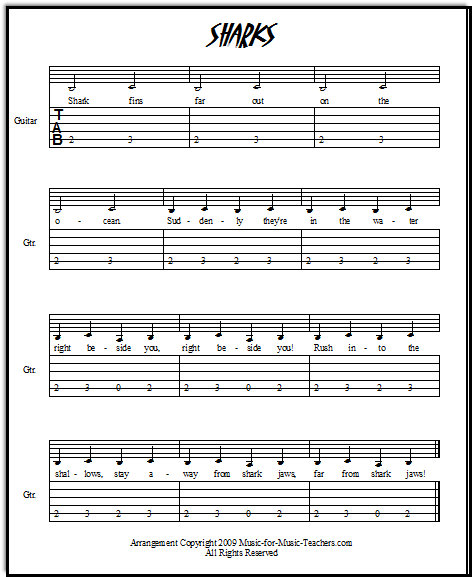
If you tell your students that this is ALMOST the same as the theme song of the movie "Jaws", they will work at it!
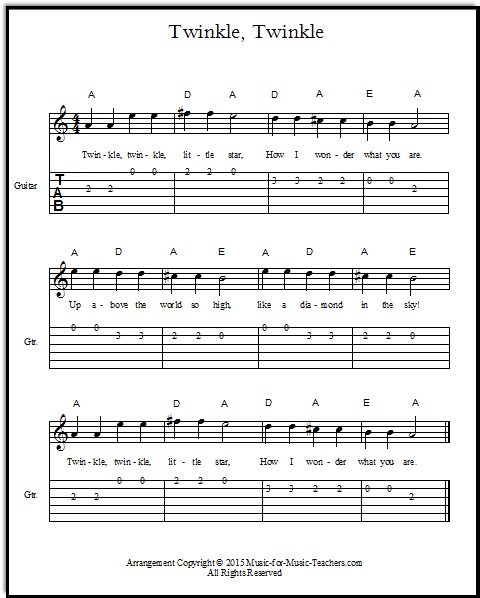
Twinkle Twinkle Little Star music
Kids like working on familiar tunes, and with guitar beginners it is even more important.
Hymns, Carols, & Anthems
Tip: young girls love to sing this song. If you can master it on the guitar, you can make them happy!
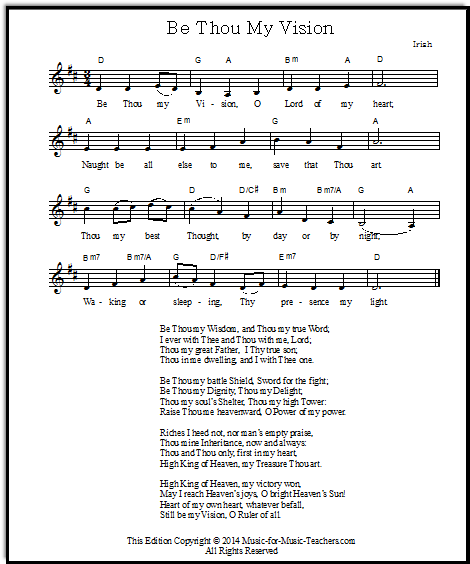
The key of D, or else check out the lead sheets for additional keys, but without guitar tablature.
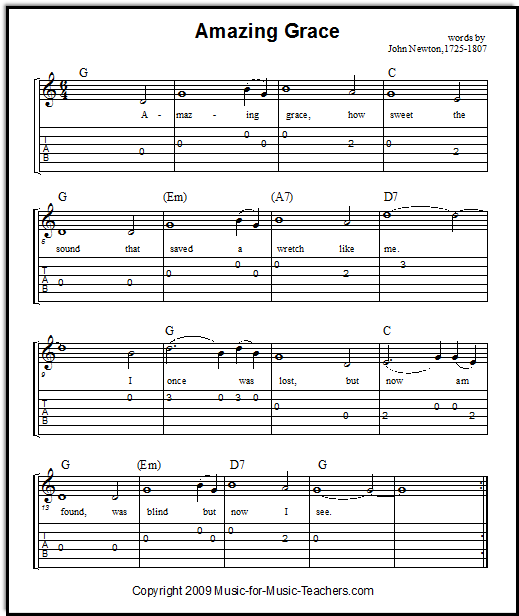
The melody of this beautiful hymn is very easy to pick in the key of G... also offered in C.
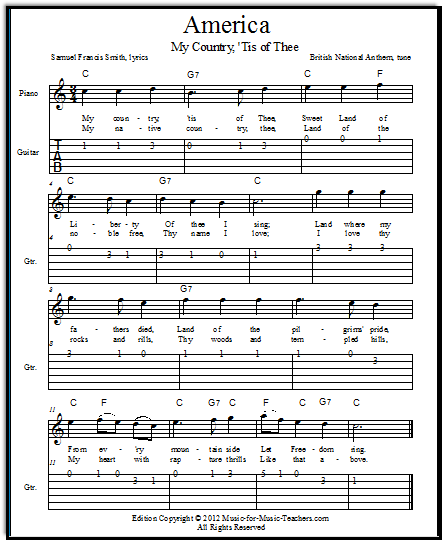
America -My Country, 'Tis of Thee
One of our nation's patriotic songs.
This melody (with different lyrics) comes from England.
There, it says, "God save our noble queen (or king)." Here, the lyrics speak of FREEDOM.
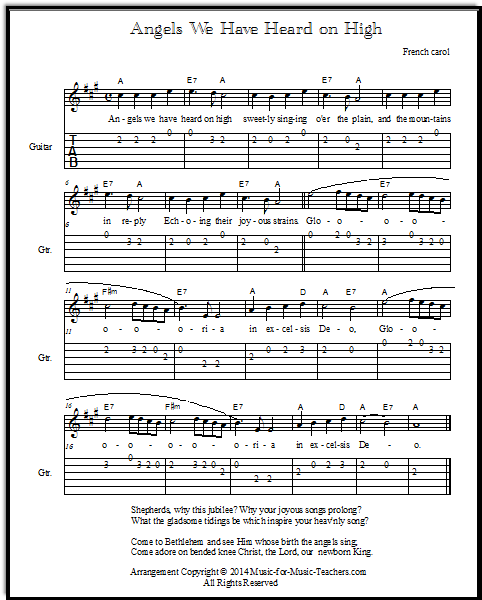
Lead sheets with chords in multiple keys, as well as the full piano accompaniment in several keys.
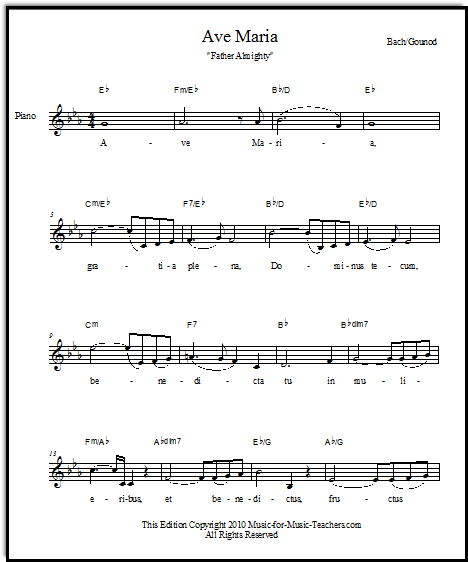
This lovely song is offered here in Latin (Ave Maria) and with a set of English lyrics, which are NOT a translation but more of a prayer to God the Father.
This is the lovely combined composition by Bach and Gounod - Charles Gounod added a soaring melody over Bach's Prelude in C for keyboard
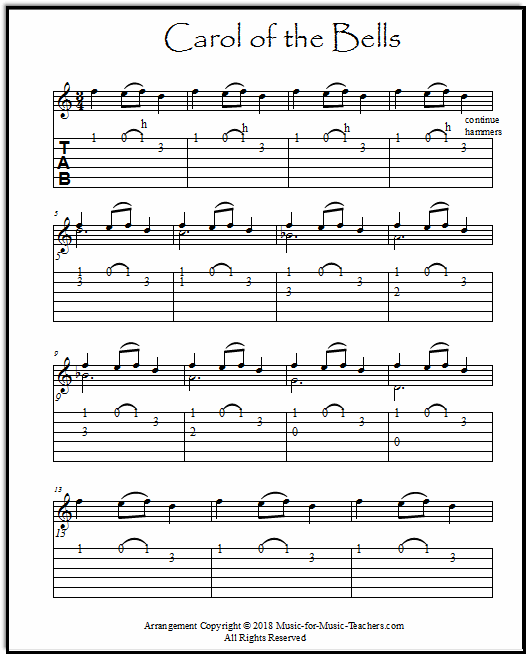
This beautiful Christmas song is not easy for young students, but the challenge to play it is fun!
Three pages.
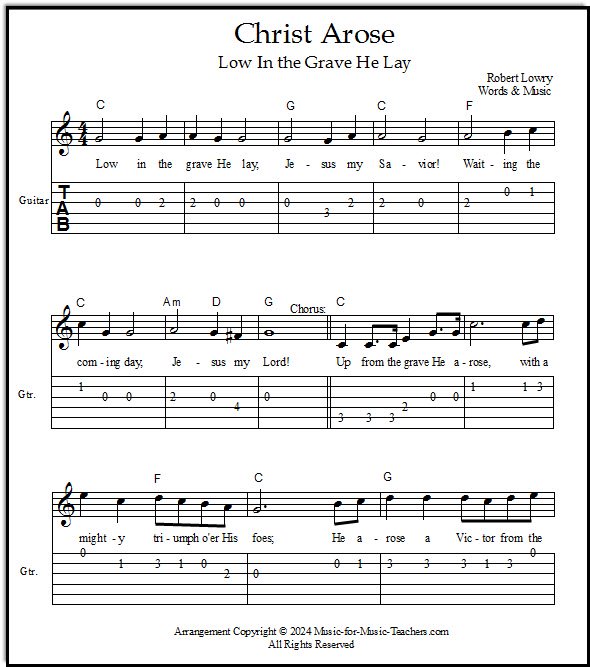
With easy key of C chords and tabs.
A great old song about Resurrection Sunday!
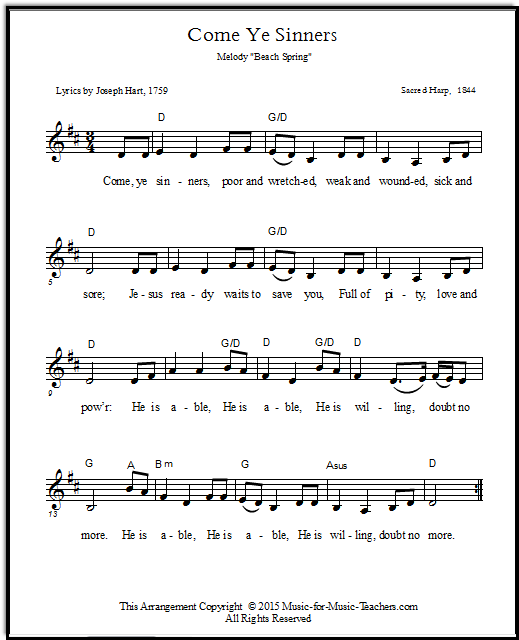
Come Ye Sinners, old gospel hymns (Beach Spring melody, from The Sacred Harp)
With guitar chords but no tabs, this is an old-fashioned hymn with an irresistible melody. Very easy for fiddle players.
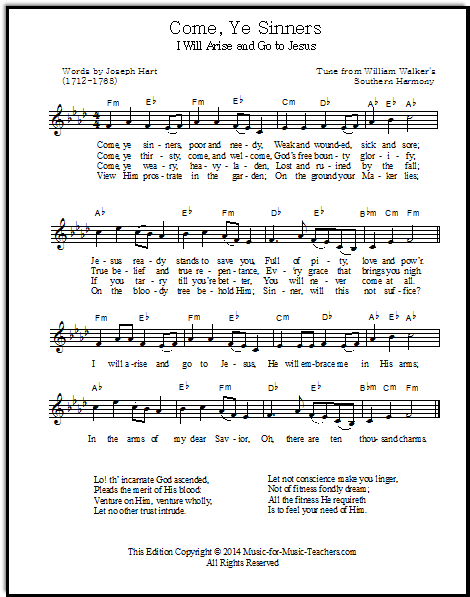
Come Ye Sinners (I Will Arise and Go to Jesus)
This hymn with the same words, plus a few more, is in a minor key, with a haunting melody.
It looks to be in a scary key for guitarists!
Don't fear; this one is just for piano. There are other keys for this lead sheet to be found on this page!
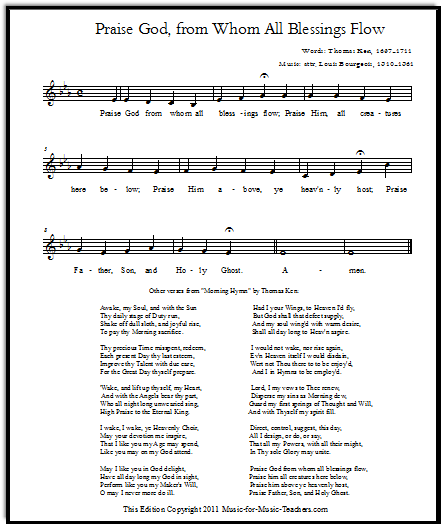
This is the well-known short hymn with the lyrics, "Praise God from whom all blessings flow..."
Did you know there are many more verses?
Lead sheets and a piano arrangement can be found on this page.
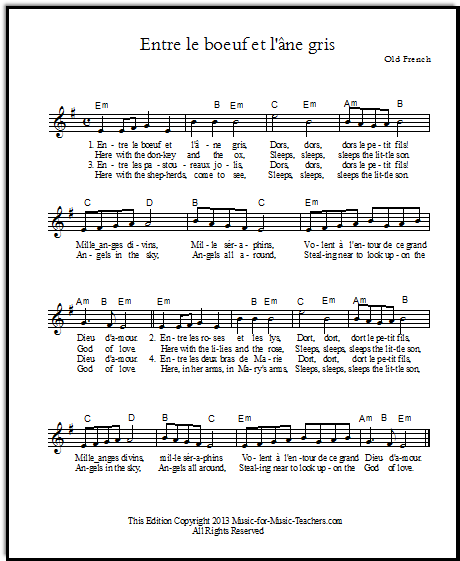
Entre le boeuf Christmas music lyrics and piano chords (Between the Ox and Donkey)
With guitar chords, this lovely Christmas carol from France is an unfamiliar song to many.
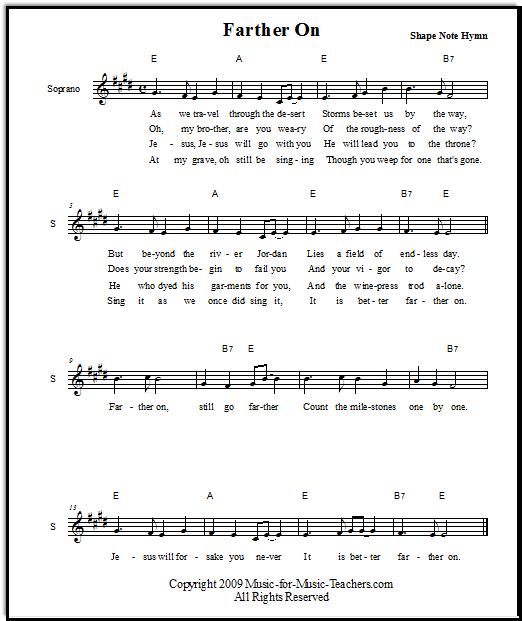
A song about going to that better place.
This is one of the sweetest hymns I know.
Chords & lyrics, and arrangements for your choral group.
A song to include in your list of funeral songs.
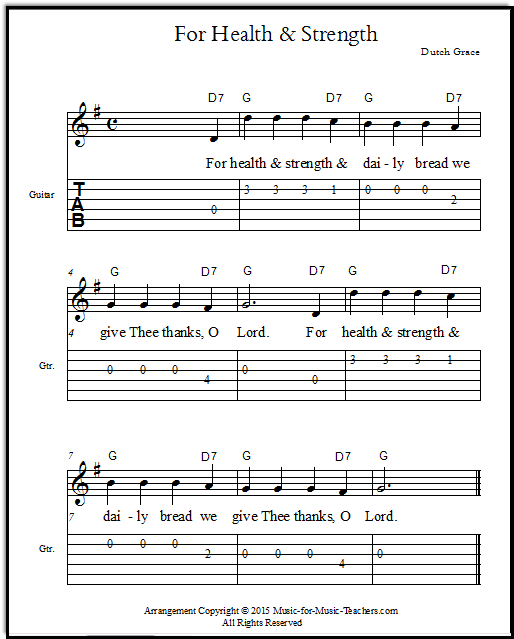
For Health & Strength & Daily Bread prayer for Thanksgiving
With guitar tabs and also guitar chords, this is a simple round with a simple and good message!
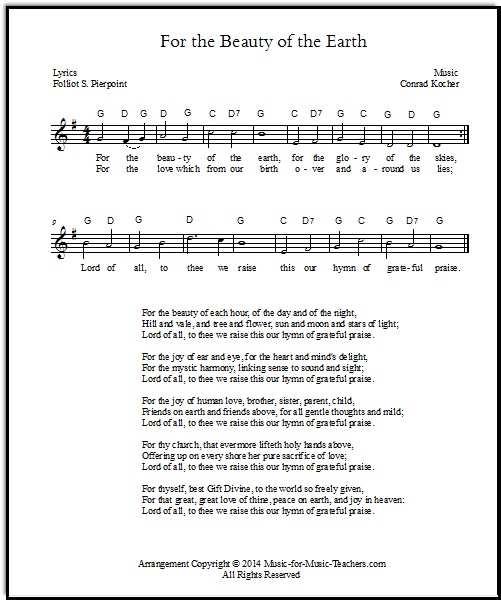
For the Beauty of the Earth Thanksgiving song
Another song of thanksgiving to God.
This song was featured in the film "Little Women" years ago, as a kind of non-denominational, inoffensive kind of hymn.
Fittingly, I suppose, as Bronson Alcott, Louisa May Alcott's father, was a Transcendentalist.
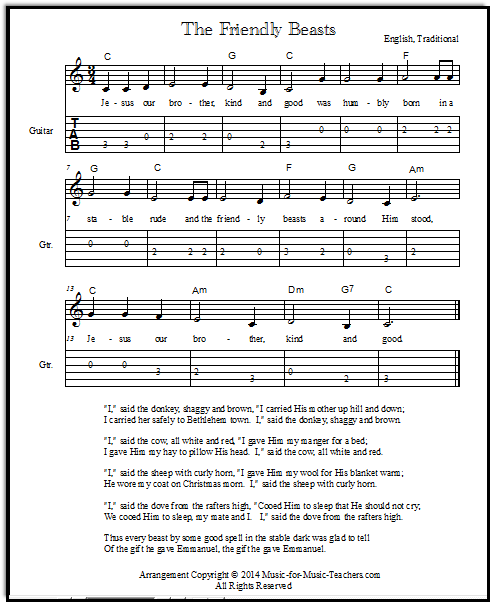
This song has a few secondary chords (Am & Dm), but the song will work with just the three main chords.
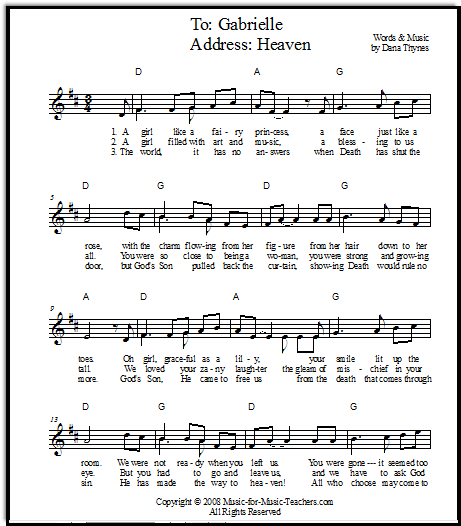
This song was written to comfort mourners - including myself - for a thirteen-year-old girl, who sickened and died inside the space of one week.
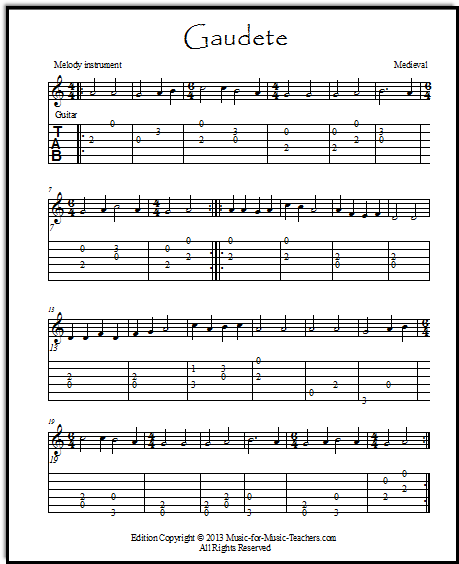
Gaudete (Rejoice!) free Christmas vocal sheet music
Several arrangements of this very interesting and OLD Latin hymn of praise. It is a bit of classical style.
God is So Good, or God is Good, lyrics and chords and tabs for guitar
A short and sweet song, easy to learn, and transpose.
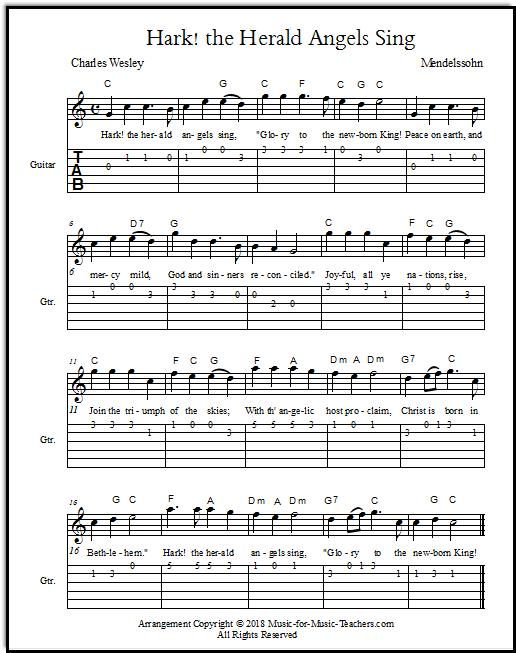
Guitar tabs, and also a beginning piano arrangement are on this web page.
Lyrics too, as a downloadable PDF!
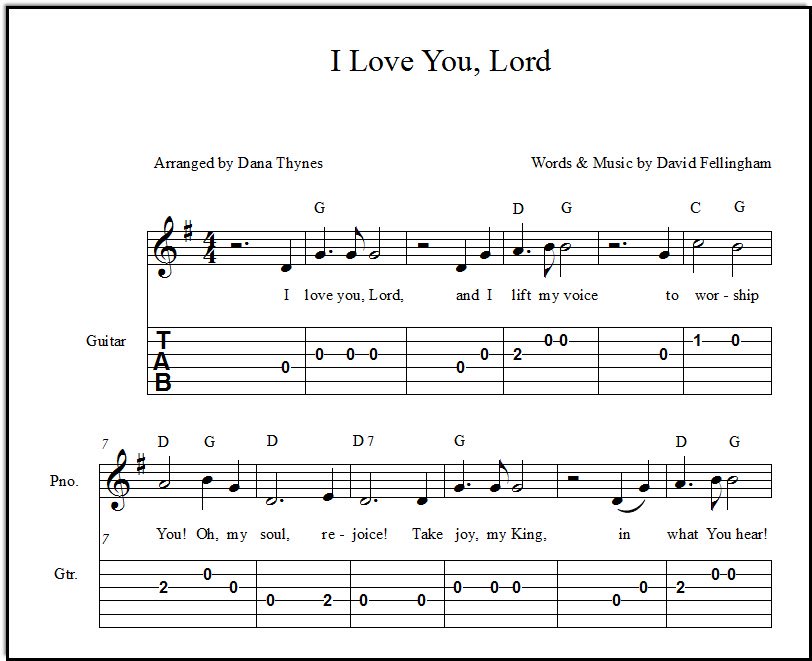
A very easy guitar melody! Easy chords, too, with lots of room for finger-picking.
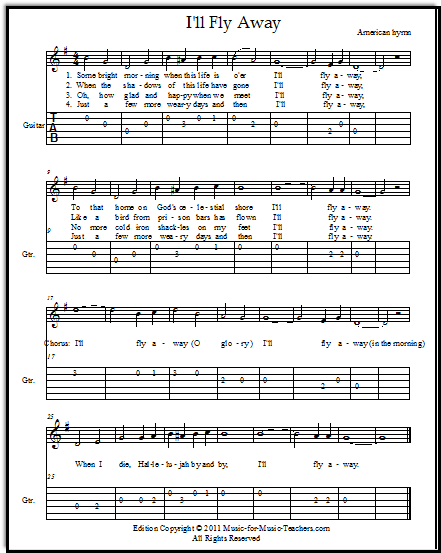
Easy guitar tabs make up the melody of this vigorous old-timey hymn about going to heaven.
It remains popular!
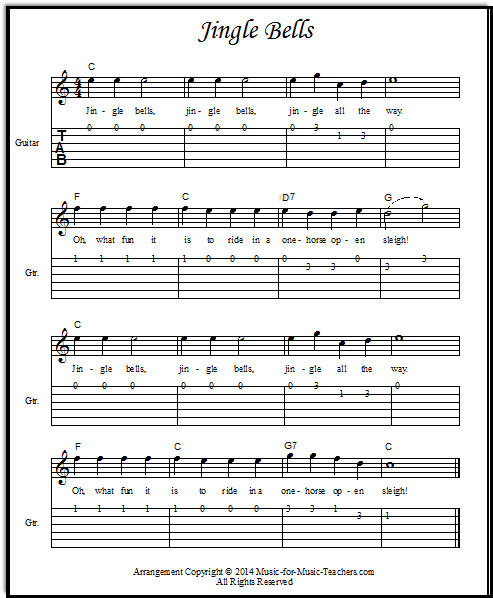
Jingle Bells guitar chords and tabs
The arrangement shown here uses C, F, D7, G, and G7 chords.
Also on this page is a very simple version using only C and G7 - perfect for beginners who are using the "Little C" and "Little G7" chords!
New students are always delighted to play this song.
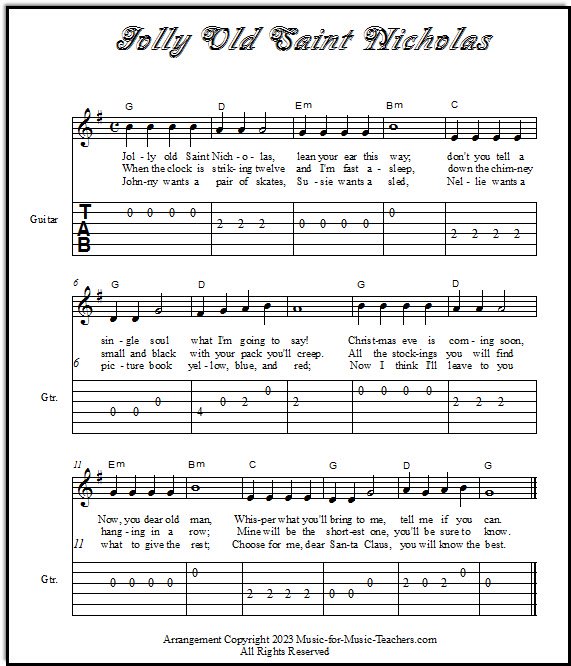
Jolly Old Saint Nicholas, free print-out sheet music
This is a fun song for little kids, and brings back happy memories for many of us grownups too!
Proceed way down the page to find the guitar music.
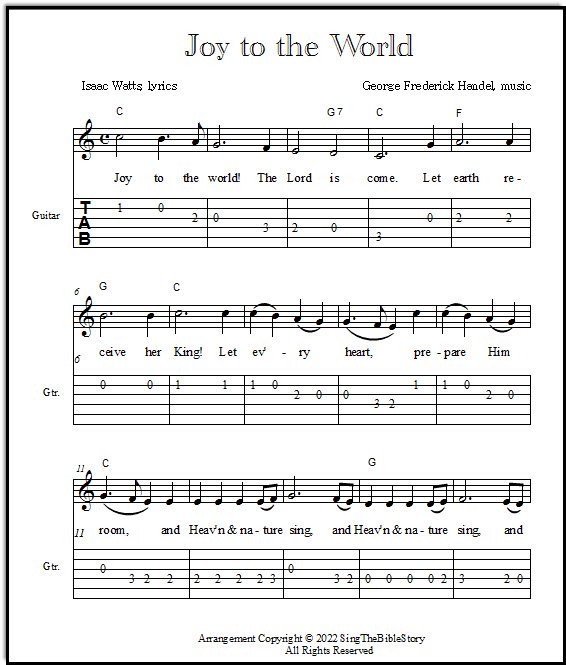
Joy to the World lyrics and guitar tabs
Several arrangements, for piano and voice as well as this guitar tab arrangement, on this web page.
You can also download a PDF of the lyrics with all the verses.
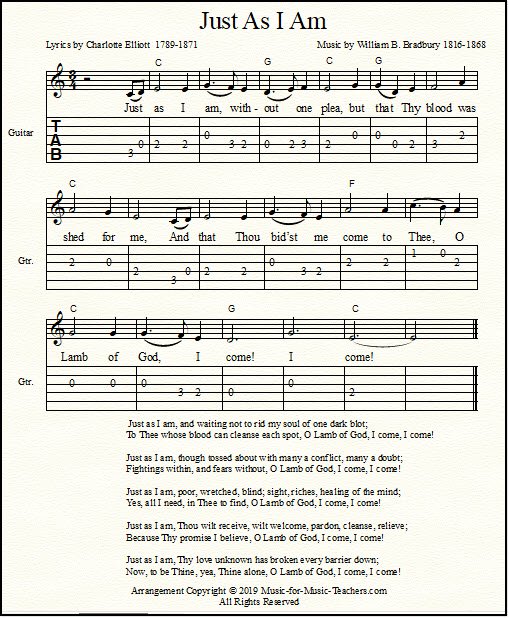
An older hymn that is still beautiful and soul-stirring.
Just three chords.
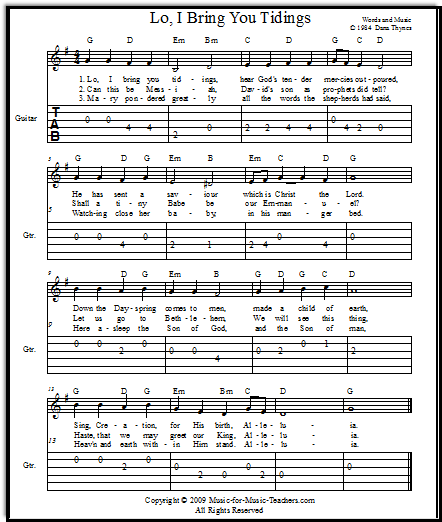
Lo I Bring You Tidings Christmas carol lyrics
A modern Christmas carol, with lyrics straight from the Bible.
Mary ponders the words that the shepherds repeat, that the angel told them.
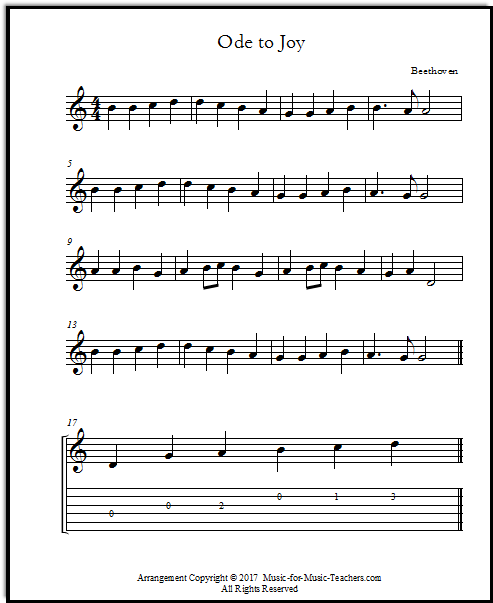
Ode to Joy guitar music for beginners
With standard notation, and "helper" tablature below.
For beginning readers!
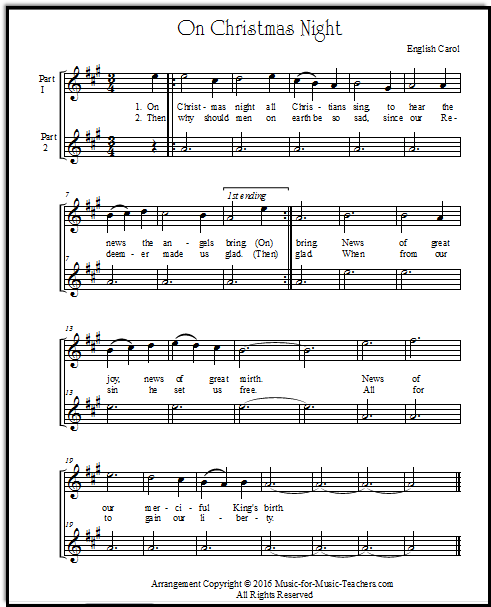
A violin duet.
This piece can also be sung, of course, but the "A" and "E" open strings of the violin part 2 make this a very easy part for beginners.
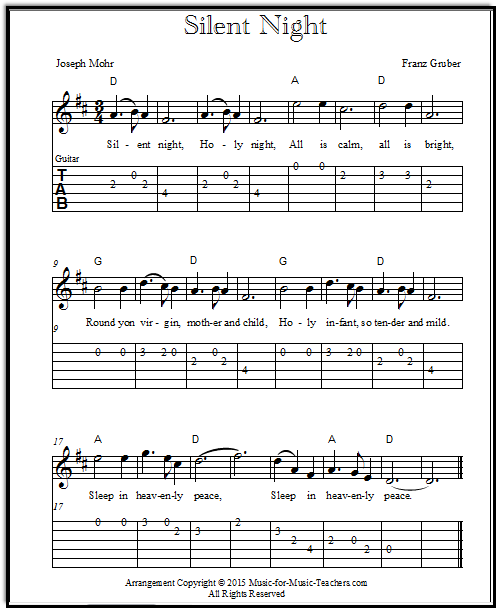
Silent Night chords, lyrics and tabs
Several ensembles for string instruments, as well as guitar solo.
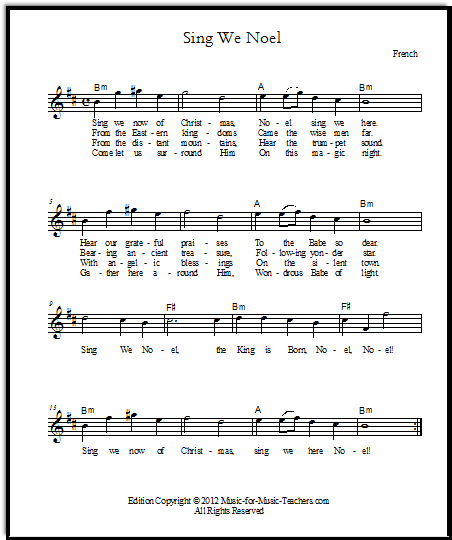
A Christmas carol from France.
This one has no tablature, but numerous keys to try out the chords to.
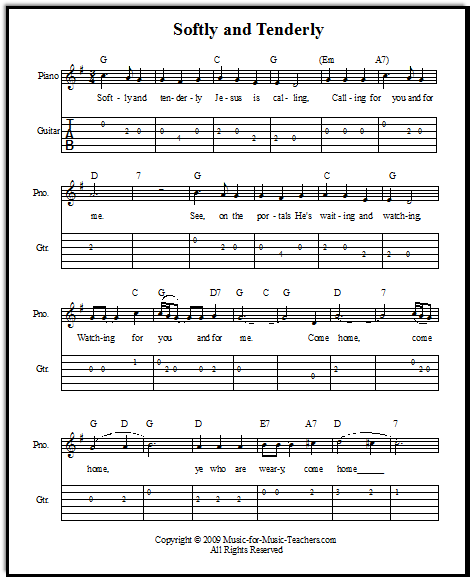
Softly and Tenderly free hymn sheet music
An old-fashioned hymn.
If you want contemplative music that will soften and touch hearts, this free hymn sheet music is what you are looking for.
"Softly and Tenderly, Jesus is Calling" is about going home -- the final home.
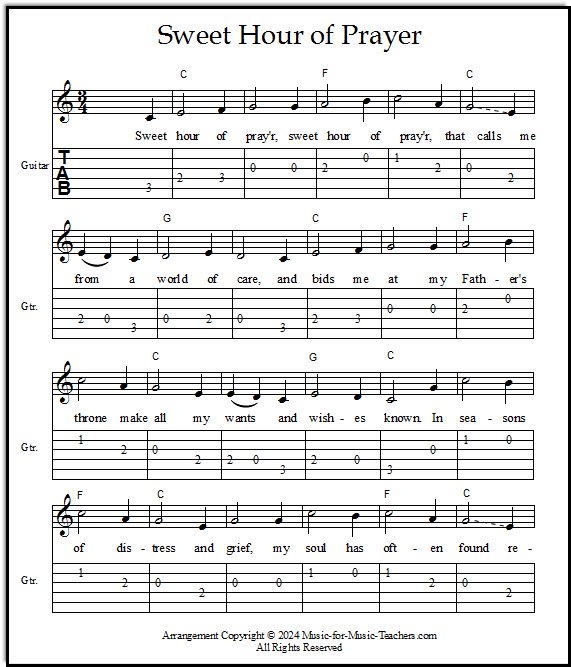
Sweet Hour of Prayer hymn music
An old-fashioned part of the hymn repertoire, this pretty melody has meaningful & scriptural lyrics.
With four verses.
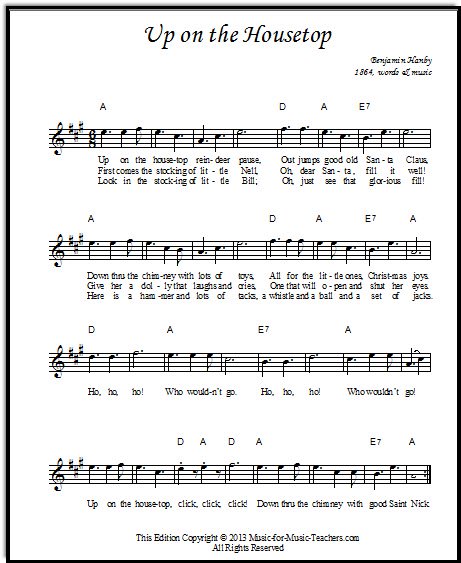
Up On the Housetop easy kids' Christmas piano sheet music
- but with chords for guitar as well!
This is, surprisingly, an old Christmas carol! It feels modern somehow.
It doesn't use many chords - just the usual three "I, IV, & V" chords.
This song has a joyous feeling!
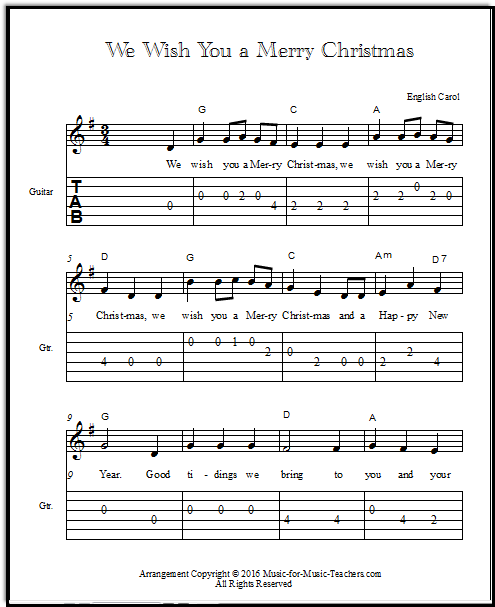
We Wish You a Merry Christmas chords, tabs, and lyrics
This joyous-sounding Christmas carol is full of energy!
Easy chords for guitar.
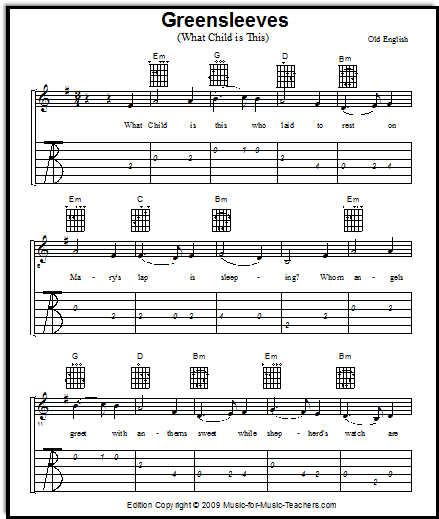
What Child is This Christmas sheet music
This is "Greensleeves", a beautiful melody hundreds of years old.
The version shown here, with the Christmas carol lyrics, has the lowered seventh tone of a more lute-like arrangement.
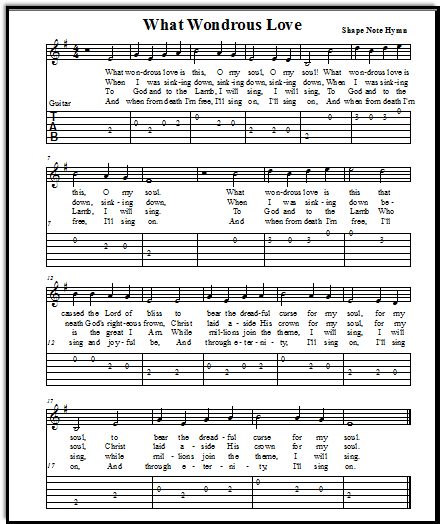
What Wondrous Love, two different melodies
This page features the familiar version of What Wondrous Love, and also a little-known version, shown here.
I like to call this second arrangement "bluegrass" - but the melody is apparently from the Shape Note tradition.
It is very unlike the most familiar version you have heard before.
Shown here are the guitar tabs and melody. On another page, I have available a four-part choral arrangement of this alternate melody!
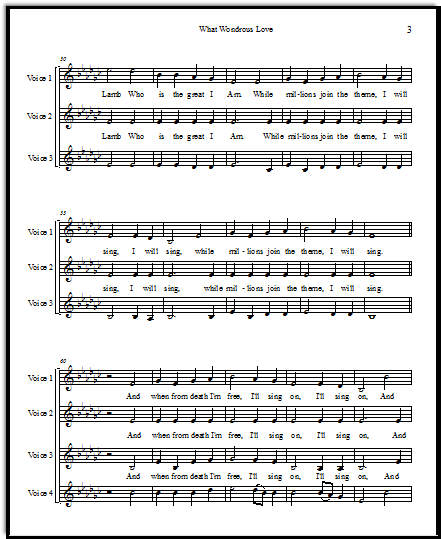
What Wondrous Love with 4-part harmony
This is the "bluegrass" or Shape Note melody that is also featured on the link above.
Few people have heard this strong, compelling tune, though they may be very familiar with the lyrics!
Shown here is page 3 of a 4-page arrangement...
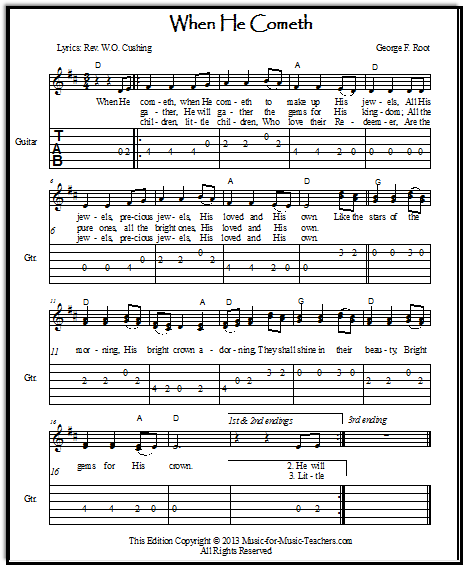
Also known as "Jewels".
This song talks about the preciousness of little children, like stars in God's crown.
Just three main chords make up the background.
Lots of opportunity for vocal harmony!
Classical Guitar
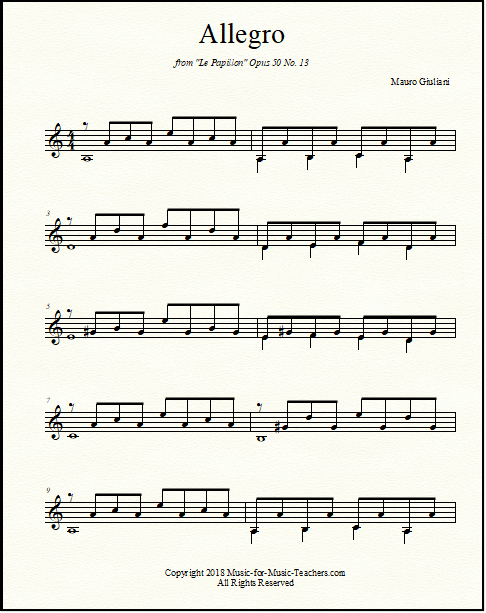
Allegro classical guitar sheet music
From Le Papillon (The Butterfly).
This piece looks more complicated than it really is, since the notes come from chord shapes Am, Dm, E, and E7.
Lovely.
This beautiful Christmas song is not easy for young students, but the challenge to play it is fun!
Three pages.
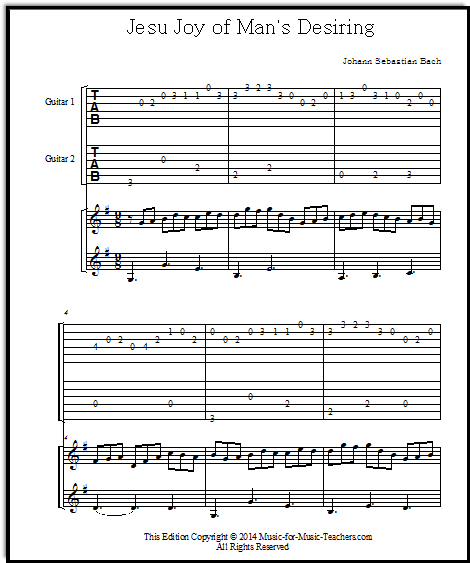
Jesu Joy of Man's Desiring duet
A well-loved piece by Bach, I have arranged it as a duet for cello and violin, for two violins, or for two guitars.
Ode to Joy guitar music for beginners
Oh no! Where's the tablature?
I left it out of this familiar song, so that students have the opportunity to practice their notereading, using the guide at the bottom of the music sheet.
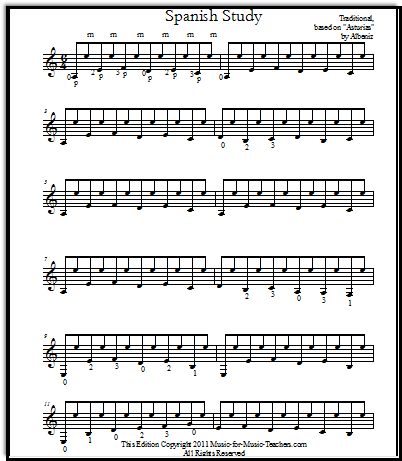
A beautiful first classical piece for young guitarists.
A 3-page version, a 1-page version, and a worksheet with empty tab below the notes.
Update:
All 3 pages with treble staff AND guitar tabs!
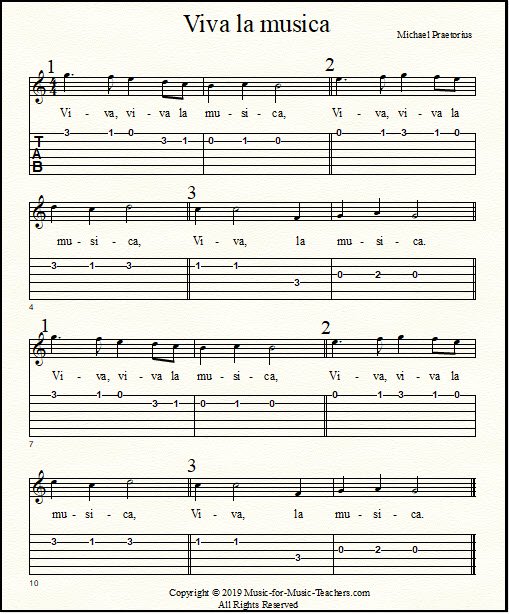
This rather simple little melody is a ROUND, and therein lies its challenge for your guitar student!
Playing with another student, or even with you, the teacher, takes focus and good listening.
This is a pretty little song, the meaning of which is "Long live music!".
Flatpicking Guitar and Fiddle Pieces
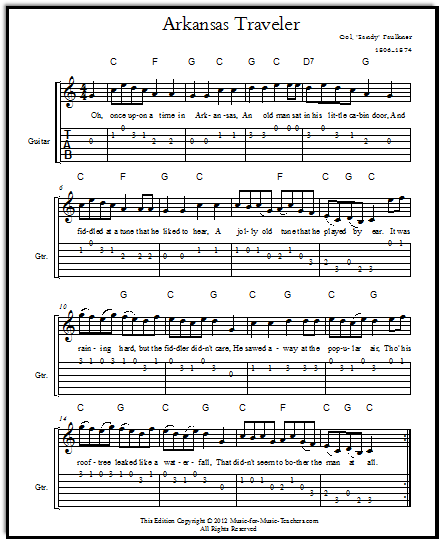
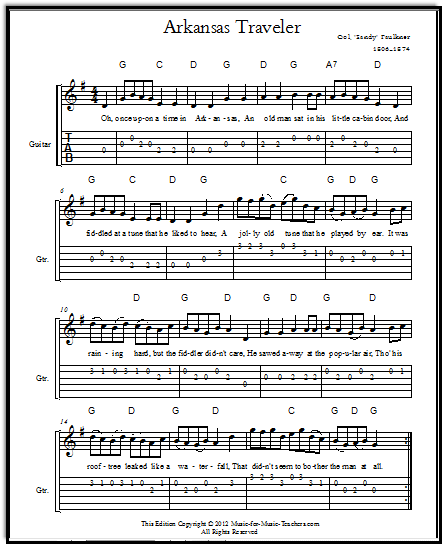
Like the version featured above, except in the key of G.
A very famous American song.
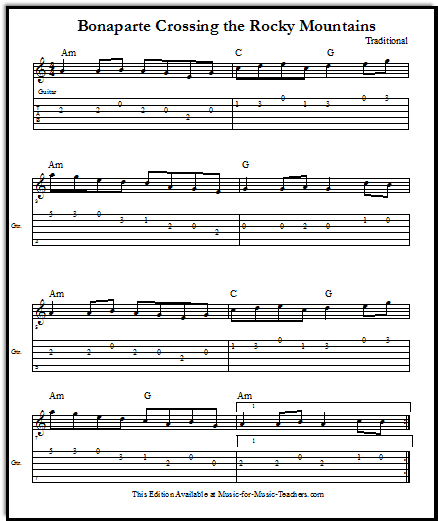
Bonaparte Crossing the Rocky Mountains, bluegrass guitar tabs
This is a very different piece, minor, with a great melody!
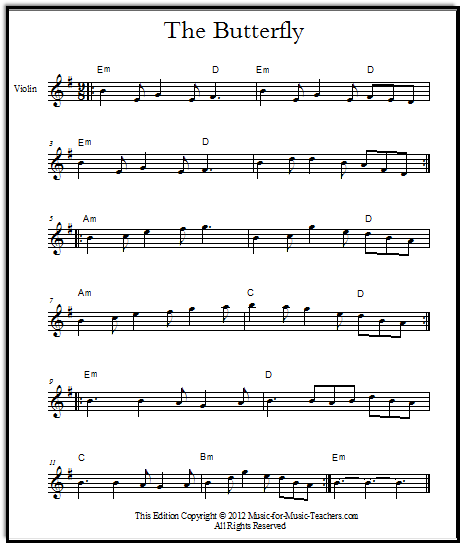
The Butterfly - free Irish fiddle sheet music
- THE popular song Celtic Woman plays!
See a video of this exciting song on this page.
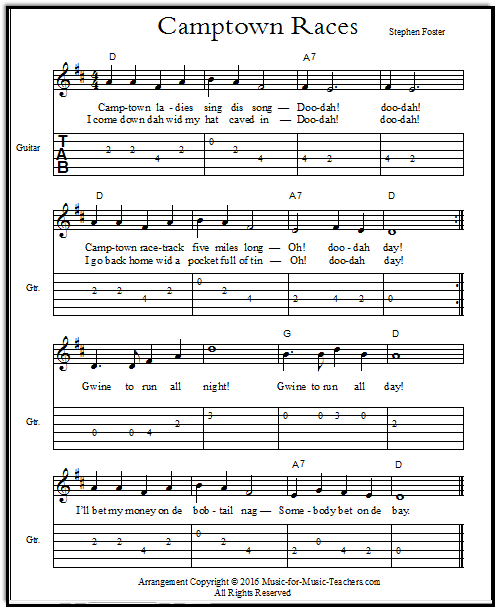
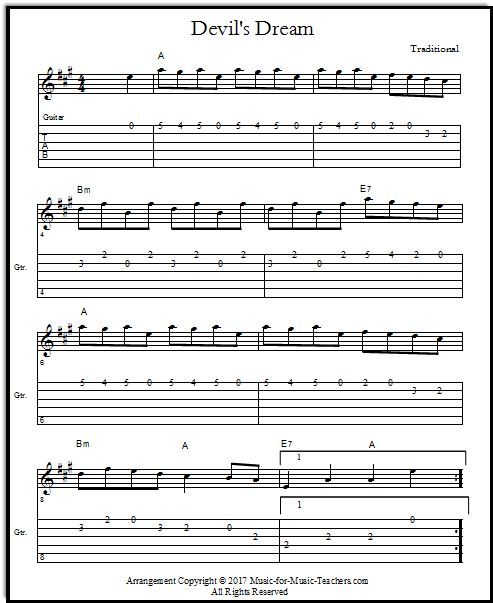
Devil's Dream free guitar tabs
This is a piece that both guitarists and fiddlers find they can grow faster and faster at playing, and increase their skill level along the way!
For guitarists learning to flatpick, this melody is almost entirely "Down-Up, Down-Up, Down-Up, Down-Up!"
Violinists may find themselves making little "bow circles" for the first time ever - very fun!
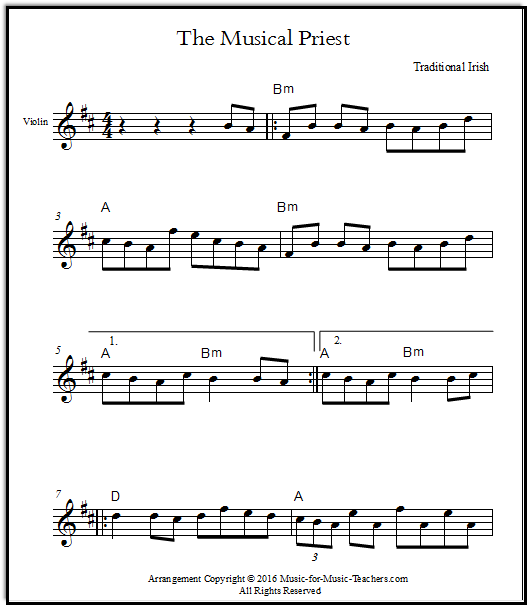
Musical Priest free printable violin music
A fun minor piece with room to learn to easily add ornaments.
Two arrangements - a simple one with the basic melody, and another with ornaments written in.
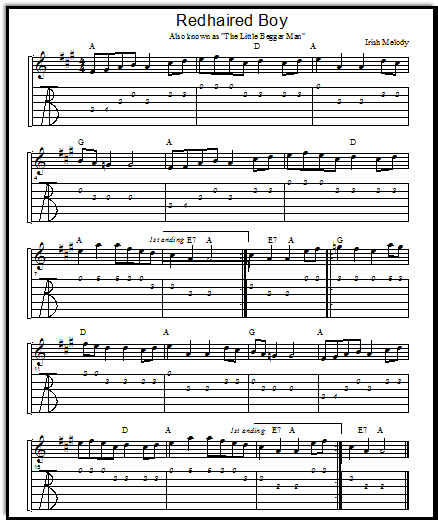
This piece is a great favorite at my studio.
In the keys of A and also G.
For fiddle or guitar.
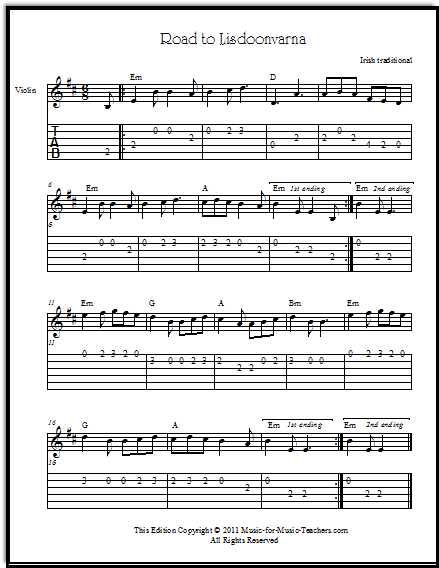
Road to Lisdoonvarna free fiddle sheet music
Two versions of this catchy fiddle and guitar tune - plain (shown here) and FANCY!
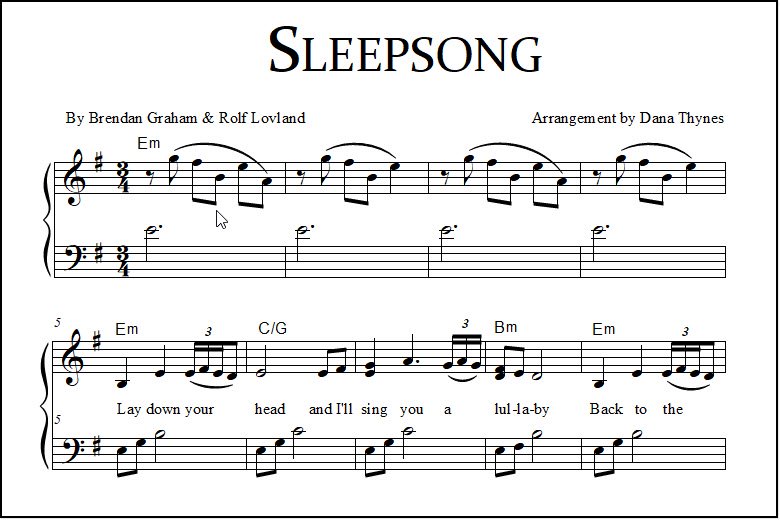
This beautiful song has been transposed to Em so as to be easier for beginner guitar players to master it.
Listen to a video that will amaze you with its beauty.
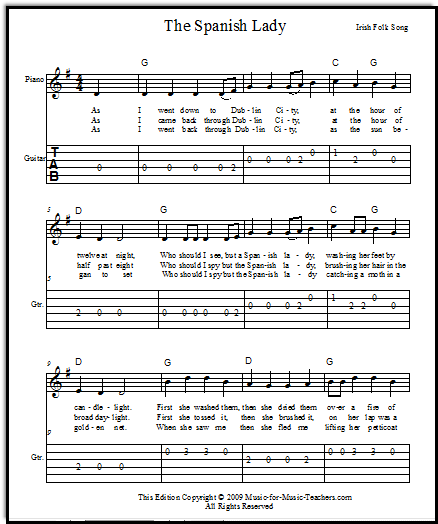
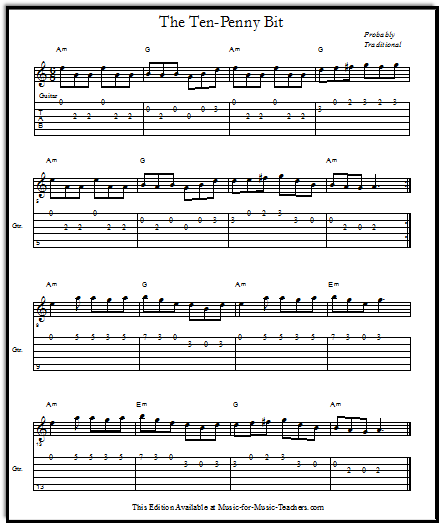
This is a great fiddle melody, and also a fun flat-picking piece for guitar.
A minor-melody tune.
Folk and Traditional Songs
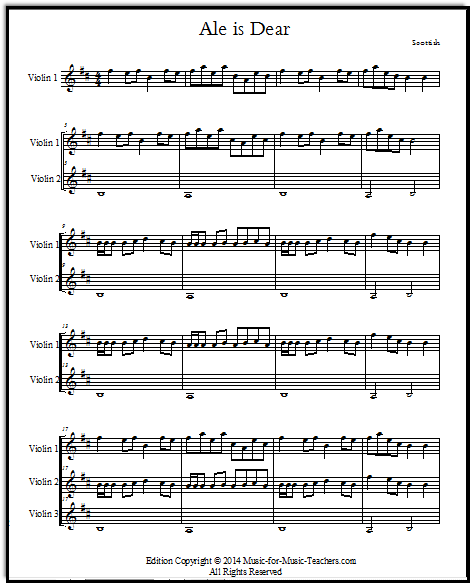
Ale is Dear fiddle sheet music for beginners
A violin trio, one part of which is almost a single-note "drone".
Very pretty.
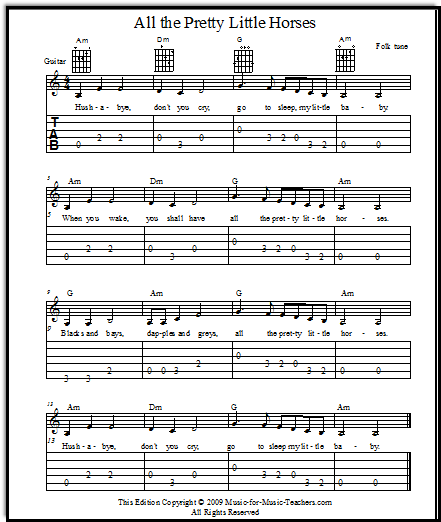
This lullaby has lovely repeating melody lines.
In two keys for guitar - there are many possibilities for finger picking with this pretty song!
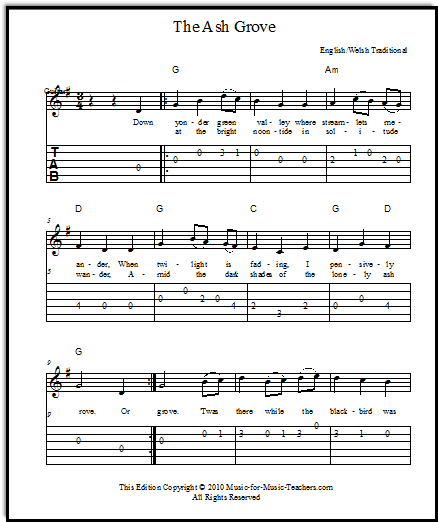
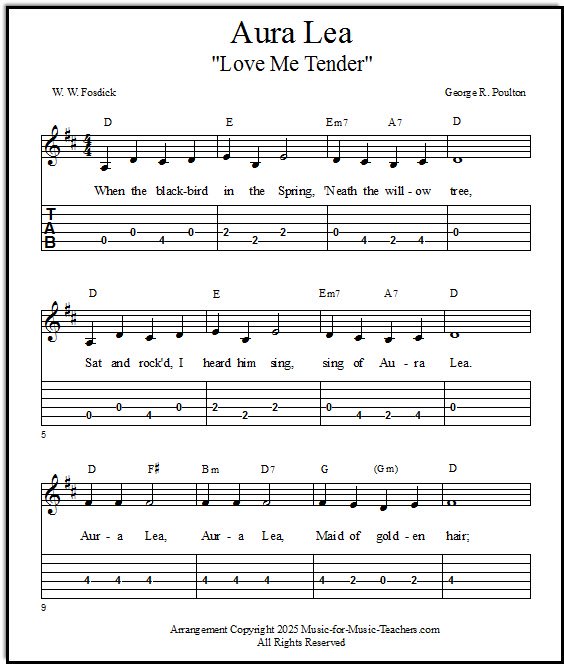
Aura Lea: Love Me Tender sheet music
This beautiful song from Civil War days was newly made famous by Elvis Presley in 1956.
Find the chords, tabs, & lyrics to both versions of this lovely tune here!
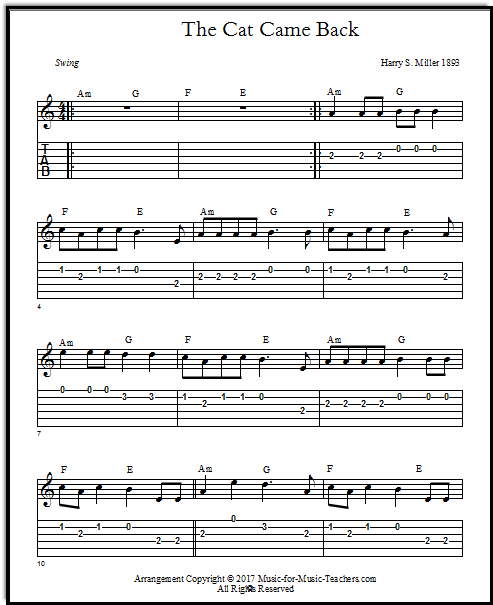
Cat Came Back lyrics and chords
Yes, the lyrics are here, on page two!
This is a very fun song with silly words about the cat that no one can seem to get rid of!
The chord pattern repeats over and over again; it makes for excellent walking bass practice.
The vocal range of this song can be limited to just five notes if necessary... handy for beginning singers.
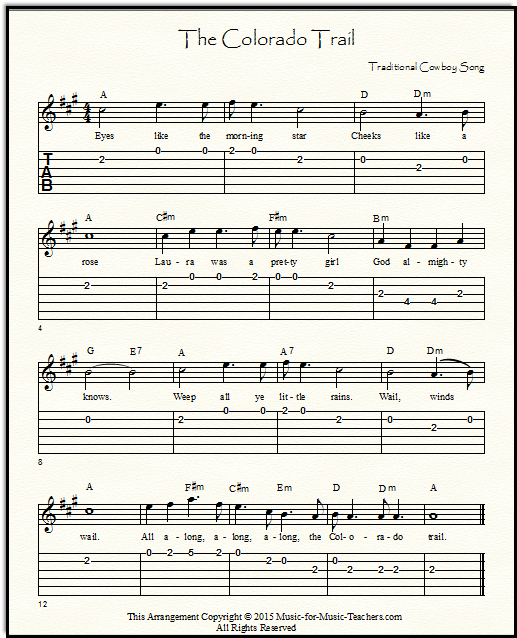
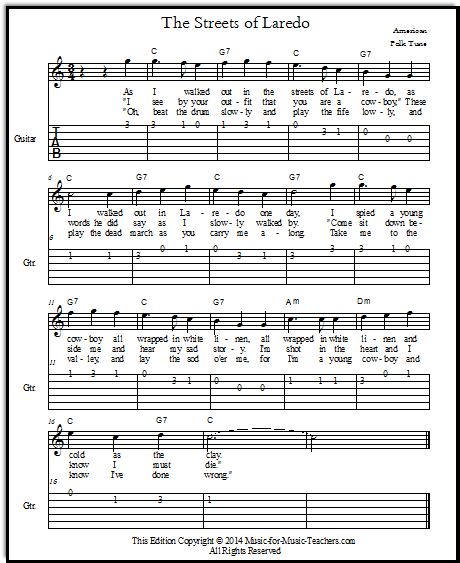
This is a genuine cowboy song, written by a real cowboy.
Surprisingly sweet, and pretty!
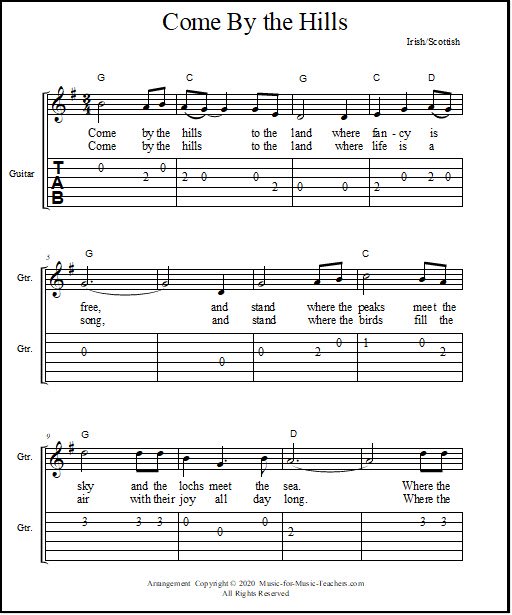
A pretty Gaelic song with English lyrics, you may recognize this tune..
Simple chords that are lovely strummed or picked, and lyrics that almost sing themselves!
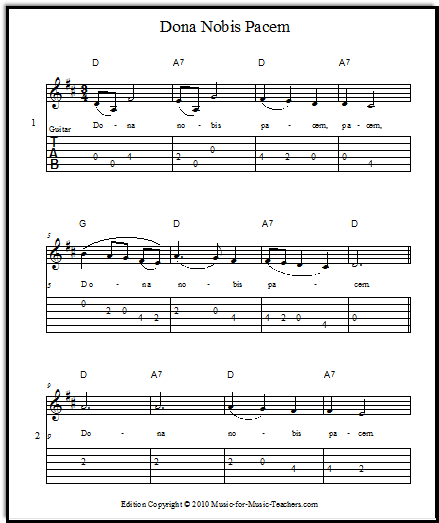
"Give us peace", a Latin poem from long ago.
Very beautiful round - not easy.
But it can be sung as a solo, too.
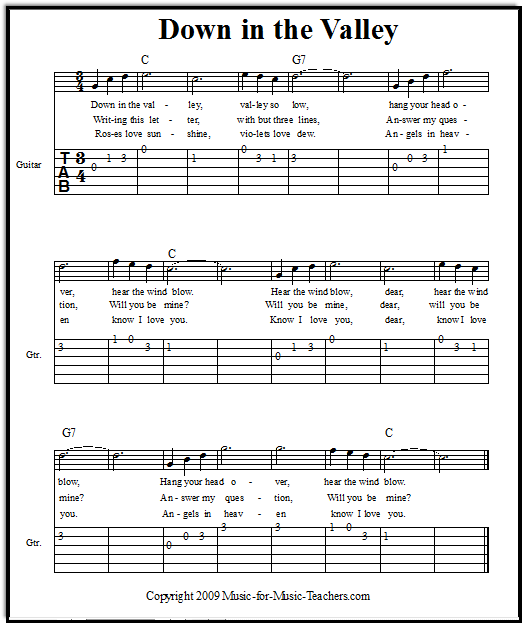
This two-chord song is a super-easy first finger picking song.
Using "baby" C and "baby" G7, students can focus on their right hand technique.
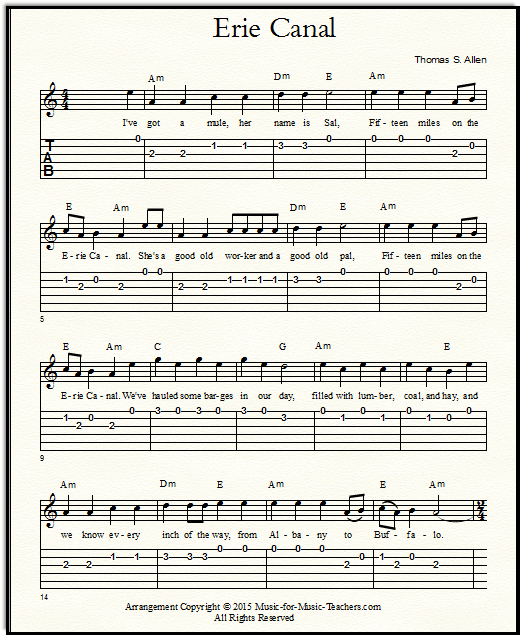
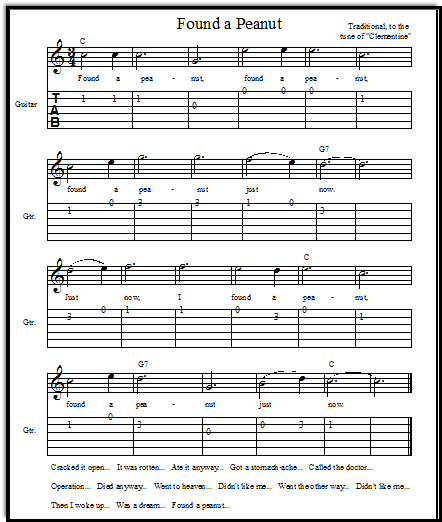
Just two chords & silly words make this a perfect song for a first lesson.
Use "baby" chords C & G7.
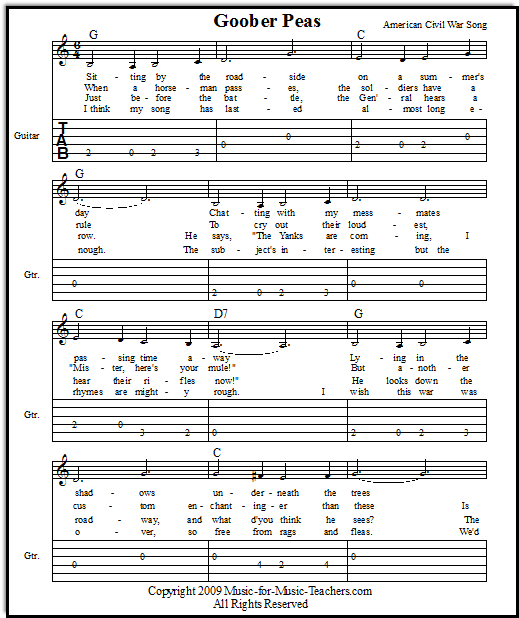
Kids may fight this unfamiliar song for a week or two until they've heard it enough - and then they love it!
Initially, it is definitely a challenge, in spite of the easy chords, because they change so quickly.
But that's just the kind of practice beginners need.
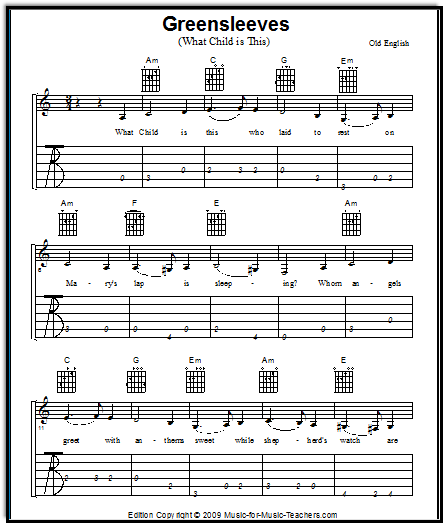
Greensleeves, the beautiful old melody that also is the Christmas sheet music "What Child is This"
Three versions for guitar:
- A minor
- E minor
- also E minor, but with a lowered seventh tone of the scale - a "lute" rendition
All with tablature for your beginner guitar students!
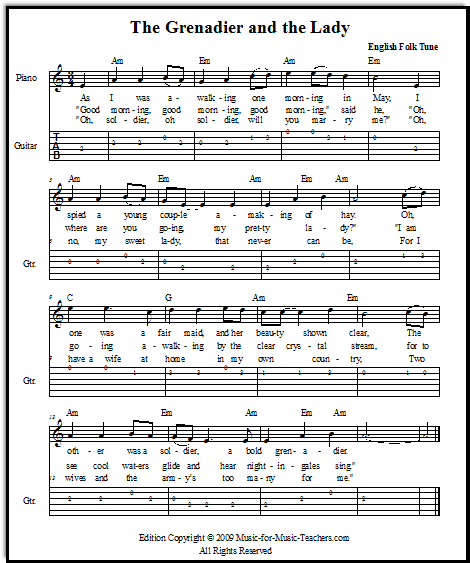
The Grenadier and the Lady, loveliest of sad songs
A beautiful minor song that tells a story.
Good opportunities for finger-picking, with mostly easy guitar chords.
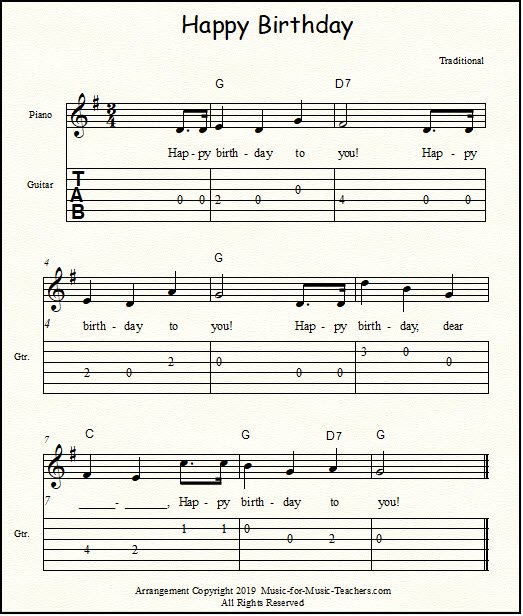
Now with guitar tabs in both the key of G and the key of D!
Also on this page are lead sheets in multiple keys, and several versions for solo piano.
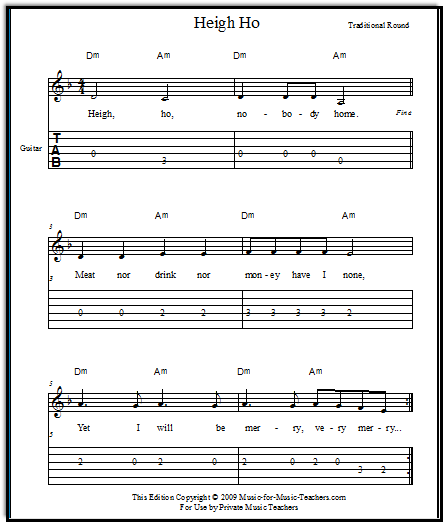
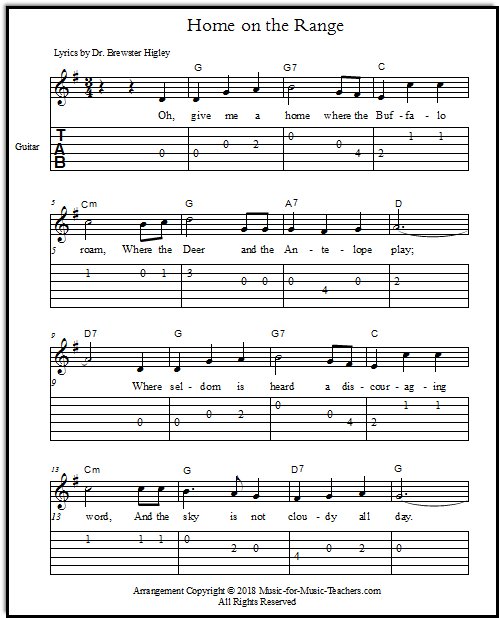
Home on the Range free tabs & lyrics
This page has a very fancy arrangement with lots of different chords, as well as a very simple 3-chord arrangement, perfect for beginners!
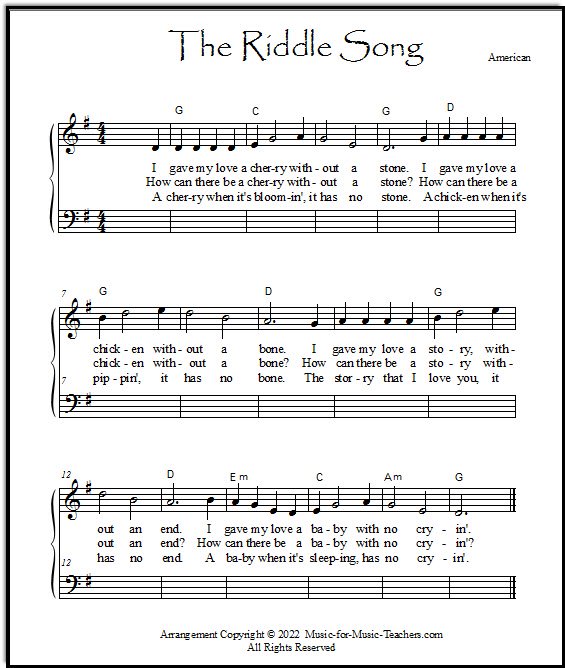
I Gave My Love a Cherry - The Riddle Song
A lovely song with a mystery to work out in the lyrics.
No tabs yet, but chords, and a recording to listen to.
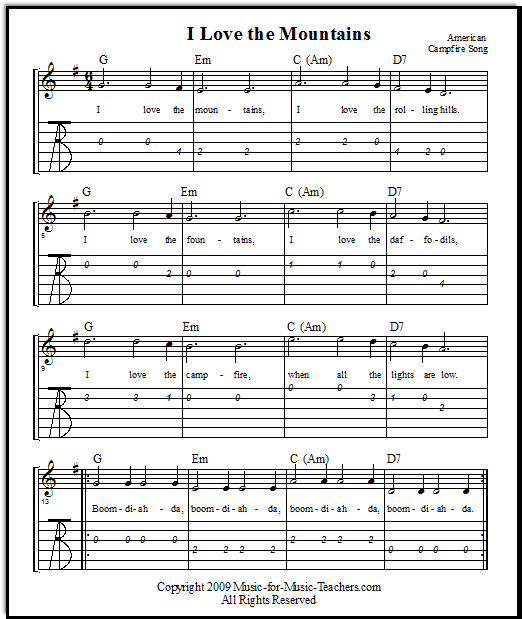
I Love the Mountains guitar chords & tabs
This is the song I use to teach beginners to switch from the G chord to Em, C, and D7!
It is invaluable for giving them a tactile feel for changing chords with no extraneous motion.
The goal? To keep one finger down on the guitar neck at all times. With this set of chords, it is possible.
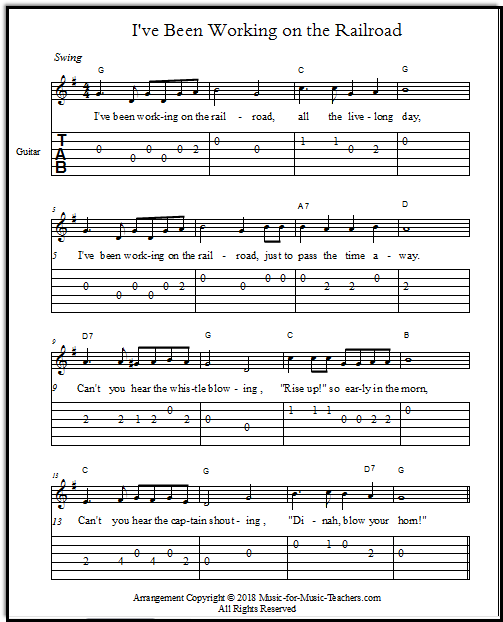
I've Been Working On the Railroad guitar tabs and chords
This is such a fun song, with words that hint at an earlier time.
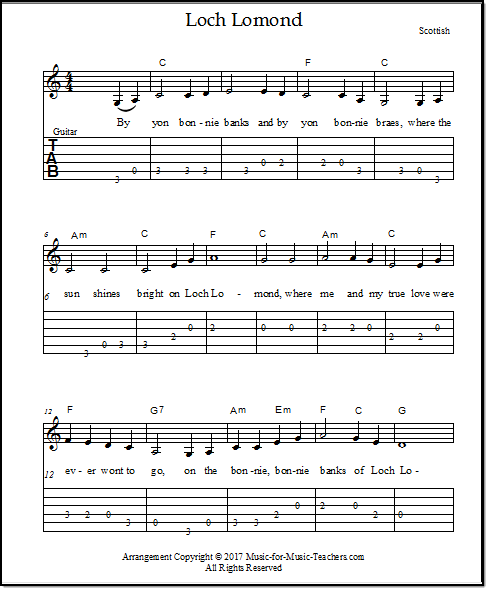
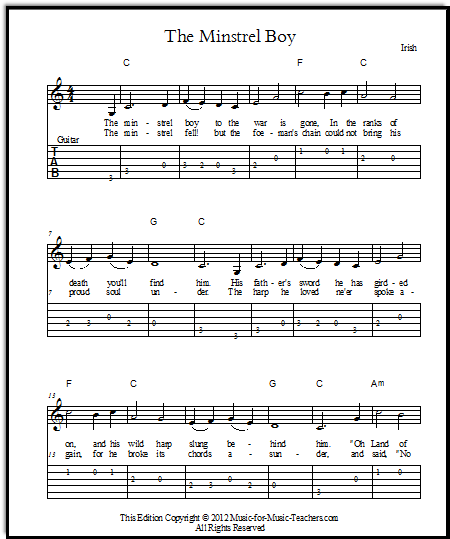
Minstrel Boy free Irish sheet music
Patriotic and beautiful, this song is lyrical and evocative.
A good song for a teenage boy, or young man, but girls could sing it as well.
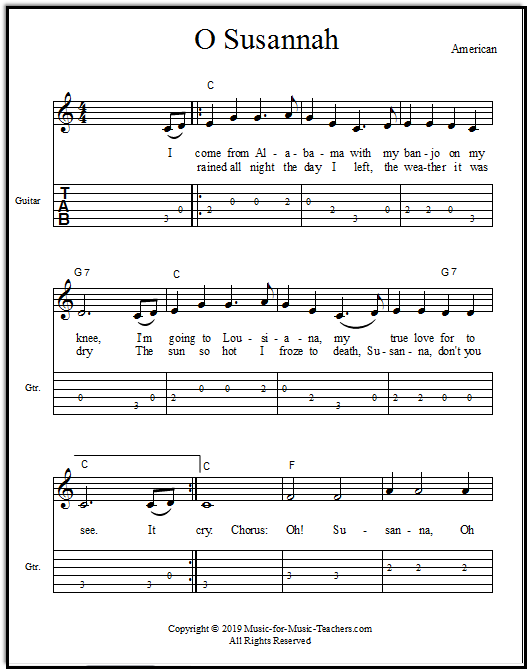
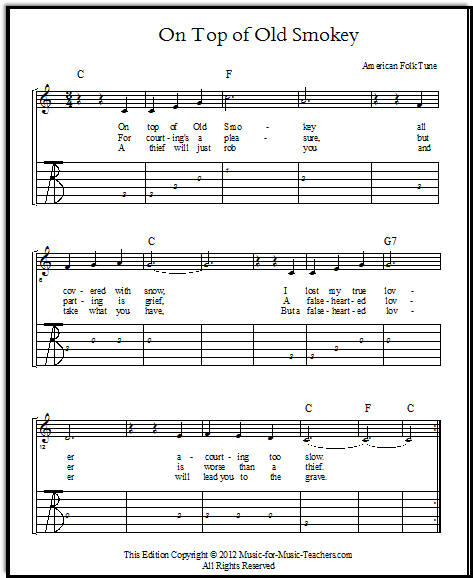
A fun kid song that uses this same melody is "On Top of Spaghetti", all covered with cheese...
Good practice for the three main chords, and for transposing into other keys.
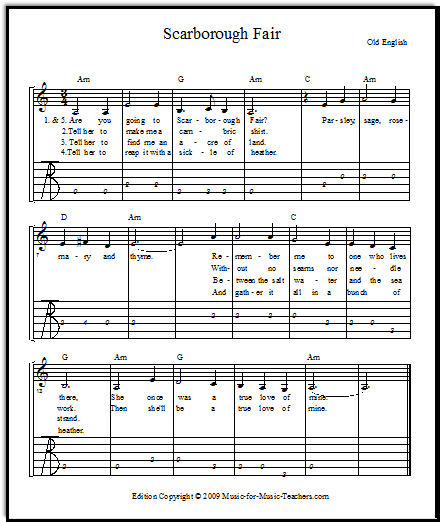
This lovely piece is timeless.
It is a great song for learning or polishing finger-picking technique.
Several different versions here, including one that shows how to walking bass, with tab.
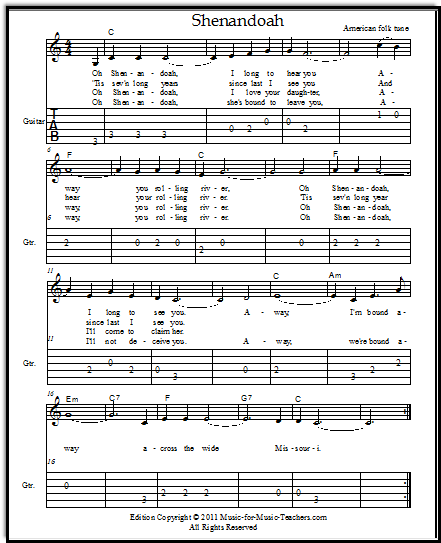
This is a beautiful song that seems distinctly American.
A lovely piece for finger-picking.
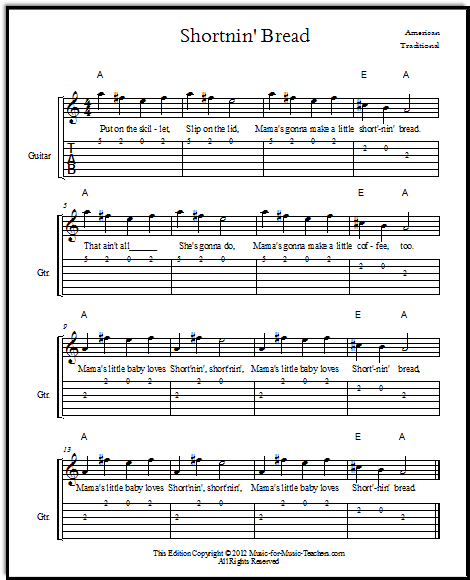
This is such a cute little American song - and EASY.
Just two chords for your beginners, and a melody line that repeats over and over.
For guitar and fiddle!
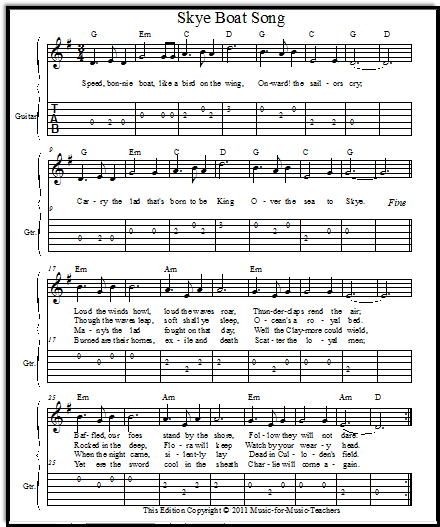
A pretty song from Scotland, about the escape of Bonnie Prince Charlie over the sea after the Battle of Culloden.
Check out the newest arrangement showing a fancy finger-picking chord backup.
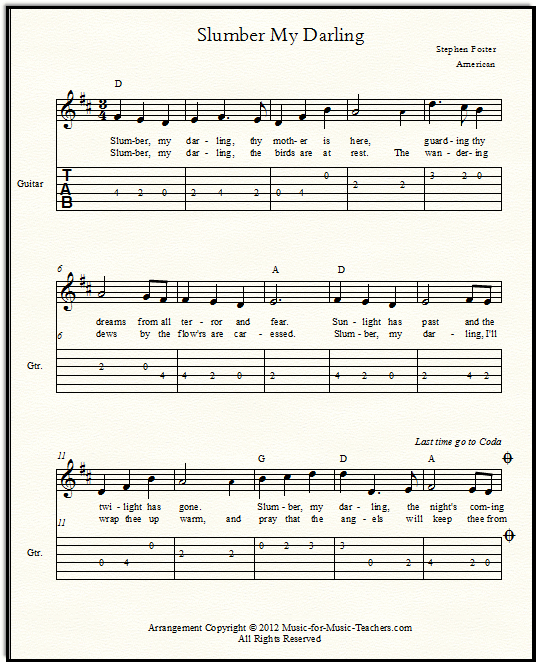
A sweet and pretty lullaby by Stephen Foster, an American composer from before the time of the War Between the States.
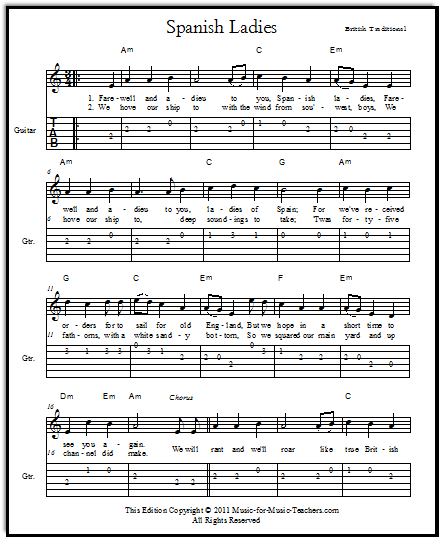
A sea chantey, or shanty.
This song has been a favorite with young boys!
The melody is rousing and singable, with great minor chords in the harmony.
Very good chord-changing practice.
Several versions.
Not to be confused with "Spanish LADIES," above, this cute song tells of how an admirer observes the Spanish lady engaged in one task after another.
No one, it seems, can perform these important feats (such as brushing her hair in the moonlight, washing her feet, etc.) like the Spanish lady can.
A pretty song with lots of energy!
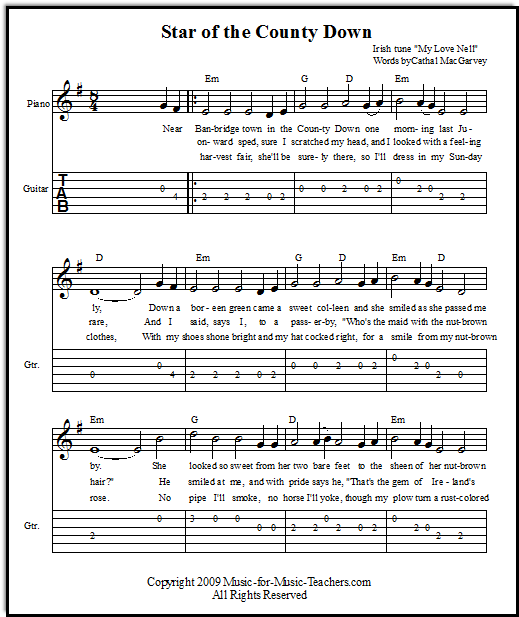
Star of the County Down guitar tabs and chords
HANDS DOWN the favorite guitar song at my studio for young guitar players, with great qualities of endurance! As in, they do not seem to get tired of it.
The "doubled timing" I have used in this particular arrangement may look peculiar, but it helps young guitarists get the timing accurate.
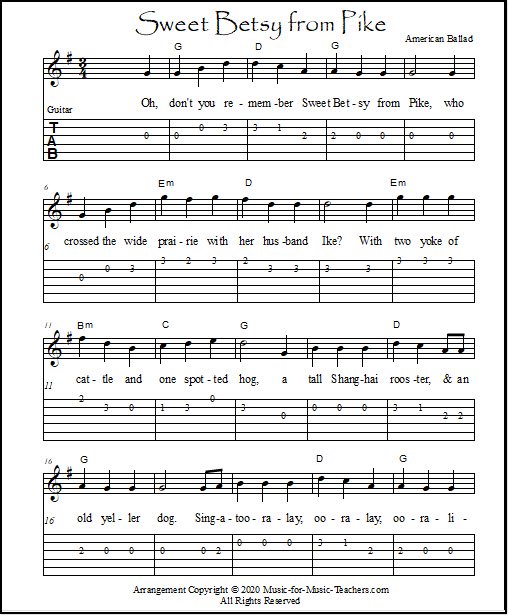
Sweet Betsy From Pike guitar chords & tabs
And lyrics! Four verses of this fun American ballad.
Play it in the key of G, or in the more singable key of C.
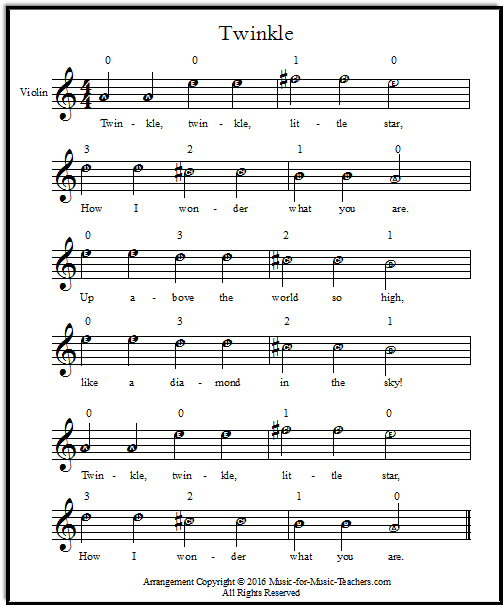
This page talks about teaching this simple piece to a young girl who had no "ear" for the music.
Ordinarily Twinkle is a piece learned by rote... that was not happening for my young student, so I took an extra step for her.
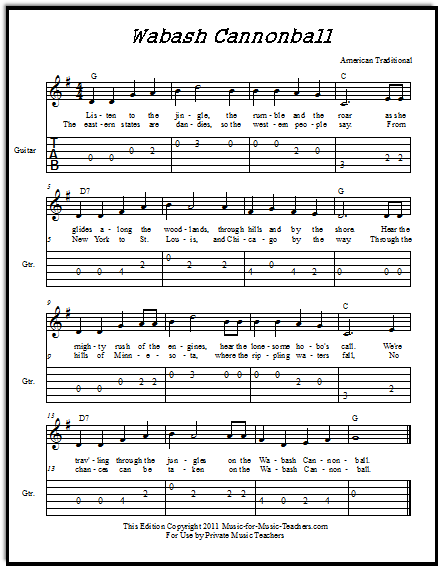
An energetic song about a famous train that crosses the mountains, the jungles, the plains.
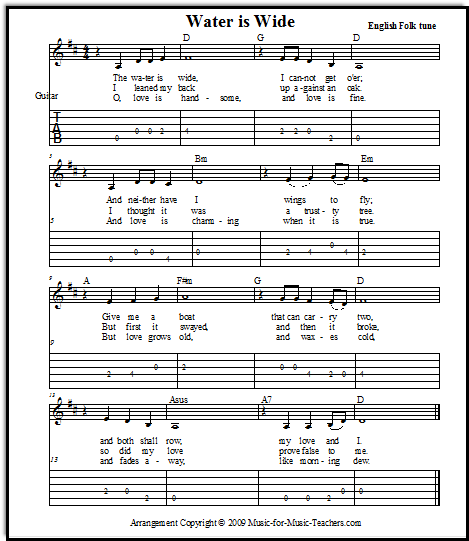
Water is Wide, easy guitar songs
A very pretty song which you may have sung in high school!
True love betrayed is the message of the song - but it is the melody and chords that are the important and memorable parts of this piece.
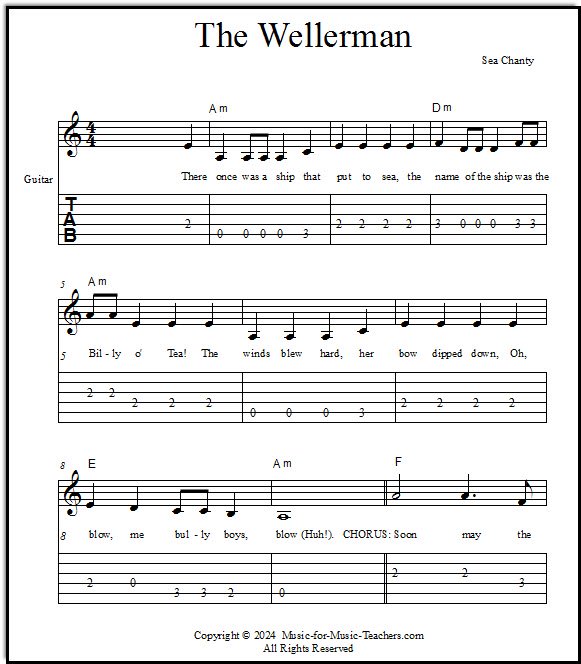
A very fun sea shanty with lots of opportunity for big swingy chord playing!
An easy melody to pick, too.
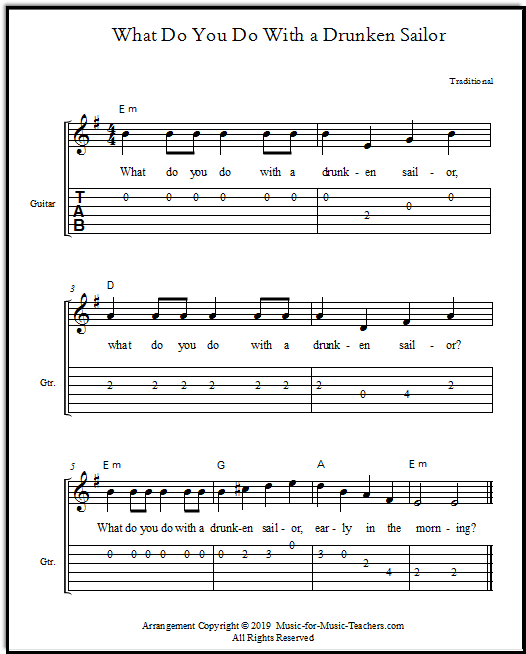
What Do You Do With a Drunken Sailor chords & melody for guitar & fiddle
This piece is EASY and energetic, and a lot of fun.
Also, check out the 3-page flat-picking duet!
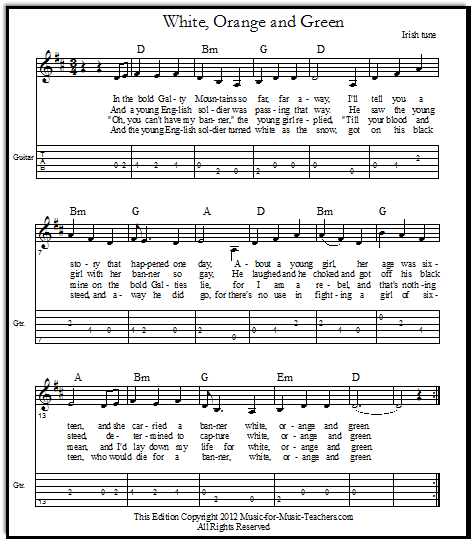
White, Orange and Green free Irish sheet music
A memorable song from Ireland about a patriotic young girl with an Irish flag facing off against a British grenadier.
This is also a pretty song, very singable, with satisfying chords that lend themselves to finger-picking for your young guitar student.
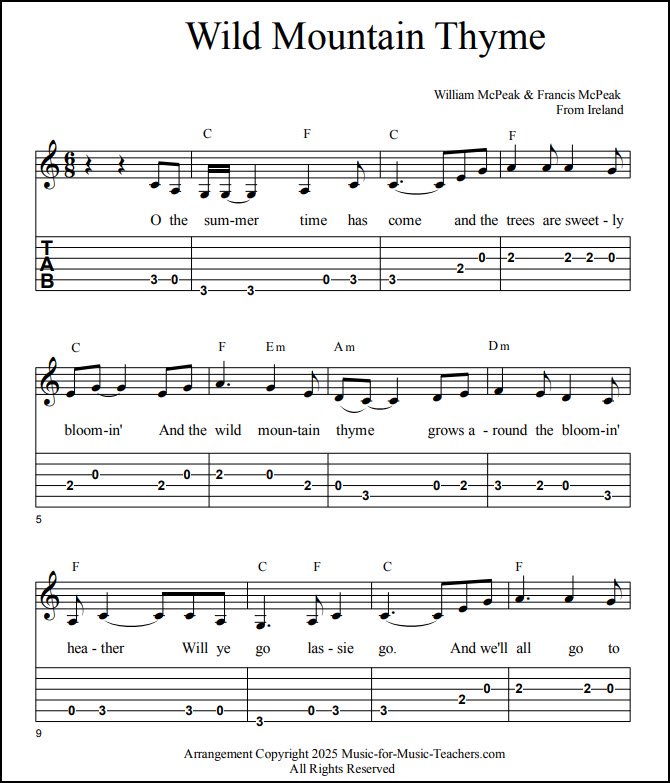
A very pretty song from Ireland about spending time out on the hills with the trees, and flowers, and wild mountain thyme.
In the keys of C & D.
Lead Sheets - see this small collection below, then visit the much longer page linked here
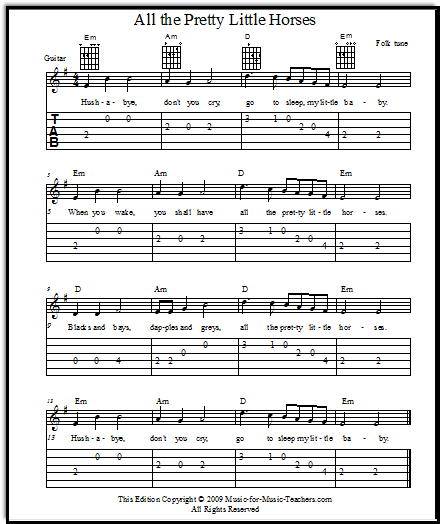
A melody that repeats 3 lines, with just one line different. This song is a confidence builder, and very pretty too!
Initially the dotted quarter note in the 3rd measure of each line may be a challenge!
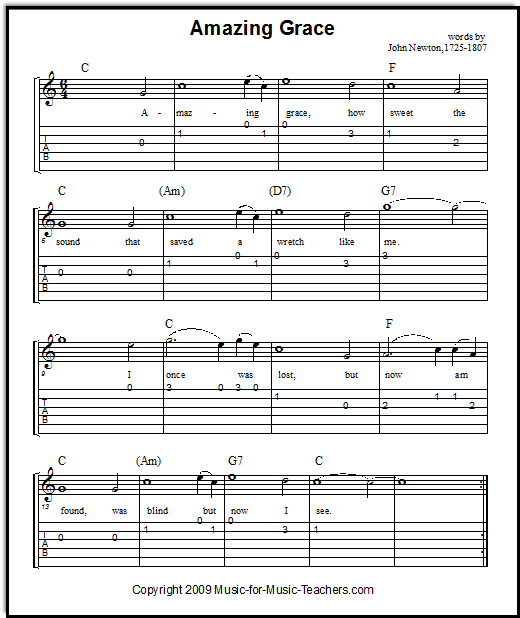
Easy guitar tabs, for a student familiar with this famous melody!
If they are NOT familiar with Amazing Grace, then this will be a string-skipping challenge for a beginner - but worth the effort.
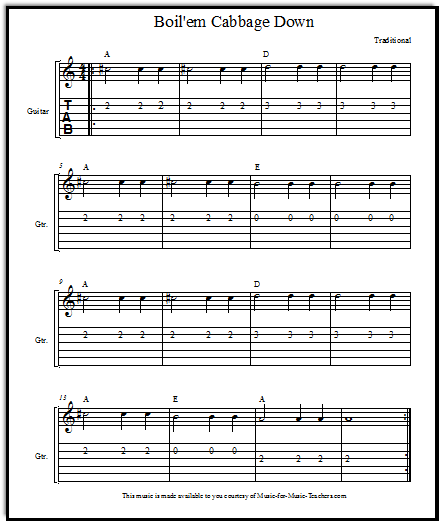
This is THE PERFECT SONG for introducing the "Down, Down-Up" flatpicking stroke to your beginners.
No lyrics, really, but despite that, this song is FUN to play!
Go here to see all the lead sheets at Music-for-Music-Teachers!
Broadway Music
Broadway Musicals List - go to this page to see the best musicals I know!
The beginner guitarist may be able to play the chords, but they won't know what they're doing!
The piano keyboard is the "Rosetta Stone" for musicians
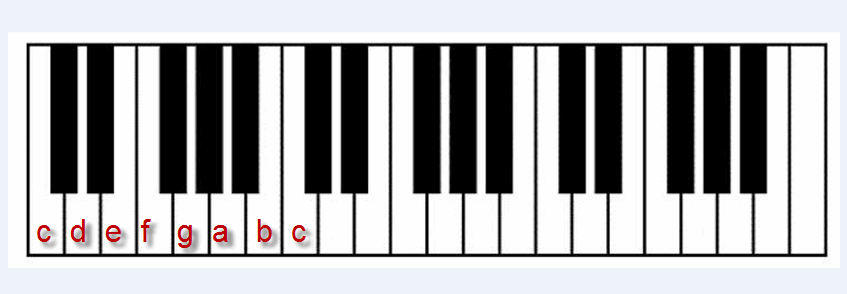
On a piano keyboard, we can look and see that between C & D is a black note, called either C sharp or D flat. And between B & C, and between E & F, there are no black notes.
We can see it just by looking -- it is self-evident.
No black keys for the guitar player
The beginner guitar player has no such obvious visual aids. On the guitar neck, it is just frets, and more frets.
The frets offer no clues of the existence or non-existence of sharps and flats. Instead, the beginner guitarist must memorize the fact that there is no real separate note called E#, no real Fb.
And a note on one string can easily be duplicated on another string. You can play 4th-fret B on the G string, then move next door to the B string and play the same note open.
What's THAT all about? On the piano the notes stay put --- Middle C is always just Middle C. This is true of most instruments, in fact.
The "OUCH" threshold
Then there's the PAIN problem -- pressing the strings hard enough to eliminate buzz, to make chords sound good. "Squeeze the strings! Squeeze them harder! Just ignore the pain.Now strum -- ugh!
"You have to press the strings harder!
"Tippy-toe, like a ballet dancer. Hmm, you'll have to cut your fingernails. Oh - you didn't know that learning how to play guitar would involve pain and suffering?"
Encourage SOUND... the quality will come!
(Of course, I don't really tell my students their playing sounds bad, even if it does. They may not sound good even when they get their skill down, if their folks didn't find them the best beginner guitar.
You must encourage them along, and if they make good progress, talk their parents into trading in the clunker guitar.)
For older and adult guitar beginners, these issues even themselves out in not too long.
But young kids who are learning how to play guitar need easy steps, even baby steps, adding up to building blocks. They need to move one small step at a time, because in reality they are bringing together so many different skills. And they need lots of repetition.
They should be learning to read tablature
I use very easy beginner guitar books for my guitar students, plus music sheets I make up, beginner guitar tabs. The music sheets are usually guitar tablature in combination with standard music notation.
(You and I both know that if guitar tabs are there, then that's what they're going to be reading, not the treble staff! But they do need the treble clef notes for the rhythm, unless they pick it up by ear.)
There are dozens, if not hundreds, of beginner guitar books out there in music land, and I must have over two dozen myself! But here are the ones I've settled on for now:
And they should read standard notation too
To teach reading notes (instead of just guitar tabs) to my youngest guitar students, I like the Progressive books for Young Beginners. They move slowly, and have CDs.
Primarily, I appreciate these books because they start with one new note per page -- or even per two pages -- NO EIGHTH NOTES (the bane of counting for young kids), and NO TABLATURE to seduce kids away from the task of notereading.
Mel Bay's Easiest Country Guitar for Children is one of the cleverest guitar books I have seen! It is nicely laid out-- it starts with six simple, uncluttered pages each presenting a single topic:
- How to Hold the Guitar,
- Parts of the Guitar,
- How to Tune the Guitar,
- Music Basics,
- How to Read Guitar Tablature,
- and one very good page about Picking Technique. (Unfortunately, there is no real discussion of note values. I guess that's where you, the teacher, come in!)
Then you turn the page, and it's all music.
Very simple tunes (such as Railroad Bill, Will the Circle Be Unbroken, Wabash Cannonball, Wildwood Flower and Shady Grove) complete with treble clef, guitar tabs, chord symbols, and where necessary, picking indications.
There are no eighth notes in the first part of the book.
Just before the final song is another instructional page called How to Play Slurs. It covers slides, hammer-ons, and pull-offs.
Then those techniques are introduced in the last song, Watermelon on the Vine. The book comes with a CD. It's a great repertoire book, but unlike the Progressive books, it does not teach notereading.
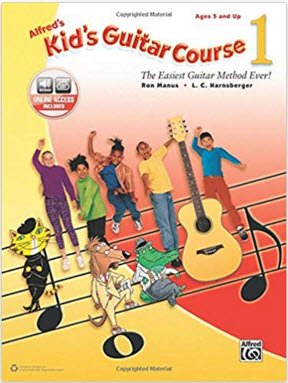
But my real favorite both for learning to read the treble clef and beginning chords is Alfred "Kids Guitar Course" Books 1.
Book One is the simplest book I have found for young kids, because it starts with the "baby" C chord -- just the one-finger on fret 1 string 2 chord, and stays with it for a few pages before venturing on to the baby G7 chord.
Lots of easy chords and strumming and counting practice before learning to pick individual notes.
This has become my favorite beginner's book, because when a little boy shouts with excitement, "That song looks fun!" and starts in playing right away a song that calls for a new technique, my heart is melted.
Another book I like very much as a supplement is Usborne's Very Easy Guitar Tunes. It has NO TABLATURE, so the student is forced to read the treble staff.
There are also no "lessons" with new things to learn -- just nice guitar tunes getting progressively more difficult. Some of the tunes are surprisingly pretty, and there are lots of duets and rounds to make playing together fun.
Because my guitar students frequently find themselves playing along with fiddlers, I recommend that they purchase Mel Bay American Fiddle Method, Vol. 1 .
The first three songs make a great medley (Boilem' Cabbage Down, Shortnin' Bread, and Cripple Creek), and help students really nail down the A, D, and E or E7 chords.
Accompanying other musicians gives real meaning and urgency to their at-home practice time! The songs in this great fiddle series all have chord symbols over the melody lines.
A couple of really great "Teach yourself guitar" books that have impressed me with their well-thought out instruction and content are The Everything Rock & Blues Guitar Book: From Chords to Scales and Licks to Tricks, All You Need to Play Like the Greats (Everything Series) and Usborne's Learn to Play Guitar (Usborne Music Guides)
If you haven't been playing a long time yourself, or have limited yourself to just one style of playing, you MAY enjoy these books. Or, they may be totally intimidating!
They aren't really for your students! Instead, garner what you can, and pass it on!
Now, for those of you who are really serious about guitar, as in classical guitar, there is a fabulous in-depth course I just started using.
I am so pleased with it, and am having fun moving through the 254-page book ahead of my students (although really applying oneself to classical style means longer right-hand fingernails - hard for a piano player!).
This terrific book, Solo Guitar Playing, Book 1, 4th Edition, was originally published in 1968 and has been reprinted several times. It is no-nonsense; no cutesy pictures for little ones, but many photographs of correct hand position and definitely NO TABLATURE!
You may ask, What does the author (Frederick Noad) cover in 254 pages? As Marley said to Ebenezer Scrooge, "MUCH!"
On Amazon you can look at the entire Table of Contents, and you will see that this is a very well-designed course.
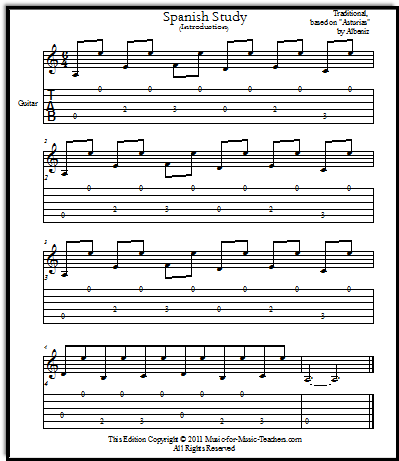
With much repetition of note reading, and steady progression into reading notes on each new string, careful preparation of the student pays off so that by the end of Lesson 7, they can be introduced to the famous Spanish study by Albeniz and not have to use tablature!
In the following lesson is the beautiful Malaguena.
Solo Guitar Playing Volume 1 (Music Sales America) and Solo Guitar Playing/Book 1 with CD (Classical Guitar) are available at Amazon, and also at Sheetmusicplus, where it also comes with a CD and without.
I got it for about six dollars less at Amazon than at Sheetmusicplus, but the shipping at Sheetmusicplus can't be beat, if you have multiple books to order. And you can't get used books with Amazon Prime's free shipping... at least not yet!
An update on the Solo Guitar Playing book: It starts out slowly, but lots of little questions pop into your mind that send you asking advice from another teacher.
For example, when pull-offs are first introduced (called "descending ligado" in the classical book), WHO KNEW that your left hand finger comes to rest on the finger board instead of remaining elevated above the neck? Descending ligado is introduced on page 72, but the author doesn't let you in on this little secret until page 89!
Another factor that diminishes my pleasure in the book is the fact the notes are tiny. TEENY-TINY. To me, anyway. All my students can see the notes just fine -- but to my over-60 eyes, it is irritating sometimes to have to peer more closely.
Still, the book is well worth it. The music selections are wonderful.
Dianna:
Your website is a light in the darkness. THANK YOU for all you do in helping to spread the love of music. It matters!
Recent Articles


-
One Hand Alone Piano Music for Beginners: How Can You Find It?
 One hand alone music for beginning piano students is pretty hard to find. Here are some suggestions for sources of piano music.
 -
Down by the Salley Gardens: Sheet Music for Singers & Instrumentalists
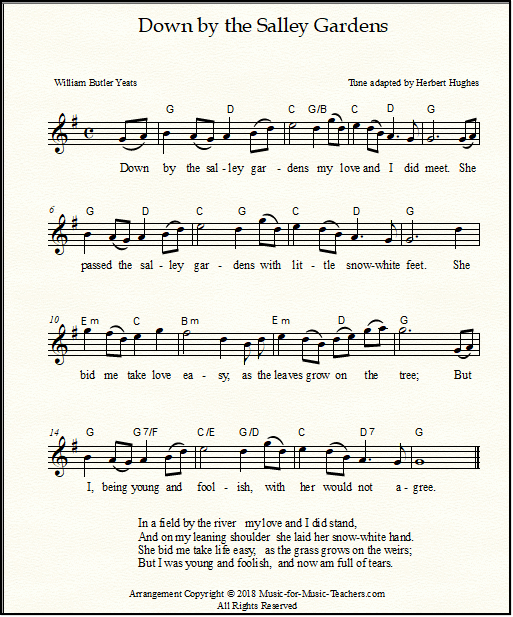 Down By the Salley Gardens is a pretty song from the British Isles with poetry by William Butler Yeats. Download piano, vocal, & lead sheets for your students!
 -
Star-Spangled Banner: Free Sheet Music & Lyrics for All Instruments
 Star-Spangled Banner free sheet music. Now with a singer's "find-your-pitch" exercise! America's national anthem in 7 keys, & lyrics for 1 or all 4 verses.
 -
Guitar Tabs for Beginners "Pizza Please" (Hot Cross Buns): 1st Lesson!
 Guitar tabs for beginners "Pizza Please" is really just Hot Cross Buns in disguise. This all-on-one-string free guitar sheetmusic is perfect for new beginners!
 -
Made-Easy Notes for Beginners: Pirate Song "Yo Ho Ho!"
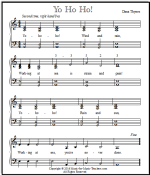 Made-easy notes for beginner pianists, "Yo Ho Ho!" is a fun song with a strong melody. With versions for three skill levels, you'll find one for your student!
Interested in songs from the Bible for your students or church? Check out my other website, SingTheBibleStory.com!
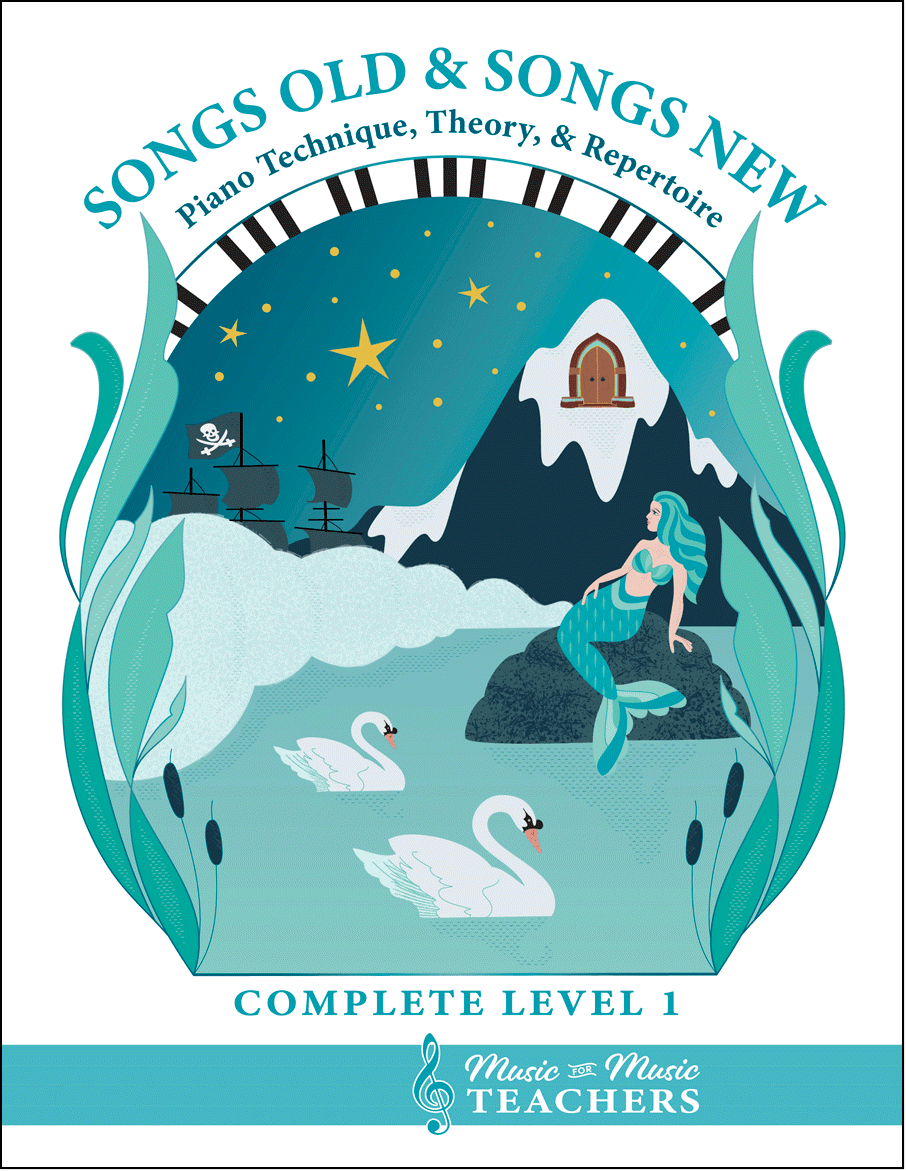
All the first-year material I give my beginner students.
Piano keyboard sheets, scales, chords, note-reading exercises, and over 256 pages of music!
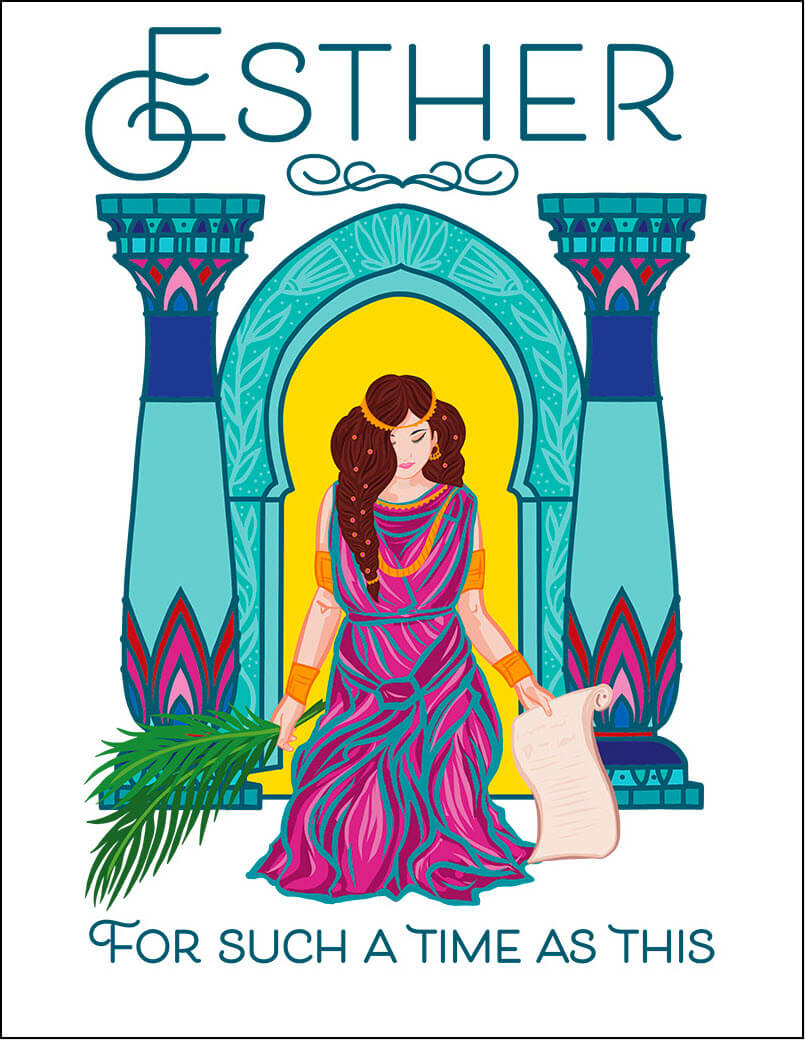
This beautiful song book for piano & voice "Esther, For Such a Time as This", available as a digital download, tells the riveting story of the time when Jews in ancient Persia faced a foe named Haman, and how a brave young queen risked her life to save her people.
A good choice for a singing story-teller, an operatic group, a short theater production, or a class of children!
This book is also available from Amazon as a paperback.

This book is available as a digital download from this site. Visit this page to see some free examples from the book.
It is also available from Amazon as a paperback!
This is the perfect easy start for little pianists.
And when they start reading white-key notes on the staff, this is a fun easy resource to say each week, "Choose a new black-key song at home this week and figure it out to show me next lesson!" They will be spending more time at the piano.
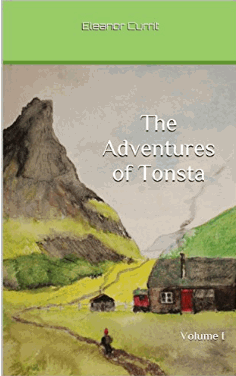
A perfect read aloud storybook
for little boys or girls.
The Adventures of Tonsta highlight the travels of a very young boy with a good heart, who goes about helping folk in trouble.
With a red cap on his head and a sack of tools slung over his shoulder, Tonsta seems to meet people in distress wherever he goes.
Lots of trolls in this book - including one who gives him a Christmas gift!
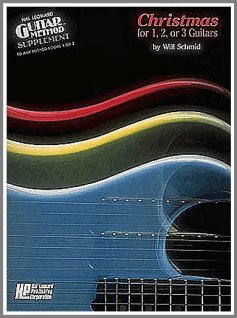


.%20%20See%20it%20at%20Music-for-Music-Teachers.com)


Becky:
A thousand thanks for your beginning piano and guitar songs.
I've already printed several for my children, including the Pretty Little Horses TAB and Carol of the Bells for piano. What a wonderful resource!
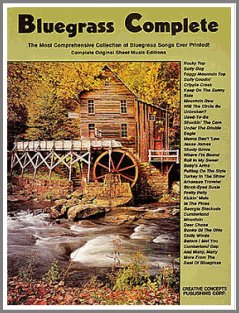
Bob:
I am a "retiree" and brand new guitar student.
I have used your guitar tabs for Shenandoah and Amazing Grace, and find it exciting to hear real music coming out of my guitar for the first time.
Lin:
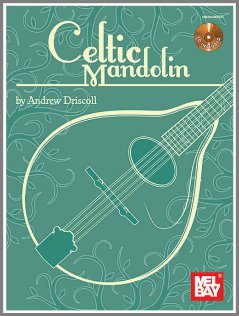
Thank you for a most excellent site. I am a classical guitar teacher, who endeavors to cover chords and finger style as well.
I especially liked the printable Celtic music, as some of my teenage students enjoy it! Thank you, again.
Dylan:
Just wanted to express my overwhelming joy in finding your web site! :D Lots of good info!!
My wife and I own our own teaching studio in Texas and I am always looking for new songs to teach my beginner guitar students. You've done a wonderful job of providing great tunes with ACCURATE sheet music/TAB!
Your web site is wonderful! Thank you so much!! Many blessings...
Comments
Do you have a funny story about this music, or does it remind you of something you'd like to share with other readers? Do you have a question? I'd love to hear it!
Please note that all comments are moderated, and will not appear until I have approved them. Also, IF YOU ARE ASKING FOR MUSIC THAT IS NOT IN THE PUBLIC DOMAIN, YOUR REQUEST WILL BE IGNORED. That's pretty much any music written in the last 75 years...
What Other Visitors Have Said
Click below to see contributions from other visitors to this page...
Mr... Learning Guitar
Hello... to whom this might concern.. some of these songs here are good and easy to do..
I started learning my guitar last year in July and I found …
Teaching Myself How to Play the Guitar--What Tools Should I Use?
Ma'am, I am 27 years old. I am not a music teacher, but I am teaching myself how to play the guitar.
I have a bit of a background in reading and …
I'm New to Guitar Teaching, No Education In It
Jonas
Hi, I'm new to guitar teaching and have no education in it. Tried to teach my daughter and her friend and the first session was just disaster …
About the Author

Hi, I'm Dana! (Say that like "Anna".) I'm the owner of Music-for-Music-Teachers.com, and a newer site, SingTheBibleStory.com.
Like some of you, I've been playing the piano since early childhood, and have added a few other instruments along the way, plus an interest in arranging and composing music.
You can find out more about me and the reason for this website at my About Me page.

Recent Articles
-
One Hand Alone Piano Music for Beginners: How Can You Find It?
One hand alone music for beginning piano students is pretty hard to find. Here are some suggestions for sources of piano music. -
Down by the Salley Gardens: Sheet Music for Singers & Instrumentalists
Down By the Salley Gardens is a pretty song from the British Isles with poetry by William Butler Yeats. Download piano, vocal, & lead sheets for your students!