Ode to Joy, from
Beethoven's 9th Symphony
Piano Sheet Music
Lots of arrangements, solo & duet
See below many arrangements of the famous music:
- An ADVANCED solo arrangement with a "majestic" sound, in 3 keys
- Two duet versions for teacher plus student, using that majestic arrangement!
- Three beginner arrangements with the Ode to Joy LYRICS ("Joyful, joyful we adore Thee")
- Several one-hand beginner versions, with and without lettered notes
- A late elementary arrangement offering a challenging and interesting set of left hand chords for students in their second year!
- And, How I Teach Ode to Joy
You will find the downloadable printable PDF links farther down the page.
Ode to Joy is one of Beethoven's most recognized and beloved melodies.
Surely your student's older brother has played this familiar melody on his trumpet in school band, or perhaps she or he has heard it sung in church as "Joyful, Joyful, we adore thee..." Your piano student will recognize this tune.
First, the easy piano versions
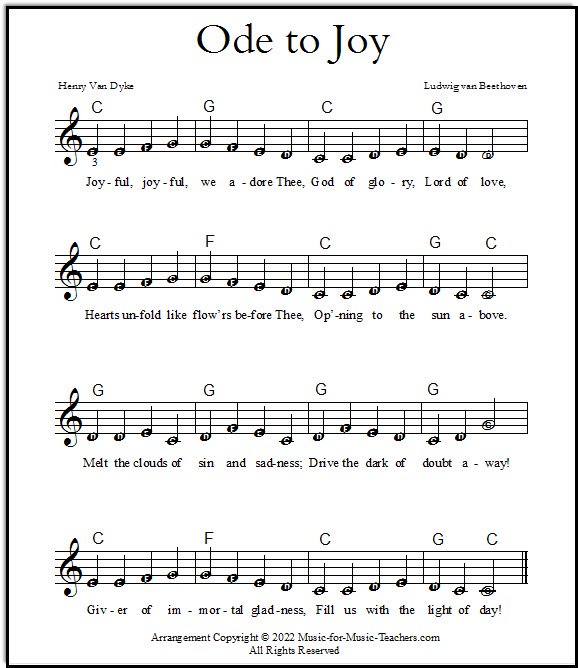
Please scroll down the page for the download links.
This newest easy arrangement, above, was made for my 6-year-old granddaughter, who has just started playing in the last few weeks, and wants to play everything that will fit into 5 fingers! She also likes to sing as she plays, so I added verse one of the hymn lyrics, an English version.
The accompanying chord symbols
You may not like the chords I have suggested in line 3. Keep in mind that this arrangement is primarily a MELODY written for beginners. If you wish to accompany your student and have those chords sound JUST RIGHT, try two chords per measure starting on line 3, like this:
G - C, G - C, G - E7/G# - Am - D7 - G....
That will be very satisfying!
How I teach Ode to Joy
Below are several easy music downloads. These pieces of simple, free kids sheet music for beginning piano players can be dressed up with chords.
Here is the VERY EASIEST Ode to Joy, a lead sheet (minus chords):
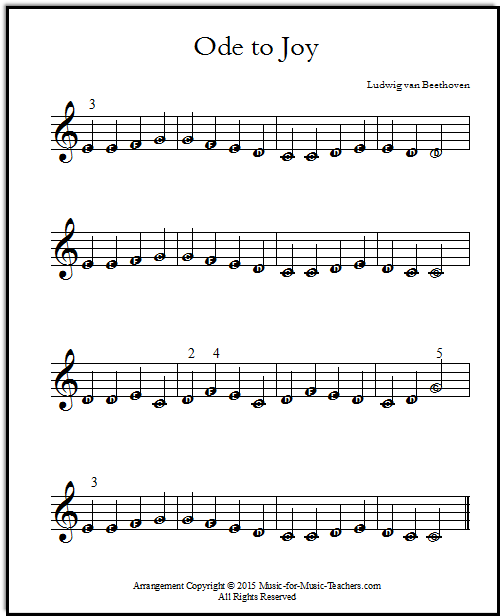
Please scroll on down the page for the free downloadable links!
Letters inside the note heads
Those notes with letters inside the heads are called "AlphaNotes", and they give new piano students COURAGE.
Is this a crutch? No, a tool. Pay attention to your student, and you will know when it is time to pull off the "training wheels"!
What makes this melody so intuitive?
After finding the starting notes, this song is almost on autopilot, if your student knows the melody at all. For the most part, reading "Ode to Joy" is just like following Wormies or Snakes, two beginning note-reading sheets which progress step-wise.
It is just possible your student has heard the song sung by a quartet at the end of Beethoven's Ninth Symphony.
However it may be, if they have heard this most famous of Beethoven's songs before, they will want to play it themselves.
How they will WANT to play the rhythm
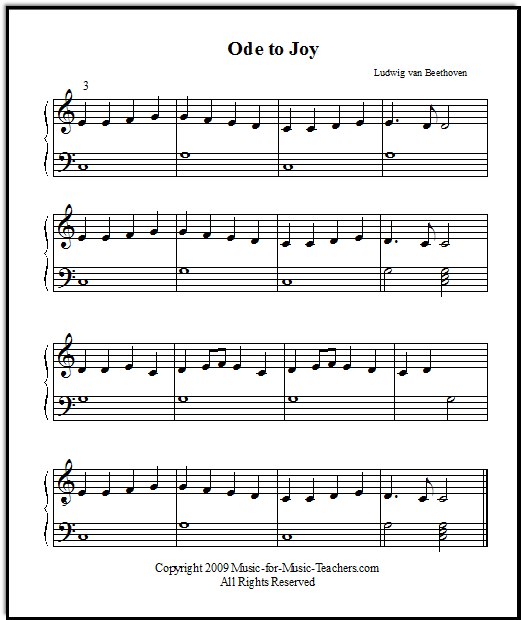
Please scroll down the page for the download links.
Observe the dotted rhythm, and see the eighth notes in line three, and at the end of lines one, two, and four.
And eventually, beginners will play it like that. If my beginners add that rhythm all on their own, I leave it be without mentioning it.
As for left hand, that equals "5, 1, 5, 1, 5, 1, 5, 1, CHORD!"
A simplified melody - the best first way if not using lettered notes
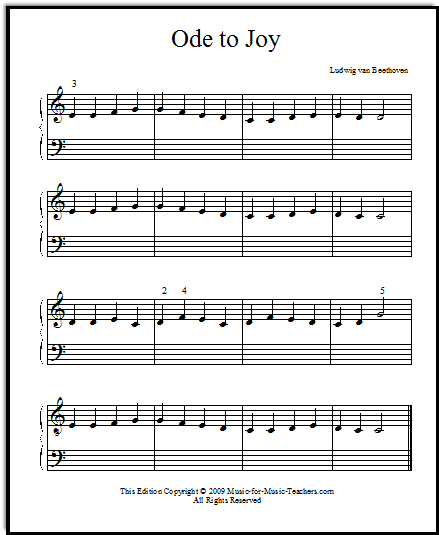
Please scroll down the page for the download links.
If they automatically play the end of lines one, two, and four with the dotted quarter note rhythm, fine. I don't try to stop that.
With only minimal fingering, kids read this song just like "Snakes," except I warn them that there are some skips hiding in some of the measures. Sometimes we go looking for the skips (or thirds), and circle them with a colored pen.
Preparing for chords
Another change I have made is to turn the melody UP at the end of line 3 instead of down, in order to contain the melody within one hand. That way, we can add chords in a few weeks or months when the melody is very strong.
With chords, Ode to Joy can be dressed up for a duet, or returned to later, when they have gained more skill and their hands are more independent.
Use the sheet below for your adventurous students and treat Ode to Joy like a lead sheet:
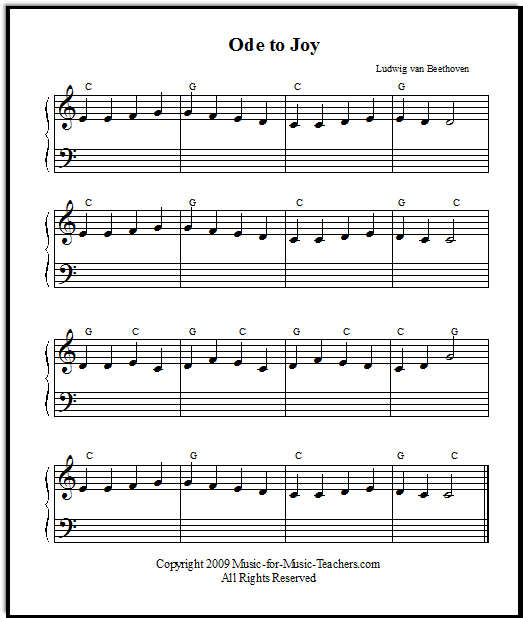
Please scroll down the page for the download links.
How should beginners use the chord symbols?
What will those chords look like, for your beginners?
I suggest just a single bass note. Yes, tell them it's like a bass guitar. Single note C, then G, then C... I may even demonstrate by using my pointer finger only, as unpianistic as that may be! It is slow, but completely understandable.
When should you start adding chords? As I said, not until the melody is well in hand.
One year or a few months later:
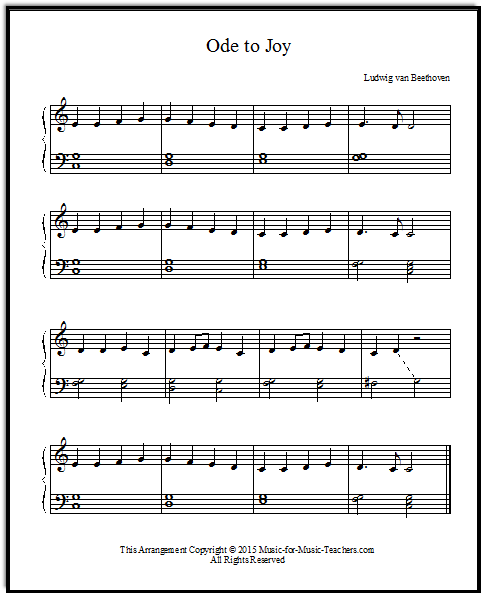
Please scroll down the page for the download links.
The hymn lyrics
Here are two arrangements which include lyrics. These are just simple arrangements.
If you are interested in an accompaniment for church playing, check out "Joyful, Joyful, We Adore Thee" (Ode to Joy's English hymn lyrics by Henry van Dyke) at my other website, SingTheBibleStory.com.
There are 2 very pretty and challenging arrangements there, in 3 keys.
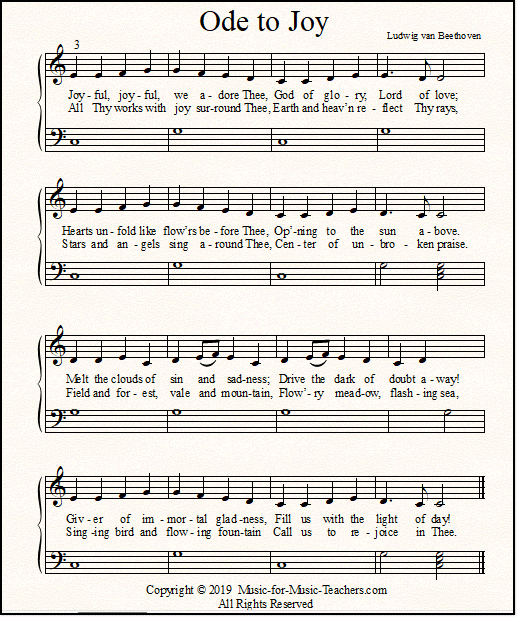
Please scroll down the page for the download links.
The lyrics in an easy piano setting
And here again are the lyrics "Joyful, joyful, we adore Thee," with another easy arrangement for beginners, with a fancier left hand part.
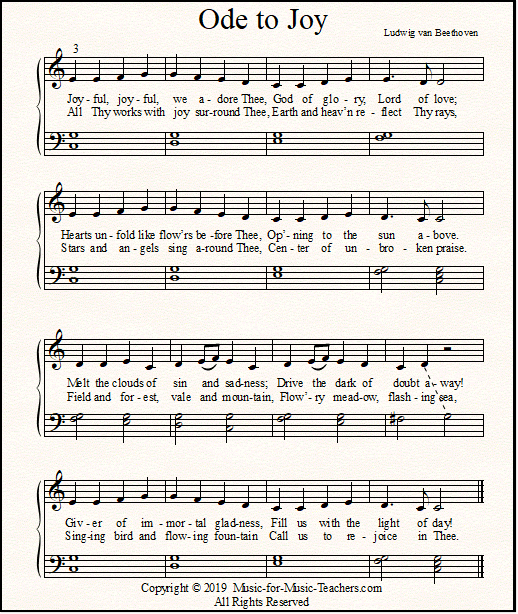
Please scroll down the page for the download links.
Let beginners experience the majesty
I've had kids play the chord accompaniment different ways in this piece, but always starting it as a duet with them on the melody and me on the chords -- BIG chords.
It's good for them to feel the majesty of this piece and to learn to feel comfortable with all the sounds happening while they strive to keep the melody going rhythmically.
If they get too lost and confused initially, then I drop my fancy accompaniment and just play along with them, doubling their part.
Here's what I mean by "majestic":
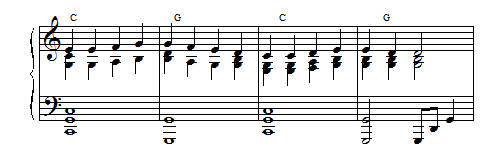
This is the kind of accompaniment I might make - FOR ME, THE TEACHER!
Then we switch places, and I have them try C and G open chords all the way through, striking the chord on beat 1 only.
Changing chords may be a little slow at first, but this student may have been playing the C, F, and G chords of Louie Louie for at least a few weeks by now, to get them ready for fast-moving chords.
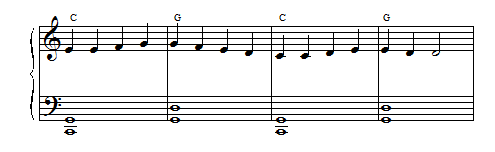
Switching chords quickly
And here is something fun. I point out to them that they can change from C to G and back to C again without even looking at their hand, if they "sneak" through the their thumb on the G key, using it as a landmark, and switching to their 5 finger.
"Close your eyes and try it," I tell them, and now it becomes a challenge. They love a challenge!
Then we go through the whole piece, with me on the melody and them on the chords, left hand only, swapping back and forth from C to G to C.
Line 3 is a lot of work, moving twice a measure. Watch out where there are two C chords in a row!
...and line 4 is just like line 2.
Amp up the energy
Finally, we make one last change... after the energy of line 3, it doesn't seem right to settle back down to just one chord a measure, so we put FOUR chords in each measure of line 4 -- one chord for each beat -- what a difference!
I ask them if they can feel the difference, and they can indeed!
It may be some time before they can put this vigorous left hand together with the right hand melody, but that's okay...in the meantime, you have a great duet, and they are learning chord basics.
"BIG" solos and duets
Please scroll down the page for the download links.
More than one key
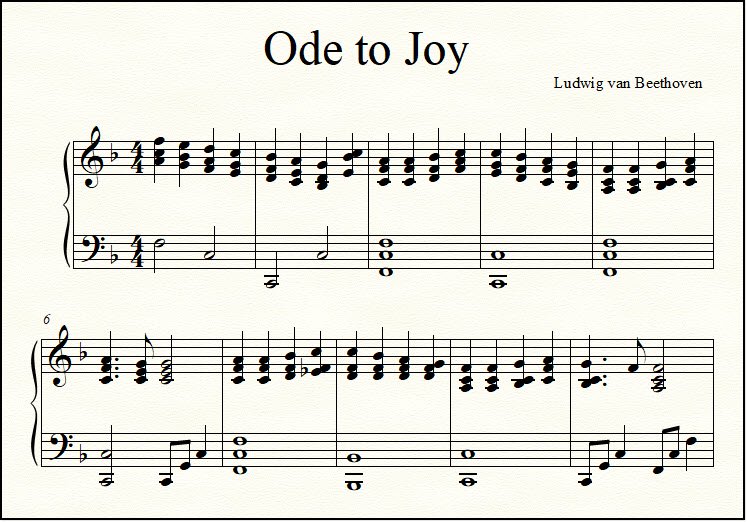
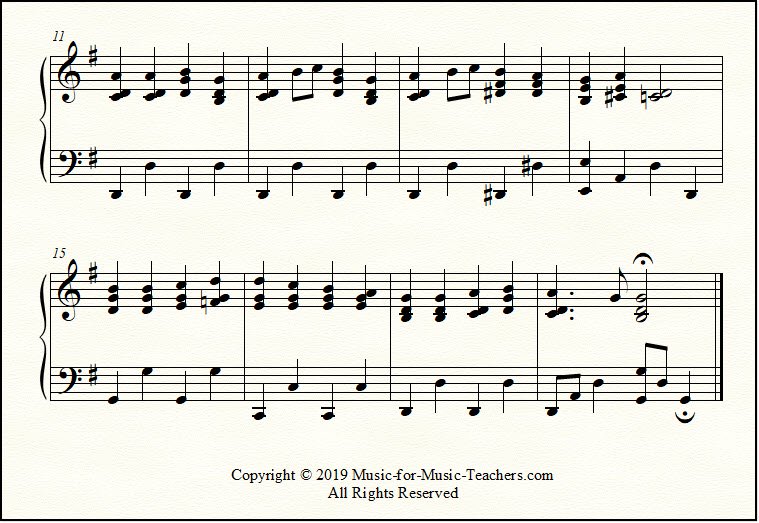
This arrangement is available in the keys of C, F, and G.
Here is a close-up look at page one of the F version:
Please scroll down the page for the download links.
Above is the G arrangement, a look at the most difficult part of the song.
Piano duets
Thanks to Alison in New Zealand!
She requested that I make a duet accompaniment for her and her daughter, using the "majestic" sound that I demonstrated higher up the page with big chords in both hands.
Here are the piano duets, both of which make use of the solo arrangement above:
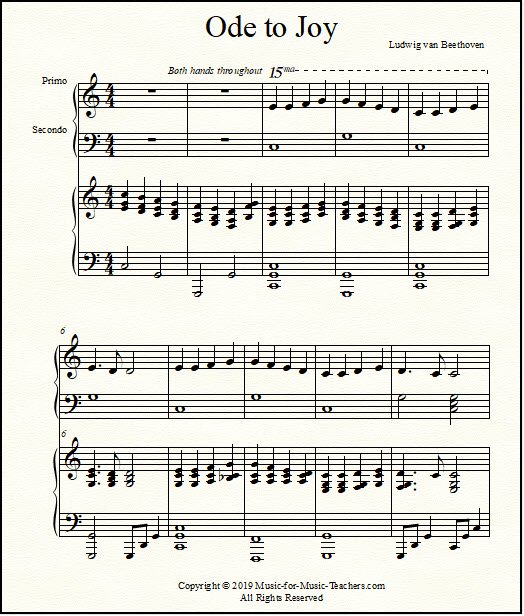
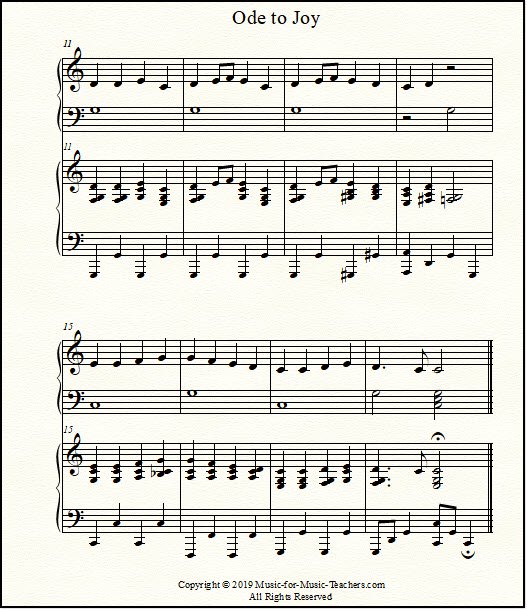
Please scroll down the page for the download links.
For a beginner, & an accomplished pianist
Here is page one of almost the exact same duet, but the primo part uses just one line, one hand, and is therefore able to be played up just one octave above the secondo part.
That's my preference, personally. I always feel like if kids play TOO high, their music starts to sound like mice singing in a closet!
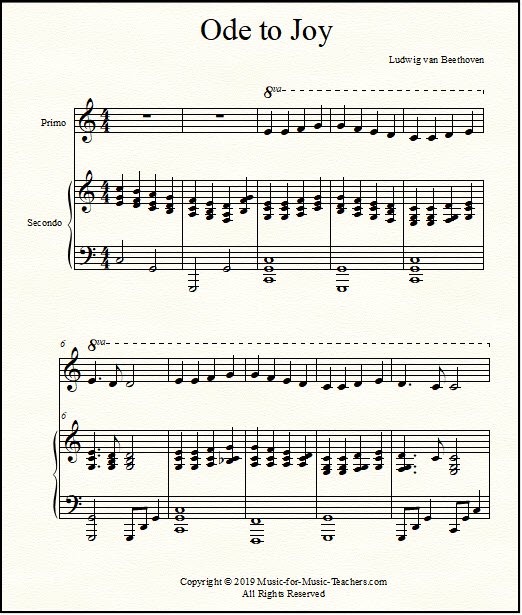
Please scroll down the page for the download links.
By the way...
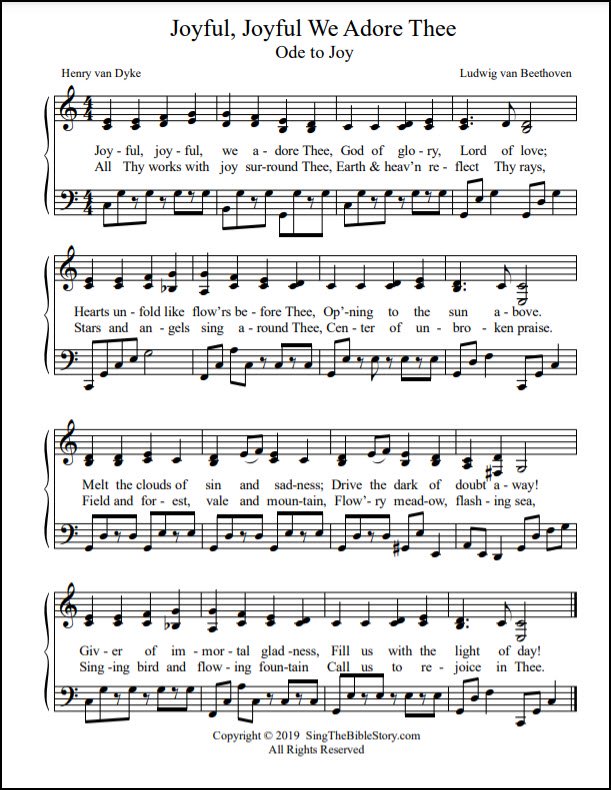
The sheet music and Christian hymn lyrics "Joyful, Joyful, We Adore Thee," set to Beethoven's Ode to Joy with two flowing arrangements in the keys of C, F, and G, are available free at my other site, SingTheBibleStory.com.
TWO VERSIONS:
EASIER...
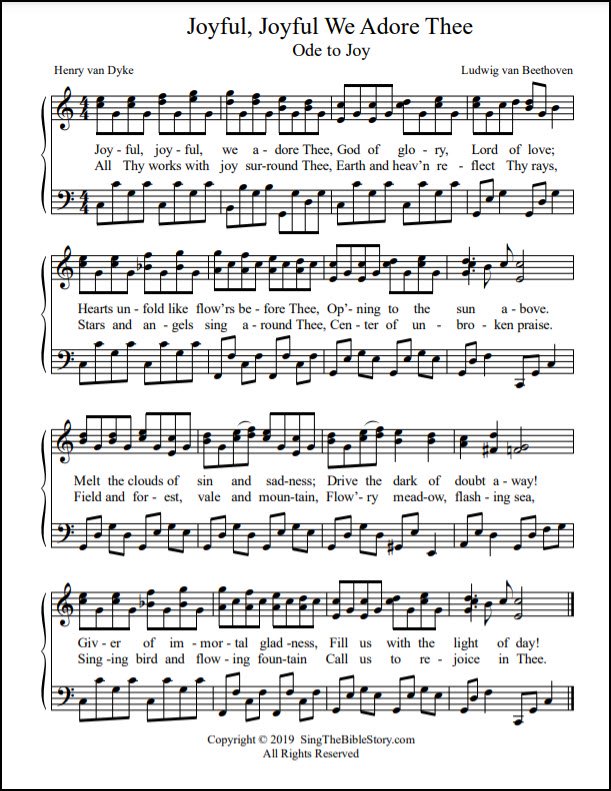
And a TRICKIER arrangement.
Here are the links for the music above
The links for the VERY EASY piano arrangements of Beethoven's song:
Download piano music with letters Ode to Joy, the EASIEST version, with all ALPHANOTES, a lead sheet
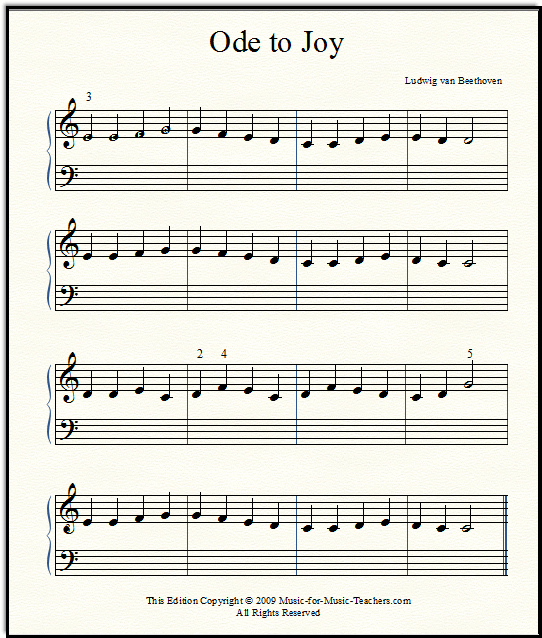
The link for the late elementary arrangement:
The links for the arrangements with the Ode to Joy hymn lyrics:
The links to the advanced level piano music:
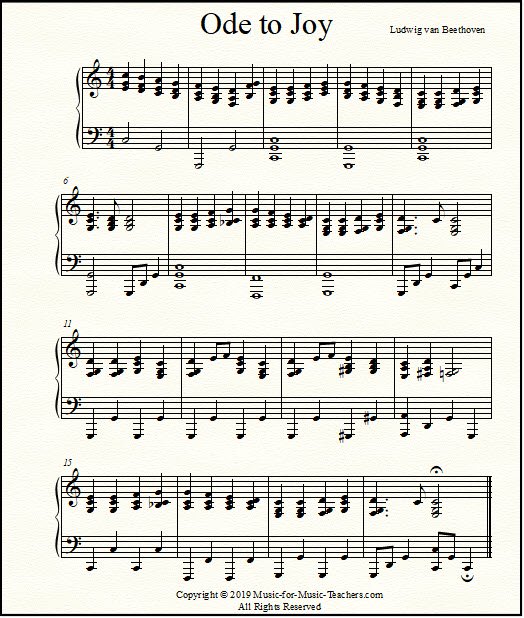
Download the majestic, advanced arrangement of Ode to Joy, in the key of C
Download the same advanced arrangement of Beethoven's music, in F
The links to the piano duets:
And don't forget...
The sheet music and Christian hymn lyrics "Joyful, Joyful, We Adore Thee," set to Beethoven's Ode to Joy with two flowing arrangements in the keys of C, F, and G, are available free at my other site, SingTheBibleStory.com.
TWO VERSIONS:
EASIER...
And a TRICKIER arrangement.
More 5-finger songs at Music-for-Music-Teachers:
Boil'em Cabbage Down - only 4 notes, and lots of repeated notes, with energy!
Cat Came Back (easiest version) - with fun-to-sing lyrics, many verses!
Eensy Weensy Spider - the easiest version has only 5 notes
Erie Canal - Part I has only 5 notes, but is a satisfying introduction to this song
God is So Good - a sweet melody with sweet words
Jingle Bells - every child knows this one
Mary Had a Little Lamb - a song with many uses!
Ode to Joy, the famous tune by Beethoven
Pizza Please (Hot Cross Buns) - 3 notes, arranged for each hand
Seek Ye First - a pretty & popular Bible verse song
Sharks (3 notes, for left hand) - this is like the Jaws theme song
Snake Charmer - with fun lyrics and a mysterious minor melody
Tarantelle - the spider dance, with silly lyrics about tarantulas
When the Saints Go Marching In - with several arrangements!
Dianna:
Your website is a light in the darkness. THANK YOU for all you do in helping to spread the love of music. It matters!
Recent Articles


-
Unchained Melody Piano Sheet Music, Chords & Lyrics
 Unchained Melody: an intermediate-level arrangement that captures the beauty & power of this song, in a version suited to piano. What do I mean? No triplets!
 -
Thank you so much for the rounds!
Hi Dana, I am just writing to thank you for the free rounds for singing -- I have put up my hand to lead folk songs and hymns for my Christian homeschool -
Teacher
 I stumbled upon this site by accident, and am very glad I did. As a bumbling untrained music teacher, I like your hints about how to teach - although I
 -
Auld Lang Syne Sheet Music PDFs: for All Instruments & Singers!
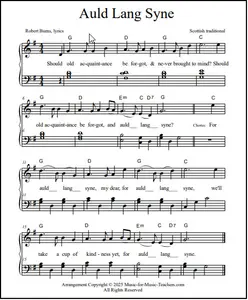 Auld Lang Syne sheet music for New Year's Eve & other gatherings! Piano arrangements, guitar tabs, & lead sheets with chords in many keys, for all singers.
 -
Favorite Christmas Songs: Duet Vocal Sheet Music
 The best duet Christmas songs are those ones you knew & loved as a child! This set of 14 "a capella" carols arranged for 2 voices is just right for caroling!
Interested in songs from the Bible for your students or church? Check out my other website, SingTheBibleStory.com!
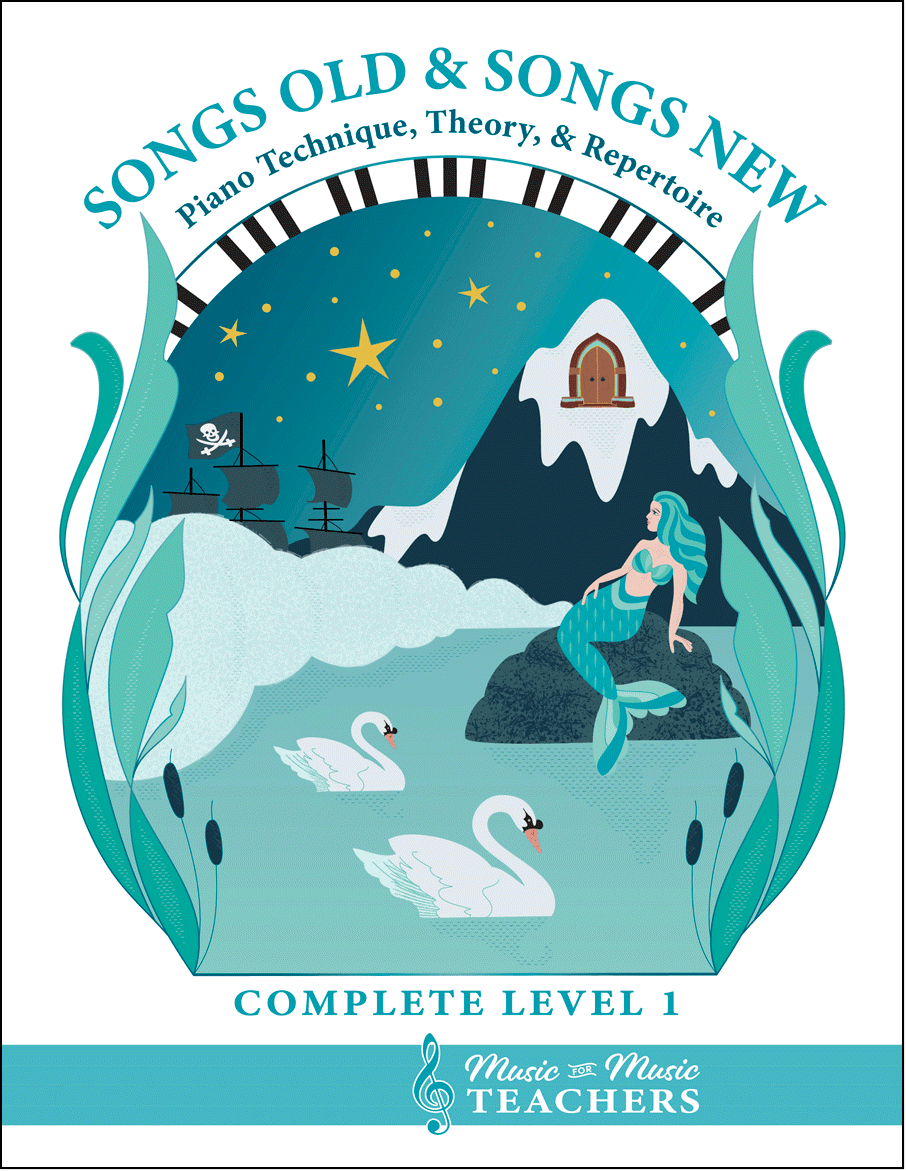
All the first-year material I give my beginner students.
Piano keyboard sheets, scales, chords, note-reading exercises, and over 256 pages of music!
Music-for-Music-Teachers.com is a participant in the Amazon Services LLC Associates Program. As an Amazon Associate I earn from qualifying purchases.
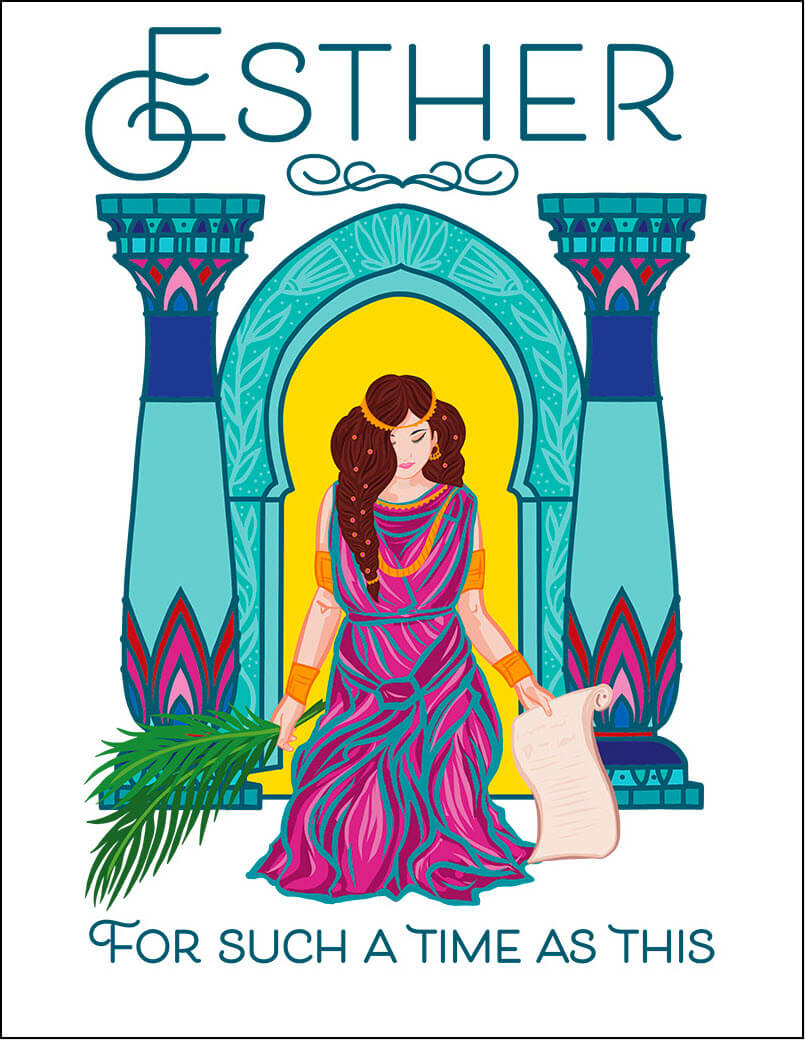
This beautiful song book for piano & voice "Esther, For Such a Time as This", available as a digital download, tells the riveting story of the time when Jews in ancient Persia faced a foe named Haman, and how a brave young queen risked her life to save her people.
A good choice for a singing story-teller, an operatic group, a short theater production, or a class of children!
This book is also available from Amazon as a paperback.
Music-for-Music-Teachers.com is a participant in the Amazon Services LLC Associates Program. As an Amazon Associate I earn from qualifying purchases.

This book is available as a digital download from this site. Visit this page to see some free examples from the book.
It is also available from Amazon as a paperback!
This is the perfect easy start for little pianists.
And when they start reading white-key notes on the staff, this is a fun easy resource to say each week, "Choose a new black-key song at home this week and figure it out to show me next lesson!" They will be spending more time at the piano.
Music-for-Music-Teachers.com is a participant in the Amazon Services LLC Associates Program. As an Amazon Associate I earn from qualifying purchases.
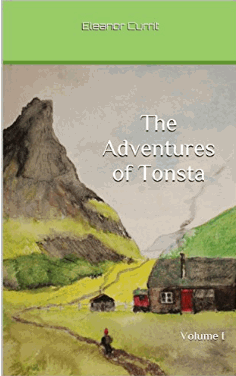


A perfect read aloud storybook
for little boys or girls.
The Adventures of Tonsta highlight the travels of a very young boy with a good heart, who goes about helping folk in trouble.
With a red cap on his head and a sack of tools slung over his shoulder, Tonsta seems to meet people in distress wherever he goes.
Lots of trolls in this book - including one who gives him a Christmas gift!
Music-for-Music-Teachers.com is a participant in the Amazon Services LLC Associates Program. As an Amazon Associate I earn from qualifying purchases.
COMMENT?
Please note that all comments are moderated, and will not appear until I have approved them, and that I never see your email. Also, IF YOU ARE ASKING FOR MUSIC THAT IS NOT IN THE PUBLIC DOMAIN, YOUR REQUEST WILL BE IGNORED. That's pretty much any music written in the last 75 years...
About the Author

Hi, I'm Dana! (Say that like "Anna".) I'm the owner of Music-for-Music-Teachers.com, and a newer site, SingTheBibleStory.com.
Like some of you, I've been playing the piano since early childhood, and have added a few other instruments along the way, plus an interest in arranging and composing music.
You can find out more about me and the reason for this website at my About Me page.

Recent Articles
-
Unchained Melody Piano Sheet Music, Chords & Lyrics
Unchained Melody: an intermediate-level arrangement that captures the beauty & power of this song, in a version suited to piano. What do I mean? No triplets! -
Thank you so much for the rounds!
Hi Dana, I am just writing to thank you for the free rounds for singing -- I have put up my hand to lead folk songs and hymns for my Christian homeschool