The Pachelbel Canon in D,
in the Keys of D and C
The Pachelbel Canon in D is the probably the most popular classical music ever. Print out this free sheet music for piano -- your students (and their parents) will love it!
Please scroll down the page for the download links.
Is this music is beyond their playing level?
Then check out one of these other pages, shown below, because on this website there are FOUR different web pages of the Pachelbel Canon music:
Here are the 4 different "Canon" pages on this website:
1.
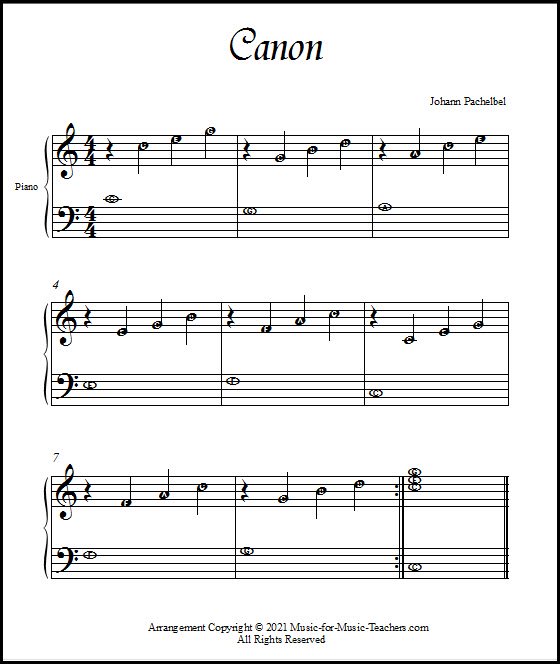
This page, Canon Sheet Music, features the very easiest arrangements of all, including a student-teacher duet.
Many versions, some with lettered notes.
2.
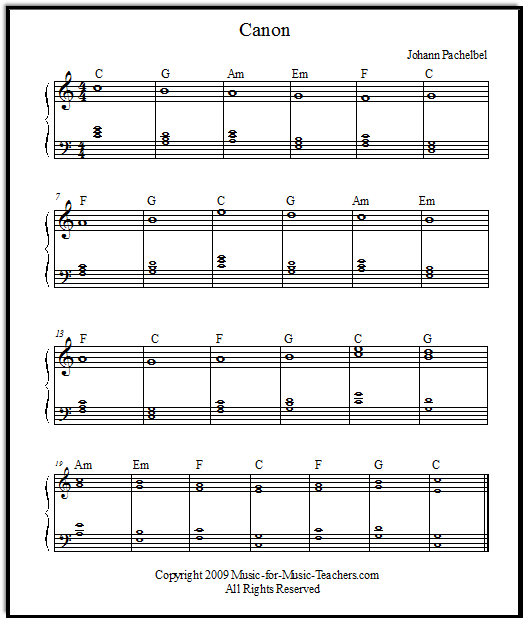
On the web page called simply "Canon," the basic melody of the Canon is paired with left hand triads, solid (as shown) and also broken.
The chord symbols are helpful for some students. But confusing for others! It is important for pianists to learn to interpret chord symbols.
3.
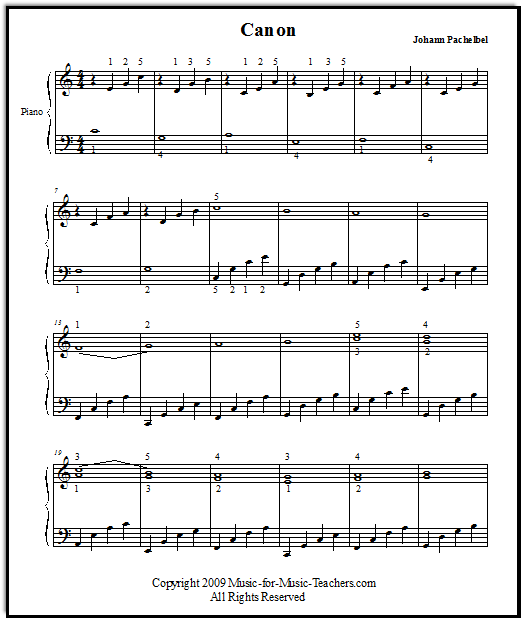
Here on this page called "Pachelbel Canon," you will find the Canon as you are accustomed to hearing it played at weddings!
Several arrangements including the original key of D.
4.
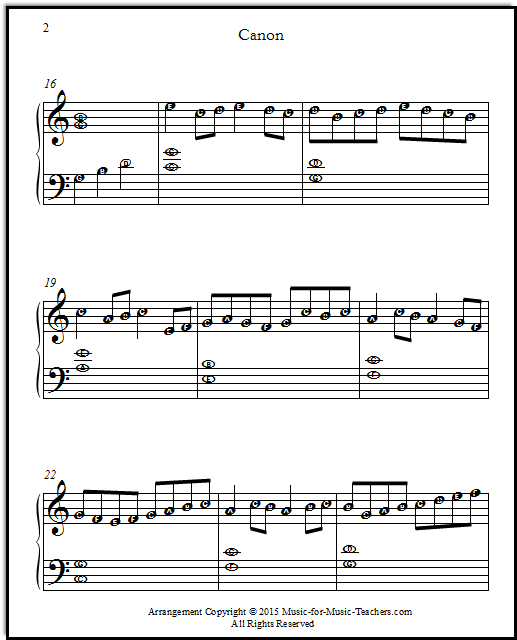
Here is the last Canon web page, called "Canon in D sheet music."
Page 2 of this arrangement is shown...
On this page of the Canon in D sheet music, you'll find ALPHANOTES (letters inside the music note-heads) in some or all of the note-heads of the music.
This arrangement was written to help an early reader conquer this piece.
It worked.
Now, back to what's on THIS page!
Here is the first arrangement (scroll down the page to see page 2 of the Canon, and also to find the free PDF download links):
Please scroll down the page for the download links.
Does your student know an inversion from a root chord?
To play these arrangements easily, it is best if the student is already acquainted with chord inversions.
Root position chords such as c-e-g become easy to spot after some experience, but when a C chord is "in disguise" (such as the combination e-g-c) or "scrambled," kids can find it quite baffling.
In the beginning of the Canon, almost every RH (right hand) chord is an inversion with a different shape from the chord before it. Help your student find PATTERNS in each hand.
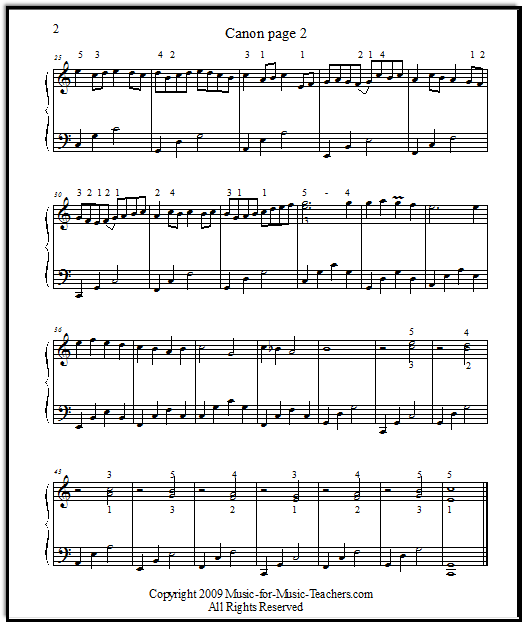
Page two:
Please scroll down the page for the download links.
What do I mean, look for patterns?
Here's the best example: the LH goes down 4 steps from C, then up 1, down 4, up 1, down 4, turn around 4, then up 1, and start over! There's always SOME kind of pattern if you look, some kind of trick to help your memory.
Careful fingering helps this arrangement work
The fingering in the tricky but beautiful middle section is really pretty good fingering. It even works in the key of D version with the black notes.
ALMOST CERTAINLY, your student will want to ignore this fingering, thus ensuring that they take 10 times longer to learn this section than they would otherwise!
Therefore, I suggest spending time playing short sections -- 2 or 3 measures of it -- over and over at lesson time; little, non-threatening amounts.
Don't load it on! Assign them LESS than you believe they can do -- then it will seem do-able to them.
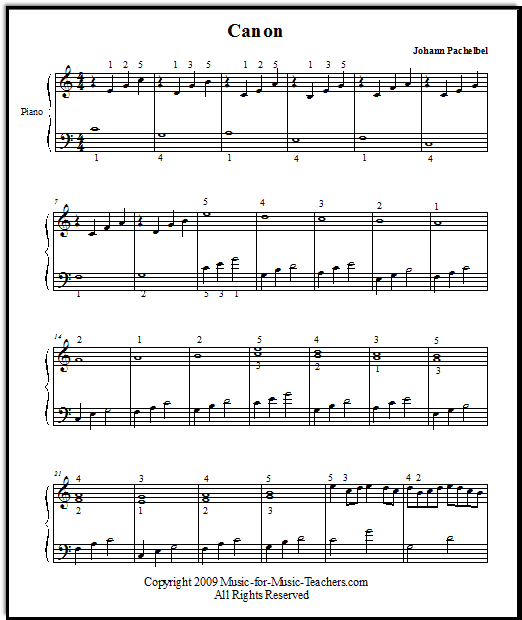
Here is a similar arrangement, but for small hands! Scroll down the page for page 2, and the free PDF download link:
Please scroll down the page for the download links.
Understanding chords means bigger-sounding music
There are many arrangements of this piece out there on the web. I like these versions of mine because they allow a player whose reading and coordination are still pretty elementary to play a big-sounding piece of music.
That is the value of knowing chords! They can be used like repeatable patterns.
Independence of hand movement
In much classical music, what makes even simple pieces hard for beginners is exactly the seeming ABSENCE of pattern.
Every finger seems to need a brain of its own, because the hands and fingers move independently.
That's where your students are headed. In the meantime, playing a beautiful-sounding piece like this motivates them to keep pushing!
Please scroll down the page for the download links.
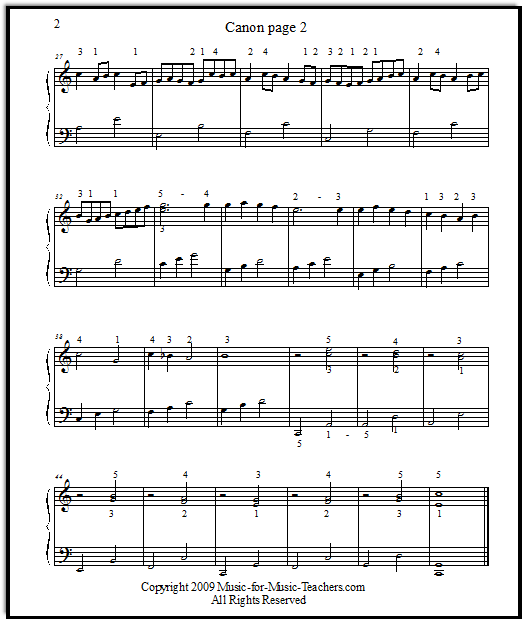
I recently had a question about measure 27 of this arrangement:
Question: "According to the score, at Bar 27, both hands have to play the same E4 at the last beat, which I don't know how to do."
Reply: " It is true that both hands will play that E note in the same measure.
"So the left hand must let go of the note early, in time for the right hand to play it, despite the fact that the half note indicates the E should be held down for 2 beats.
"Music writing is sometimes a bit of a compromise.
I could have written that left hand E as a quarter note followed by a rest, and that would be a more accurate portrayal of what must happen, but that would have been more musical symbols to interpret what's happening.
"I prefer to keep the measures consistent-looking and clean for beginning & early musicians."
The Pachelbel Canon is number one!
A classical radio station in Seattle used to have a Top 100 Countdown of the most popular classical pieces just before New Year's Day each year. Invariably, listeners voted the Pachelbel Canon number one!
The links for the downloadable piano PDFs:
Download free sheet music for Pachelbel Canon in the key of C
Here it is in its original key of D, but otherwise just the same as the C version.
Download Canon arrangement for small hands
Check out a fancy version of the Pachelbel Canon that even elementary students can play!
Recent Articles


-
When He Cometh "Jewels" Hymn: Piano, Guitar, Vocal
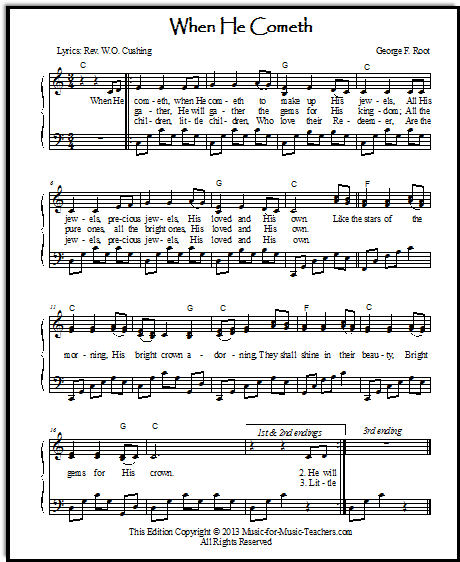 When He Cometh or "Jewels" is an old-timey sounding hymn. Very sweet & very simple, this is one your piano students & vocalists can learn from!
 -
Moonlight Sonata: How to Play This Piece Full of Black Keys & Triplets
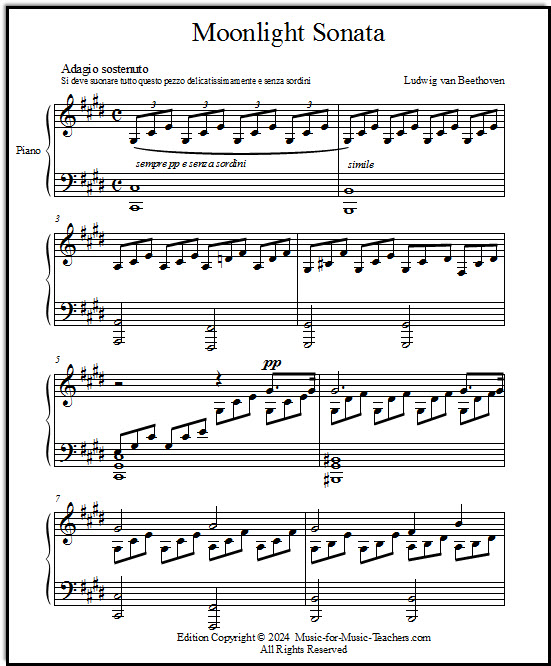 Moonlight Sonata: How to play this difficult piece full of black keys & triplets? Use large notes, lots of white space, & letters inside the note heads - easy!
 -
Bach Well-Known Pieces for Piano: the Musette in D, a Crowd-Pleaser!
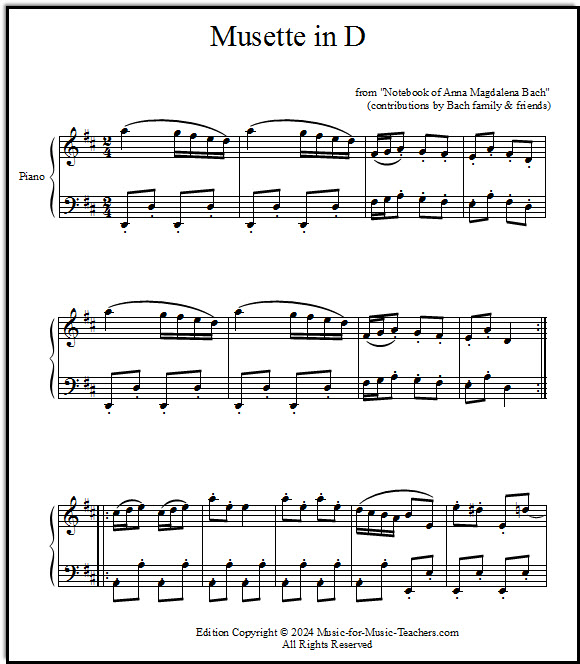 Some of the best Bach well known pieces include those from the "Notebook for Anna Magdalena Bach." Among piano pieces, "Musette" is perhaps the most joyous!
 -
Christ Arose Sheet Music: Resurrection Day Song for Piano or Guitar
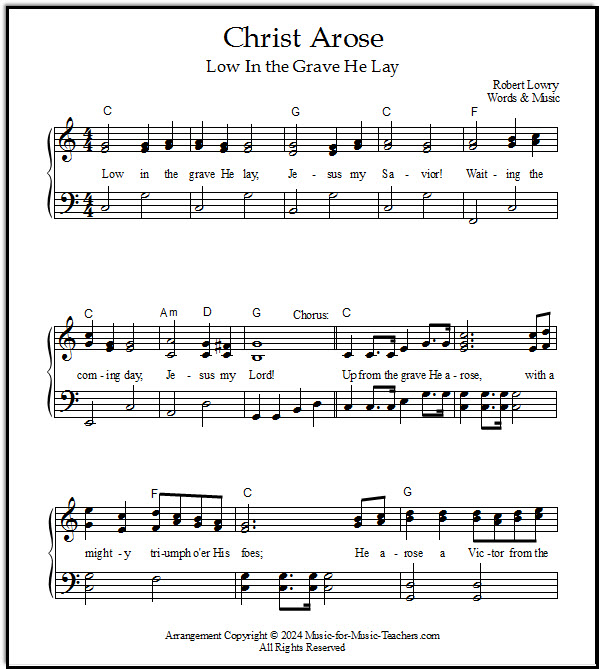 "Christ Arose" sheet music is perfect for Easter, or as many Bible believers say, "Resurrection Sunday." Mixing somberness & triumph, this song explains Easter.
 -
Sweet Hour of Prayer Hymn Sheet Music for Late Elementary Piano
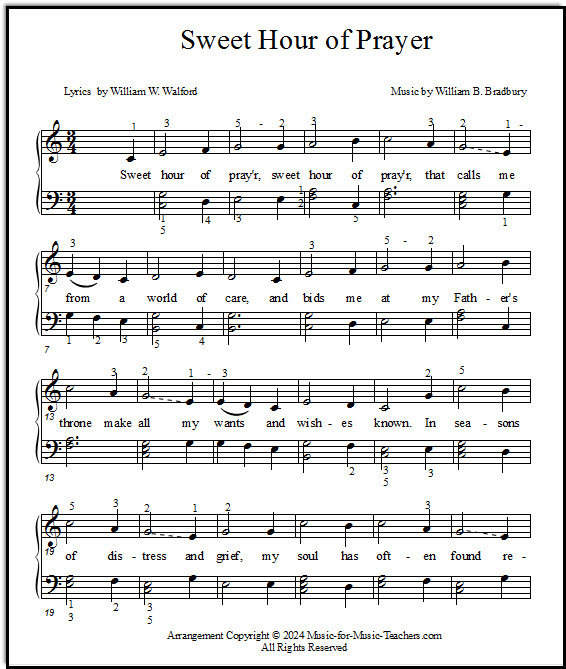 Sweet Hour of Prayer hymn music has been around a long time, and is greatly loved still. Check out 4 arrangements for beginning to elementary piano, & guitar!
Interested in songs from the Bible for your students or church? Check out my other website, SingTheBibleStory.com!
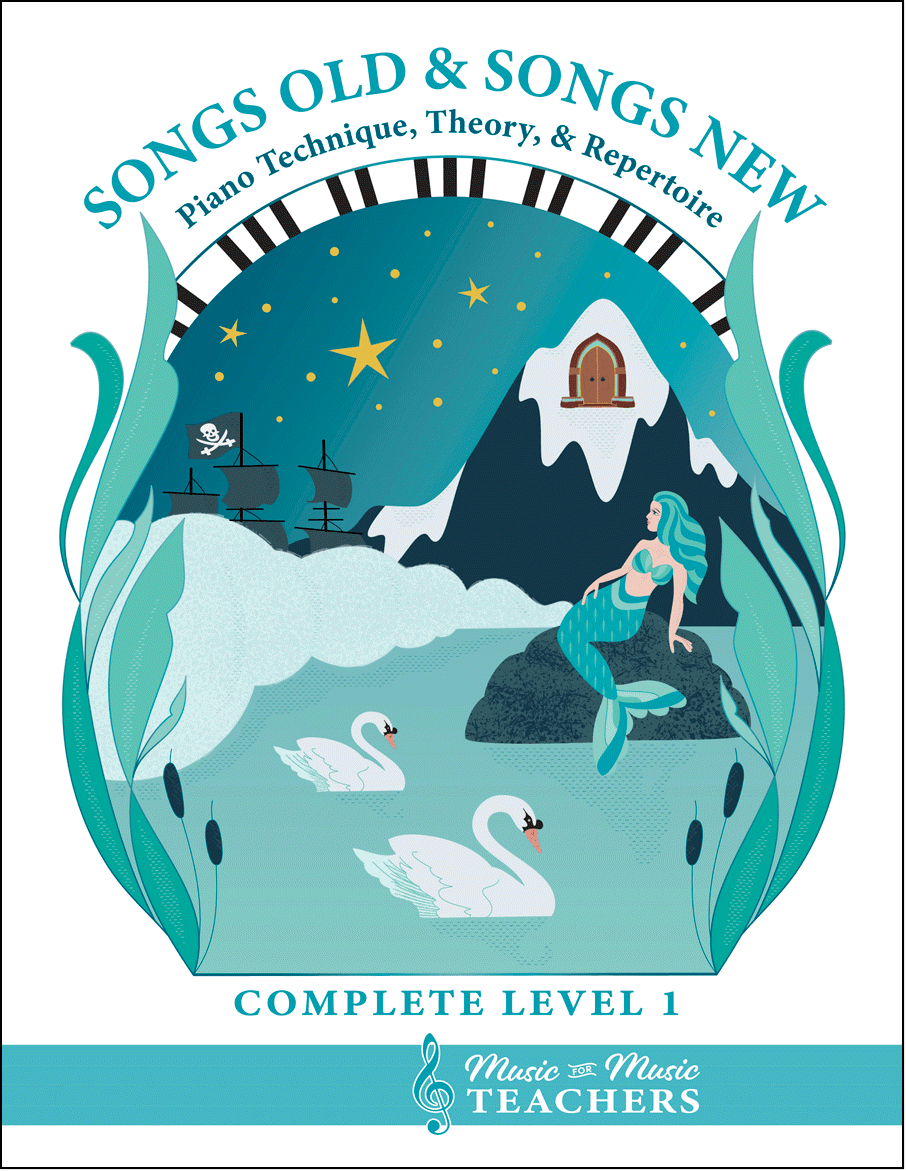
All the first-year material I give my beginner students.
Piano keyboard sheets, scales, chords, note-reading exercises, and over 256 pages of music!

This beautiful song book for piano & voice "Esther, For Such a Time as This", available as a digital download, tells the riveting story of the time when Jews in ancient Persia faced a foe named Haman, and how a brave young queen risked her life to save her people.
A good choice for a singing story-teller, an operatic group, a short theater production, or a class of children!
This book is also available from Amazon as a paperback.

This book is available as a digital download from this site. Visit this page to see some free examples from the book.
It is also available from Amazon as a paperback!
This is the perfect easy start for little pianists.
And when they start reading white-key notes on the staff, this is a fun easy resource to say each week, "Choose a new black-key song at home this week and figure it out to show me next lesson!" They will be spending more time at the piano.
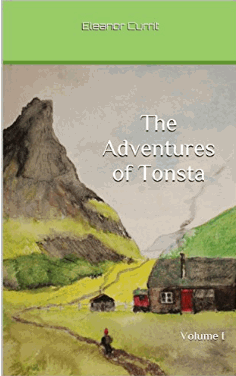
A perfect read aloud storybook
for little boys or girls.
The Adventures of Tonsta highlight the travels of a very young boy with a good heart, who goes about helping folk in trouble.
With a red cap on his head and a sack of tools slung over his shoulder, Tonsta seems to meet people in distress wherever he goes.
Lots of trolls in this book - including one who gives him a Christmas gift!


Becky:
A thousand thanks for your beginning piano and guitar songs.
I've already printed several for my children, including the Pretty Little Horses TAB and Carol of the Bells for piano. What a wonderful resource!
MusicGardenStudios:
This is an absolutely wonderful site!
As a voice and piano teacher looking for enrichment material for beginners, I have found your collections to be comprehensive and purposeful. It is clear that you are a wonderful musician and educator. Thank you!
Ashley:
Thank you so so much for this site!
I'm teaching my little sister and everything up here is absolutely amazing! I will definitely be making a donation as soon as possible! Thank you again! You're wonderful!
Bidur Kumar:
Thanks a lot for building such a nice site where people can easily find and free download sheet music for beginners. I am going to start teaching piano to kids.
I was just searching for some basic interesting songs for my pupil. Here, I found a wonderful site where I spent more than 3 hours and downloaded some music. Thanks again for making my day easier.
Sign up for "Take Note!" to see what's new every month.
Comments: Do you have a story or a question about music teaching? Share it!
Please note that all comments are moderated, and will not appear until I have approved them. Also, IF YOU ARE ASKING FOR MUSIC THAT IS NOT IN THE PUBLIC DOMAIN, YOUR REQUEST WILL BE IGNORED. That's pretty much any music written in the last 75 years...
What Other Visitors Have Said
Click below to see contributions from other visitors to this page...
Canon in C! 
Thanks for this post. I am a Celtic harp teacher, and I always start my students out with Pachelbel's Canon ... in C! We at least work on what you have …
About the Author

Hi, I'm Dana! (Say that like "Anna".) I'm the owner of Music-for-Music-Teachers.com, and a newer site, SingTheBibleStory.com.
Like some of you, I've been playing the piano since early childhood, and have added a few other instruments along the way, plus an interest in arranging and composing music.
You can find out more about me and the reason for this website at my About Me page.

Recent Articles
-
When He Cometh "Jewels" Hymn: Piano, Guitar, Vocal
When He Cometh or "Jewels" is an old-timey sounding hymn. Very sweet & very simple, this is one your piano students & vocalists can learn from! -
Moonlight Sonata: How to Play This Piece Full of Black Keys & Triplets
Moonlight Sonata: How to play this difficult piece full of black keys & triplets? Use large notes, lots of white space, & letters inside the note heads - easy!