Autism and Music
Autism and music do definitely go together, but it can be a challenge for the parents, the child, and the teacher.
Personally, I have teaching experience with only one child with autism, and another one with Asperger's Syndrome.
Teaching younger kids can be difficult enough, but special needs students require extra attention and patience.
My student with autism is charming and polite, and always willing to do what I ask. He is a storyteller, and loves to talk about his favorite things -- mostly the video games he's been playing, the cartoons he's been drawing, and what mischief his baby brother has been up to.
My piano student is not one of those "autistic savants" -- one of those individuals who perform brilliantly within a narrow specialization. He is just a nice kid who enjoys music, especially music with which he is familiar.
Though he is willing to take instruction, his autism means his processing time for questions and directions can be slow.
I have found that I can direct him to do something, but then I must wait for him to work it out...without interrupting his thinking with another comment.
If I do interrupt, he may have to start the process over again almost from the beginning, typical for children with autism.
This makes things pretty hard for him in public school (he does attend school currently), because he seems mature and is very high-functioning in a lot of ways...but he needs more time than kids without autism to work things out.
I have learned to curb my natural impetuosity and occasional flamboyant teaching style somewhat during his lessons, because he finds my enthusiasm more confusing than exciting.
Usually he doesn't understand humor as intuitively as other kids, so I can't always interact with him in just the same way as with other students. (Actually, this is true with ANY student -- a teacher finds that what works with one child finds no response in another child.)
Nevertheless, it is a pleasure to teach him and see him make progress.
My student struggles with rhythm. Where others count numbers evenly spaced ("1...2...3...4..."), he may count "1-2....1-2...1,1,1-2!" (Although lots of piano students in the first couple of years will do this, even past Level 1.)
Counting with a metronome, rather than helping, is terribly distracting for him.
Staying focused is very hard for kids with autism. His mother has told me that tree branches moving outside the window will also break up his concentration...and indeed I can see him struggling to re-focus numerous times during a lesson.
Hand gestures from me (as in a simple kind of conducting) work much better than a metronome to help him "hold" a half note for its 2 beats, or a whole note for 4 beats.
The music that seems to work best for my autistic student is music he has heard before in video games or movies, famous tunes such as Ode to Joy and Yankee Doodle, and very dramatic melodies such as the first phrase from Bach's Toccata in Dm. (He learned it by rote, one figure at a time.)

I suspect that my black keys songs would have been a very good start for him, but when he was a beginner I hadn't yet thought of writing these songs.
(I do use this book with not just younger children, but with older kids who seem to learn more slowly.
Their basic note values become second nature, not to mention fingers 2, 3, and 4.)
He LOVES the 12-Bar Blues, which is not really a song at all, but just a group of chords with a simple melody, a pattern that gets more and more complex as students' abilities increase and we add more to it.
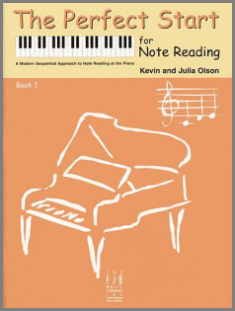
When the Fabers of FJH Music came out with their series "My First Piano Adventures," I took him out of the regular Primer ("the Purple Book," as we call it at my studio) and switched him to the B level book of the new series. It was pretty easy for him, giving him reachable goals from month to month. He tends to stay on the same couple of pieces for about 3 weeks. He is now in the C Book, over halfway through, and doing fine. (Update: Now I would have him in the series The Perfect Start for Note Reading, because the quirky graphics and song lyrics are more age-appropriate for him, and there is more repetition of the same notes over and over again. I'm really impressed by the series.)
It turns out that actual note-reading is not too hard for my student, though like a lot of kids, he finds it difficult to make changes and correct errors, once he has been playing a piece for a few days.
Therefore, introduction of new things must be done carefully and with enough time to do a thorough job! No waiting until the end of the lesson to pop something new on this boy!
His biggest problem seems to be a failure to "hear" how the song should be executed. Frequently, his pieces don't feel like they have a direction, a goal --it sounds more like his fingers are tapping computer keys, rather than one note leading to the next.
Unless he really likes a piece of music, he may not be focused enough to make it SOUND like music. But he CAN make some of his pieces sound musical.
His hand position is still not entirely what it should be. Though he has a decent arch in the shape of his hand posture, his finger number 5 is always wanting to curl under his palm, in a way I've never seen in any other student.
I tend not to try to fix everything in one lesson; this is a boy with a lot of challenges at school, and autistic kids can be prone to depression. I want him to improve, but I don't want to add to the burdens in his life.
Over the last few years, I've given him such music as the Pink Panther, Imperial March (from Star Wars), Spiderman, the James Bond Theme, the Batman Theme... you get the picture.
All these pieces were re-arranged by me into simple adaptations, with as rich a harmony as I could contrive that I felt wouldn't overwhelm my student. (I'm sorry I can't share them with you -- copyright issues-- but I am sure you can figure them out for your student yourself.)
He also loves Halloween music --it has mood, drama, a sense of story behind it. FJH's Spotlight I has a few fun Halloween pieces at the beginning of the book.
I have also written some easy and creepy-sounding Halloween pieces suitable for early readers, being right around Middle C position, which have been great favorites of his.
Over time, I have decided to teach my autistic piano-player pretty much the way I teach all my students, but more slowly, and with much more repetition.
One of the biggest lessons I have learned with him is:
Teach it the first time the way I want him to play it eventually. No simplified versions along the way to getting to the difficult version. His memory is too long, and apparently too inflexible.
For example, he learned the easiest version of Hark How the Bells (Carol of the Bells, or Ukrainian Bell Carol) in which the left hand takes the primary motif. Then,some time later, I decide it was time for him to learn the regular "easy" version. WRONG!
Despite careful preparation each week with the new version and the rhythmic motif in the right hand, lesson after lesson he would come back, look at the new music, and play the old version! I decided it was not a good use of our time, and that we will re-visit the song MUCH later.
I made the same mistake with the 12-Bar-Blues, giving him an easier, but different right hand part than I gave my other students, knowing we would eventually switch.
Again, bad idea. He had a hard time letting go of the old pattern, because it was so ingrained (and he liked it).
This time I persevered, treating the piece as a duet between him and me, and at last we won through.
One week, he finally played the basic pattern for me, WITH SYNCOPATION, just as well as any other student. Now the door to using all of the blues scale is opening for him.
The summer before he entered the 6th Grade of public school (age 11 or so here in the U.S.) I was a little concerned about the mandatory band requirement.
While I would not want to say that any child with a desire to be in a musical group should be persuaded not to join, I was worried about the attitude of the other kids when he failed to keep the beat. This is an important consideration in a band!
It is hard to balance the needs of an individual child against the aims of a group which necessarily aims for precision.
Of course, beginning bands rarely sound like precision machines.
But my student with autism feels very keenly the disapproval of other school kids, and it is a source of depression for him... potentially a dangerous situation. (Some kids with autism can become suicidal.)
His parents --apart from any input from me-- decided against his joining band and persuaded the school to give him another option.
My student with autism really does enjoy conquering a piece and playing it with energy. He doesn't polish most of his music, and I probably give him too much to work on, but he steadily improves.
Without lots of review, he does lose his old pieces (well, don't they all?).
I would like to hear strategies from other teachers, or know how they encourage growth in their children with autism... so if you are willing to share your story or your questions with me and visitors to this site, please make use of the invitation form below!
To read what others have said about their experiences with music and autistic children, please scroll all the way to the bottom of this page.
The following video is a fascinating interview (part 1 of 6) between Dr. Natasha Campbell-McBride (MD, neurology & nutrition) and Dr. Mercola of www.mercola.com, The World's #1 Natural Health Website. Her own son was diagnosed with autism at the age of three, and she hit the ground running, so to speak, to find answers.
What she has to say about a compromised digestive system that fails to nourish the body, and instead turns food into toxicity for the body, was initially eye-popping, at least for me.
But by now , everyone has heard of how gut problems compromise total health, including the central nervous system.
It is Dr. Campbell-McBride's contention that many afflictions which bear different names, such as epilepsy, schizophrenia, depression, ADHD and ADD, as well as dyslexia and dyspraxia, all share a common origin with autism -- the condition of the digestive system.
Her book deals not with the symptoms of these challenges, but with going to the source and changing the health of the gut.
If you would like to go to the page on YouTube.com that contains the rest of the six videos, CLICK HERE. You may also wish to check out her book, Gut and Psychology Syndrome: Natural Treatment for Autism, Dyspraxia, A.D.D., Dyslexia, A.D.H.D., Depression, Schizophrenia.
And please check out "Vaxxed" the movie if you haven't yet watched the story of CDC (Centers for Disease Control and Prevention) whistleblower Dr. William Thompson.
Dr. Thompson claims the members of his study team at the CDC (Centers for Disease Control and Prevention) were ordered in 2004 to bring a trash can and destroy all their documents regarding the potentially harmful effects of the MMR vaccine (measles/mumps/rubella).
Contrary to the understanding of most parents and the general public (and sadly, the medical profession too), the MMR is the ONLY vaccine that has been studied in any depth by the U.S.'s own researchers.
And that study was fraudulent, according to Dr. William Thompson, the CDC whistleblower whom Congress still delays calling upon (being a government employee still, he cannot testify against the CDC unless Congress subpoenas him... he has been waiting since 2014, while still working at the CDC).
And from a paper by Dr.Theresa Deisher, discoverer of human adult stem cells,
"The perceived link between childhood vaccines and autism has generated significant press and controversy since 1992. The suggested link has been, and is today, the MMR vaccine. Since 1983, the MMR vaccine in the US has only been produced using aborted fetal cells.
"Coincidentally, severe autism began to rise in the US in 1983, increasing from less than 1 child per 10,000 to 16-17 children per 10,000 (or about 1 in 500) by 1990.
"The aborted fetal produced MMR was introduced to the UK almost a decade later, and an immediate rise in autism levels was noted, which led to the suspected link between the vaccine and autism."
Please visit my other pages with additional information about teaching techniques that can be useful when teaching children with autism, and for finding a teacher for your child:
ARE YOUR FEELINGS HURT BY THIS PAGE?
Recently I received a letter from a reader from the UK, who took me to task for spreading "anti-vax propaganda." This person said,
"Why do you have emotive, anti-vax propaganda on a music website? The UK does not use 'aborted embryos' to manufacture MMR. I doubt the US does either. Pig gelatin is the carrier ingredient, and those with faith objections can choose a different vaccine (MMRVaxPro) to avoid this."
I replied to this reader:
I AM very emotional about vaccine damage, which is covered up and denied by both your government and mine.
When I say that aborted human fetal tissue is used to manufacture MMR (and other live virus vaccines such as Hepatitis A, rabies, shingles, and chickenpox, known as varicella - which I understand you are lucky enough NOT to endure in the UK -) I am quoting directly from the U.S. CDC's own list of vaccine ingredients called the Vaccine Excipient & Media Summary Table. Here is a link:
https://www.cdc.gov/vaccines/pubs/pinkbook/downloads/appendices/b/excipient-table-2.pdf
The CDC stands for "Centers for Disease Control and Prevention". This excipient list used to be 4 pages long, but is shorter now, because as people "wise up" to what the ingredients are, the CDC is surreptitiously dropping off mention of some of them, bit by bit.
I have a 4-page Table from 2017 that includes MORE ingredients, including the human fetal tissue elements, which can be identified by the terms "human albumin," "MRC-5", "human diploid cells", and "WI-38". The MRC-5 was a little boy; the WI-38 was a Swedish baby girl.
(And who wants pig gelatin in an injected product anyway? Neither kosher nor halal.)
You are mistaken about the MMRVAXPRO - it does indeed have human fetal residue - a very quick search online brought me to this UK site:
https://www.medicines.org.uk/emc/product/6307/smpc
(See where it says "produced in WI-38 human diploid lung fibroblasts.")
1. Name of the medicinal product
M-M-RVAXPRO® powder and solvent for suspension for injection in pre-filled syringe
Measles, mumps, and rubella vaccine (live)
2. Qualitative and quantitative composition
After reconstitution, one dose (0.5 ml) contains:
Measles virus1 Enders' Edmonston strain (live, attenuated) ……….not less than 1x10³ CCID50*
Mumps virus1 Jeryl Lynn™ [Level B] strain (live, attenuated)………not less than 12.5x10³ CCID50*
Rubella virus2 Wistar RA 27/3 strain (live, attenuated) ………………….not less than 1x10³ CCID50*
*50% cell culture infectious dose
1 produced in chick embryo cells.
2 produced in WI-38 human diploid lung fibroblasts.
The vaccine may contain traces of recombinant human albumin (rHA).
This vaccine contains a trace amount of neomycin. See section 4.3.
Excipients with known effect:
The vaccine contains 14.5 mg of sorbitol. See section 4.4.
For the full list of excipients, see section 6.1.
I appreciate that your passion about this issue led you to write to me, but you apparently haven't been moved to do even the minimum of research. It is very hard to have one's world view challenged - I get that. It is cognitive dissonance - a paradigm shift.
Right now, it is you who are believing propaganda. Once I was where you are.
I wish you luck in going down this rabbit hole, or I challenge you to PROVE ME WRONG. Bare assertions are not enough.
Thanks for writing,
Dana
SO, DEAR READERS, IF YOUR FEELINGS ARE HURT...
...LET THOSE FEELINGS ROUSE YOU TO DO A BIT OF RESEARCH.
I care less about offending people than I do about the lives of families with autistic members. I cannot begin to imagine the hardships and sorrows of living with children who can never reach the potential they were born with.
Another recent letter
N. R. M. Roshak:
Thank you for the music teaching resources! I wanted to write to let you know of a mistake on this page in the NON-musical, NON-teaching discussion. You wrote:
"I have a 4-page Table from 2017 that includes MORE ingredients, including the human fetal tissue elements, which can be identified by the terms "human albumin," "MRC-5", "human diploid cells", and "WI-38". The MRC-5 was a little boy; the WI-38 was a Swedish baby girl."
First, you are absolutely correct that the original cells for the WI-38 and MRC-5 cell lines came from a aborted fetuses. WI-38 is a cell line created from a 3-month-old aborted fetus, and MRC-5 from a 2-week-old aborted male fetus. They were both created in the 1960s, before "ethics review panels" were a thing. The two fetuses weren't aborted for vaccine reasons, and these cell lines weren't created for vaccines; but cells descended from them (by many, many, many generations!) are now used to grow viruses for vaccines. (These cell lines are also used for other medical research as well.)
The mistake I'm writing you about is that these WI-38 cells are not INCLUDED in the vaccine. They are used to produce the viruses that go into the vaccine. You can see this in the ingredients list you quoted:
"Measles virus1 Enders' Edmonston strain (live, attenuated) ……….not less than 1x10³ CCID50*
Mumps virus1 Jeryl Lynn™ [Level B] strain (live, attenuated)………not less than 12.5x10³ CCID50*
Rubella virus2 Wistar RA 27/3 strain (live, attenuated) ………………….not less than 1x10³ CCID50*
*50% cell culture infectious dose
1 produced in chick embryo cells.
2 produced in WI-38 human diploid lung fibroblasts."
Please note that it says "produced in" WI-38 human diploid lung fibroblasts. To make the vaccine, they first make a cell culture of these lung cells, then infect the culture with the virus. Only the virus goes into the vaccine, not the cells themselves. (https://en.wikipedia.org/wiki/Use_of_fetal_tissue_in_vaccine_development)
Thank you again for the resources!
Dana:
Thank you for your thoughtful letter, N.R.M! I appreciate your perspective, and I respect the time and effort that you took to look into this difficult issue.
However, I'm not in error. If you had read my comments a bit more carefully, you would have noticed that I DID say, "See where it says 'produced in WI-38 human diploid lung fibroblasts.'"
Nevertheless, the CDC excipient table (https://www.cdc.gov/vaccines/pubs/pinkbook/downloads/appendices/b/excipient-table-2.pdf) does say of the chickenpox vaccine Varivax,
"MRC-5 human diploid CELLS, including DNA & protein, sucrose, hydrolyzed gelatin, sodium chloride, monosodium L-glutamate, urea, sodium phosphate dibasic, potassium phosphate monobasic, potassium chloride, neomycin, bovine calf serum".
The shingles vaccine is very similar, with "MRC-5 human diploid CELLS, including DNA & protein" at the beginning of the list of ingredients.
Why does the CDC say that actual cells are part of the vaccine? I don't know.
Even if the fetal tissue was only a part of a process, it is impossible to completely purify the final product.
Dr. Theresa Deisher of SoundChoice.org maintains that the level of fetal human DNA left behind in childhood vaccines is more than the amount needed to get labor going - and plenty to cause autoimmune issues. See her comment in the paper "An Open Letter to Legislators Regarding Fetal Cell DNA in Vaccines" (https://www.soundchoice.org/open-letter-to-legislators/):
Merck’s MMR II vaccine (as well as the chickenpox, Pentacel, and all Hep-A containing vaccines) is manufactured using human fetal cell lines and are heavily contaminated with human fetal DNA from the production process. Levels in our children can reach up to 5 ng/ml after vaccination, depending on the age, weight and blood volume of the child. That level is known to activate Toll-like receptor 9 (TLR9), which can cause autoimmune attacks.
To illustrate the autoimmune capability of very small amounts of fetal DNA, consider this: labor is triggered by fetal DNA from the baby that builds up in the mother’s bloodstream, triggering a massive immune rejection of the baby. This is labor.
It works like this: fetal DNA fragments[i] from a baby with about 300 base pairs in length are found in a pregnant mother’s serum. When they reach between 0.46– 5.08 ng/mL, they trigger labor via the TLR9 mechanism[ii]. The corresponding blood levels are 0.22 ng/ml and 3.12 ng/ml. The fetal DNA levels in a child after being injected with fetal-manufactured vaccines reach the same level that triggers autoimmune rejection of baby by mother.
Anyone who says that the fetal DNA contaminating our vaccines is harmless either does not know anything about immunity and Toll- like receptors or they are not telling the truth.
If fetal DNA can trigger labor (a naturally desired autoimmune reaction), then those same levels in vaccines can trigger autoimmunity in a child. Fragmented fetal DNA contained in vaccines is of similar size, ~215 base pairs.[iii]
This is direct biological evidence that fetal DNA contaminants in vaccines are not in low innocuous amounts. They are a very strong proinflammatory trigger.
Administration of fragments of human fetal (primitive) non-self DNA to a child could generate an immune response that would also cross-react with the child’s own DNA, since the contaminating DNA could have sections of overlap very similar to the child’s own DNA.
Children with autistic disorder have antibodies against human DNA in their circulation that non- autistic children do not have. These antibodies may be involved in autoimmune attacks in autistic children.
Is This a Moral Issue?
Even if the presence of human DNA in vaccines wasn't harmful to the recipient's body, there are many who feel strongly that the use of fetal tissue is abhorrent and immoral. I feel that way.
And it is not an issue of old, "immortal" cell lines from 50 years ago... the harvesting of babies for their body parts and tissue is ongoing.
Even upcoming vaccines apparently in development right now for the current perceived crisis in our country (I'm writing in April 2020) by Johnson and Johnson and Moderna will be using fetal cell lines, new and improved!
See the headlines at Children of God For Life.
Sadly, we have been lied to for YEARS.
The chief scientist of W.H.O. (World Health Organization), back before COVID. Here she is stating in a Public Service Announcement that vaccines are safe, and then 5 days later saying the opposite at a summit:

Sites for More Info on Teaching Music to Kids on the Spectrum:
My Child Has Autism: How Can I Find a Music Teacher?
AutismOneMedia YouTube channel - a source of medical, legal, and political education
Autism & Interactive Toys, by Helen Nichols
Dianna:
Your website is a light in the darkness. THANK YOU for all you do in helping to spread the love of music. It matters!
Recent Articles


-
One Hand Alone Piano Music for Beginners: How Can You Find It?
 One hand alone music for beginning piano students is pretty hard to find. Here are some suggestions for sources of piano music.
 -
Down by the Salley Gardens: Sheet Music for Singers & Instrumentalists
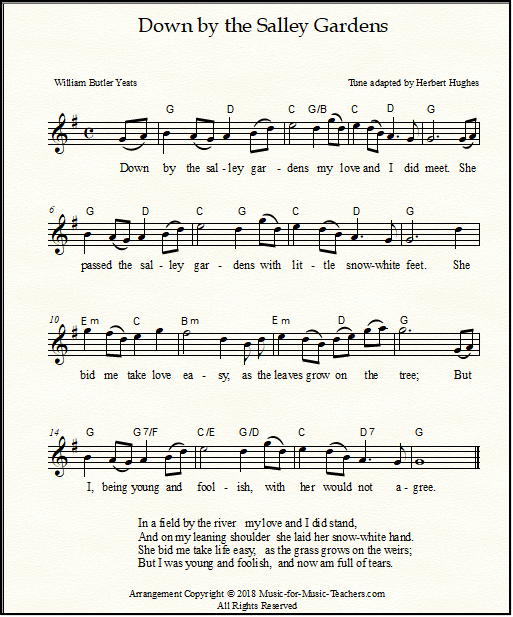 Down By the Salley Gardens is a pretty song from the British Isles with poetry by William Butler Yeats. Download piano, vocal, & lead sheets for your students!
 -
Star-Spangled Banner: Free Sheet Music & Lyrics for All Instruments
 Star-Spangled Banner free sheet music. Now with a singer's "find-your-pitch" exercise! America's national anthem in 7 keys, & lyrics for 1 or all 4 verses.
 -
Guitar Tabs for Beginners "Pizza Please" (Hot Cross Buns): 1st Lesson!
 Guitar tabs for beginners "Pizza Please" is really just Hot Cross Buns in disguise. This all-on-one-string free guitar sheetmusic is perfect for new beginners!
 -
Made-Easy Notes for Beginners: Pirate Song "Yo Ho Ho!"
 Made-easy notes for beginner pianists, "Yo Ho Ho!" is a fun song with a strong melody. With versions for three skill levels, you'll find one for your student!
Interested in songs from the Bible for your students or church? Check out my other website, SingTheBibleStory.com!
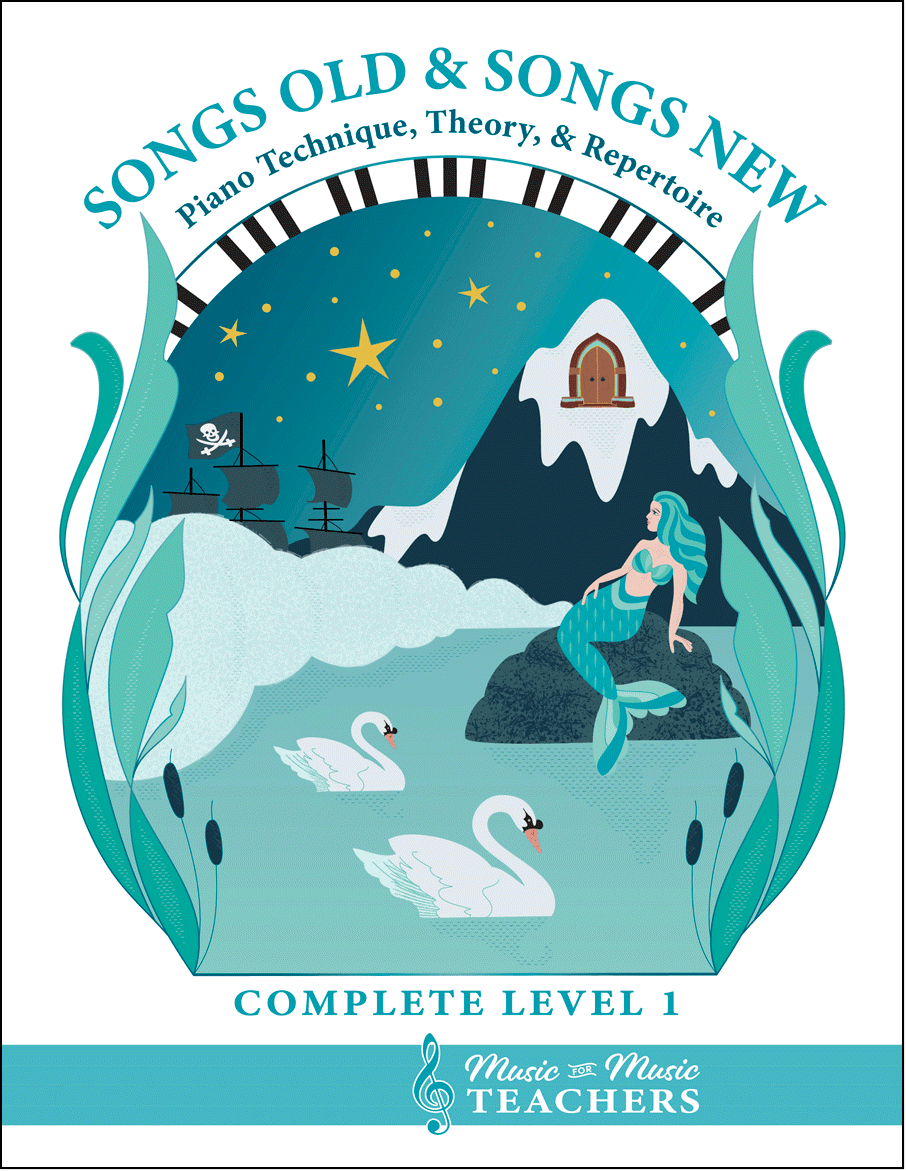
All the first-year material I give my beginner students.
Piano keyboard sheets, scales, chords, note-reading exercises, and over 256 pages of music!
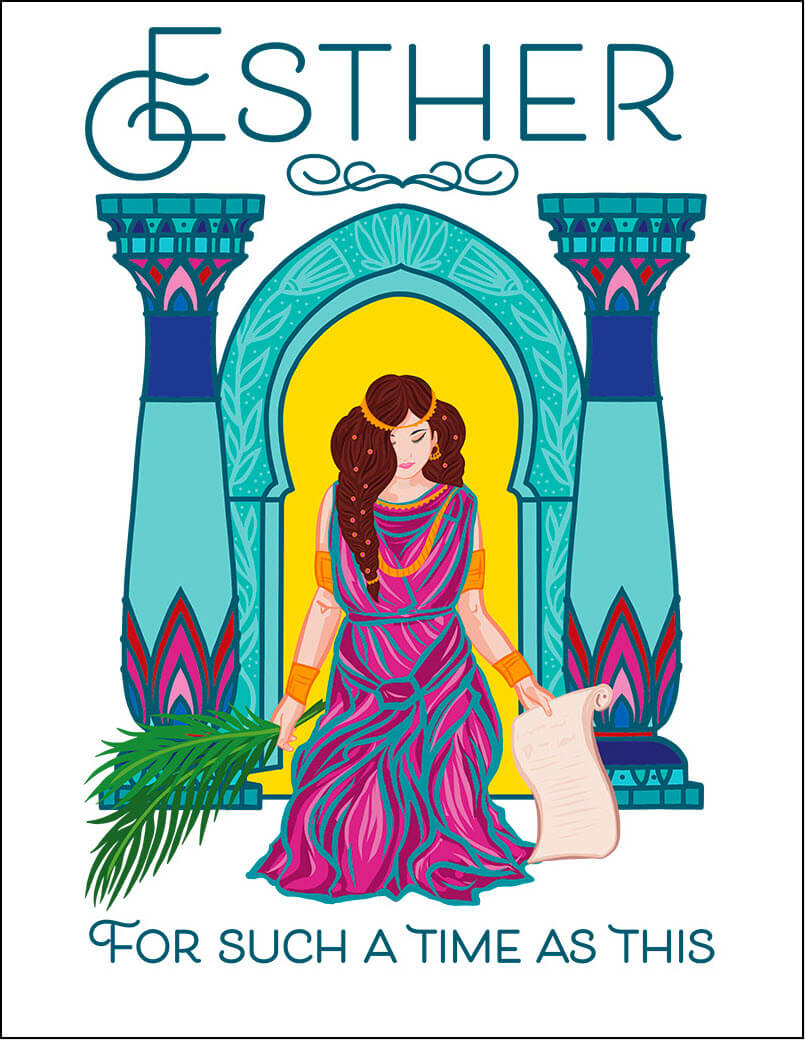
This beautiful song book for piano & voice "Esther, For Such a Time as This", available as a digital download, tells the riveting story of the time when Jews in ancient Persia faced a foe named Haman, and how a brave young queen risked her life to save her people.
A good choice for a singing story-teller, an operatic group, a short theater production, or a class of children!
This book is also available from Amazon as a paperback.
This book is available as a digital download from this site. Visit this page to see some free examples from the book.
It is also available from Amazon as a paperback!
This is the perfect easy start for little pianists.
And when they start reading white-key notes on the staff, this is a fun easy resource to say each week, "Choose a new black-key song at home this week and figure it out to show me next lesson!" They will be spending more time at the piano.
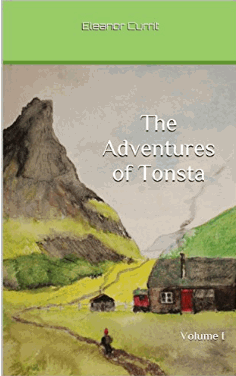


A perfect read aloud storybook
for little boys or girls.
The Adventures of Tonsta highlight the travels of a very young boy with a good heart, who goes about helping folk in trouble.
With a red cap on his head and a sack of tools slung over his shoulder, Tonsta seems to meet people in distress wherever he goes.
Lots of trolls in this book - including one who gives him a Christmas gift!
Comments
Have you got experiences, insights, knowledge or just plain frustrations to share with others who teach music to these special kids? Perhaps you have books, articles, or websites to recommend, techniques you've found helpful, or a success story! Every additional bit of information is helpful to those seeking for solutions...
What Other Visitors Have Said
Click below to see stories or questions from other visitors to this page...
Should I Even Bother Trying to Re-Learn Piano, Or Is It a Waste of Time? 
Comments or Questions:
I was just reading about autism and music. I am recovering from a subarachnoid hemmorhage (bleeding in the brain) that ended …
Autistic guitar teacher on YouTube providing free lesson videos
My son has a friend who told him about this man on YouTube you gives free guitar lessons by posting instructional videos and lessons.
The best part …
I teach my own son with Aspergers
I've taught piano since I was a teen. I've taught all my kids piano since they were preschoolers.
My son was diagnosed with Aspergers a little over …
My Grandson: Music and Autism
I am in my 48th year of professional piano teaching (plus a couple more years of teaching before graduating college). On the light side, don't see me …
Finding the Right Music Teacher for My Musical Genius
I enjoyed reading your webpage and thank you for a list of your favorite resources and etc. I have a son that was diagnosed with a mild case of Autism …
Students with Autism Can Participate in Music Ensembles
I am a Special Education teacher in Texas and have worked with students with autism of all grade levels for many years. I would like to address your concern …
Autistic Student Can't Tell If Notes Are On Lines Or Spaces
I have been teaching a 9 year-old girl with autism for about a year. She knows the notes on the keyboard, but doesn't seem to be able to identify whether …
Teaching Non-verbal Children with Autism
I am currently a special education teacher in the public schools, working with children who in many cases have no functional speech and significant cognitive …
Could it be that Auspies can teach Auspies music better?
I'm 60. A business owner; a sign maker artist and self taught musician; many artists swing both ways between the two areas.
I have never been diagnosed …
Teaching Autistic Children Music...
I have exclusively taught autistic children music, both in school and privately for the past ten years.
Much of the information given in this article …
My Experience with Autism and Music
I have Asperger Syndrome myself. I started playing drums when I was 7. I am almost 16 now. I'm starting to play piano now.
Although I'm not a teacher …
Autism and the Role of Music
If you have a child with autism who enjoys music, should you do anything about it? Although many people would like to use music as therapy, as I’ve mentioned …
My First Experience Teaching an Autistic Student
Hi..
I am currently assigned to teach a teenage autistic student. In our previous lesson, I did not know that she was autistic and used a book from Alfred's …
Autistic Clarinet Student got to intermediate level, even did three successful exams
I taught a high-functioning autistic clarinet student for 5 1/2 years, between the time he was 11 to 16 years old. He did his Royal Conservatory of Music …
New Therapy for Autistic, Dyslexic, and ADD kids
For those interested in more information about helping kids with autism, dyslexia and ADD, I recommend the book, "Disconnected Kids" by Dr. Robert Melillo. …
Teaching Piano to an Autistic Seven-Year-Old Who Plays by Ear
I thought my 7 yr. old little Autistic piano student was progressing really well. I started with teaching her the number method. She learned all the …
Teaching Autistic Adults
Hi there,
Thanks for your story. I have just been offered a job teaching adults with autism the keyboards. I am qualified to grade 6 level ARBSM but …
With Aspergers Kids, Try singing your instructions and using videos
I have a very musical child with Aspergers - perfect pitch, good pianist and excellent harpist. She is just 11 now. Only goes to school part time - she …
After Two Years, Autistic Student Still Not Recognizing Notes
I have taught an autistic student for 2 years. He has progressed marvelously, but can't seem to get past the 3rd level. He can not recognize his notes …
Creating Music Lesson Plans for Three Autistic Students
Hello! I am currently licensed as a PK-6th grade teacher, and a board substitute for music at two elementary schools. I am naturally musical and creative, …
Piano by Color for the Very Young or for Low Functioning Autistic Children
Pamela:
I am a Music Therapist and piano teacher. I have worked with 23 autistic children (all ages, all levels) on keyboard and piano skills. Several …
Teaching an autistic with perfect pitch
Hello, I found your site looking for advice about teaching piano to an autistic child with perfect pitch.
I am talking about my son who is now almost …
Autistic non-verbal 6-year-old
I teach a very bright and musical 10-year-old boy in his home whose younger sister is autistic and non-verbal. She can hear and understand but does not …
How to Teach Piano to an Autistic 4-Year-Old?
I've been teaching piano for 17 years and recently I started teaching a 4 year old autistic boy. It's a first for me, I wouldn't normally take an autistic …
My Autistic Child
My daughter is two and a half and has just been diagnosed with autism spectrum disorder. She seems to be very drawn to music. As a piano teacher, this …
My Autistic Son Won't Practice for More Than a Few Minutes. 
I have a question, sort of, for the parents of your student.
My son started piano this year and really seems to like it. He has Asperger's, a high …
My Only Autistic and Wonderful Piano Student
I am currently teaching piano to a wonderful 9 year old young boy who has autism. He has a curiosity for music which is inspiring and contagious. He …
Just Beginning a Young Boy with Autism
I have just had a young boy scheduled to begin piano lessons, he has autism... I have never taught a autistic child and am looking forward to the experience. …
Where to Find A Good Teacher for My Autistic Son?
I am searching for a good teacher for my child, recently diagnosed Autistic at age nine. He has been learning to play piano for the past four years and …
When Speaking of Children with Autism...
Hello.
I really enjoyed browsing through your website. I am a music therapist and I work with individuals with special needs. You may want to consider …
A Thank You, and A Note About Wi-38 Not rated yet
Thank you for the music teaching resources! I wanted to write to let you know of a mistake on this page in the NON-musical, NON-teaching discussion. You …
Book written about teaching autistics piano students Not rated yet
Hi.
My name is Susan Rancer.
I am a Music Therapist and have been working with autistics and other disabilities all of my 44 years of my career. …
my aim is my brother life Not rated yet
my brother age is 17 i do know how to teach him a piano can you tell some tips pls mam/sir
Dana:
Hi, Aarthika, Please look at all the pages in the …
Teaching and Coaching 2 Autistic Kids Not rated yet
I have a home studio and just started teaching 2 autistic boys (one in high school, the other 8 years old) and, among my other 15 students, I also have …
Repetitive Behavior I Must Correct Not rated yet
Hi. I am glad I have found this page.
I have been teaching a young boy violin. . I took over the teaching 4 months ago and he was preparing for grade …
My Autistic Learner is Blind! Not rated yet
Please help. I am from South Africa, living in a small town in the middle of the Karoo with the name of Hopetown.
I'm trying to help a 9 year old blind, …
Asbergers and piano lessons Not rated yet
This has completely changed the way I am going to teach my children to play the piano. I have two kids with Asbergers and the things you listed are exactly …
Your songs and resources are going to help me out SO MUCH this year! Not rated yet
This website is saving me!
I teach students with multiple needs, including students on the autism spectrum. All of my students also have cognitive …
This Side of the Fence - Pupils With Autism See It Differently Not rated yet
Hi,
Reading your story, the thing that strikes me most is the problem you have presenting concepts step-by-step. "Allists" seem to have some fuzzy state …
Good Resources to Learn more about Music Therapy Not rated yet
For those of you looking for some books on the subject of music therapy / teaching music to people with special needs, here are some good ones that I have …
Teaching my son with ASD and significantly delayed understanding Not rated yet
Hi,
Thank you for your interesting page. I am currently teaching my nearly 5 year old son the piano. I wondered if I could get your opinion on how to …
Piano Lessons Have Been A Safe Place For Autistic Student Not rated yet
I have been teaching piano lessons for the last 25 years. For the past six years, I have been working for a non profit organization that provides free …
I just began teaching a little five year old boy with autistic-like features, brought on by a seizure disorder and AEDS. Not rated yet
The little boy I began teaching is five years old. He has difficulty communicating, and also has some motor difficulties. It is very challenging to get …
When Teaching Students on the Autism Spectrum Disorder, a Little Flexibility Really Helps Not rated yet
I run a private teaching studio with an average of between 10 to 15 high-functioning autism spectrum children having lessons each week. Most are boys …
Teaching a 7 year old girl with Autism/ADD Not rated yet
I have a piano student with Autism, a 7 year old girl. I started her with the Bastien piano method, and she was doing well, learned to read music. She …
Autism and the Role of Music: Part Two Not rated yet
After you’ve found the perfect piano teacher and taught your child the basic skills, he or she should be reading music and on the way to becoming an amateur …
My Asperger Daughter Found Music Not rated yet
At age 12, without having shown any previous interest in music, she took up the trumpet in band class. Her amazing focus - and difficulty in shifting focus …
My grandson KENAN Not rated yet
Hi,
Until age 7 my grandson Kenan did not speak a word and he was wearing diapers. He did not have any characteristics of autism like constant certain …
Setting Up a Singing/Music Group Not rated yet
Hello. I am a Speech and Language Therapy student in my third year of study. I am also a singer and a piano player and have been struck by the extent to …
Teaching Special Needs Children Not rated yet
Steve:
I've been working with children with autism for a long time. I would like to start giving music lessons to children with any kind of disablities. …
Music Therapists can offer you some extra insight Not rated yet
Hi all!
This is just an informational note :)
Music Therapists would be a great asset to all of you teaching children on the spectrum. We attend …
Teaching Autistic child who knows music but can't play what he knows Not rated yet
I have a question. I am a piano teacher who teaches beginners. I chose beginners because I believe in building a strong foundation.
All this changed …
Haydon the autistic baritone player Not rated yet
I am a music teacher in a secondary school in the UK.
Amongst my pupils I have a year 7 boy called Haydon who is a very good baritone player.
He …
Numbers & Jammin' Not rated yet
Hi all, I've worked with three autistic students and each had a different learning style. I did have to work fast and stay a step ahead to keep them focused. …
About the Author
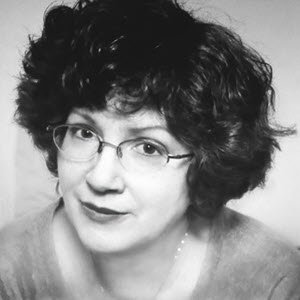
Hi, I'm Dana! (Say that like "Anna".) I'm the owner of Music-for-Music-Teachers.com, and a newer site, SingTheBibleStory.com.
Like some of you, I've been playing the piano since early childhood, and have added a few other instruments along the way, plus an interest in arranging and composing music.
You can find out more about me and the reason for this website at my About Me page.

Recent Articles
-
One Hand Alone Piano Music for Beginners: How Can You Find It?
One hand alone music for beginning piano students is pretty hard to find. Here are some suggestions for sources of piano music. -
Down by the Salley Gardens: Sheet Music for Singers & Instrumentalists
Down By the Salley Gardens is a pretty song from the British Isles with poetry by William Butler Yeats. Download piano, vocal, & lead sheets for your students!