O Mio Babbino Caro for Vocalists
Puccini's "O Mio Babbino Caro" is surely one of the loveliest opera arias of all time.
It is also fairly easy to learn the melody, and the notes are not too difficult, except for the octave leaps, which give the song such excitement.
My favorite video is sung by Anna Netrebko, who puts her whole self into the aria, looking like the most gorgeous Barbie Doll come-to-life.
Take advantage of the free opera sheet music I offer here as lead sheets, and also the for-sale collections of four different piano accompaniments and three - four different keys, to suit young voices. (Go here if you are looking for the standard arrangement - harder but very beautiful!)
Scroll down the page for the links to the FREE downloadable PDF links.
Please scroll down the page for the download links.
Easy to sing? What?
Now when I say "fairly easy to sing," I am of course not suggesting that it is easy to sing it like a professional opera singer - or that you would want your young singers to try to sing it that way!
I mean that even a young singer can "cotton on to" the melody.
This piece enjoys star status, even with non-classical singers. Your students will fall in love with it, especially if you show them the aria sung by a beautiful and glamorous opera singer.
You can use a lower key
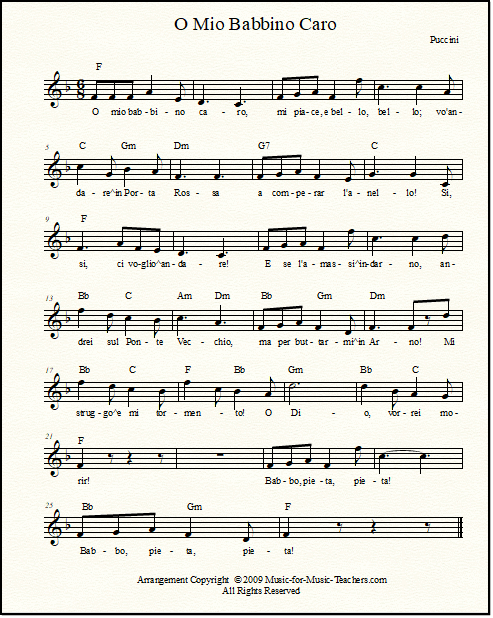
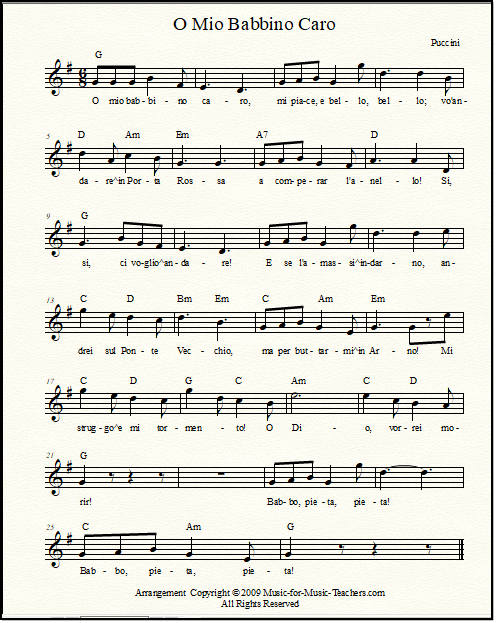
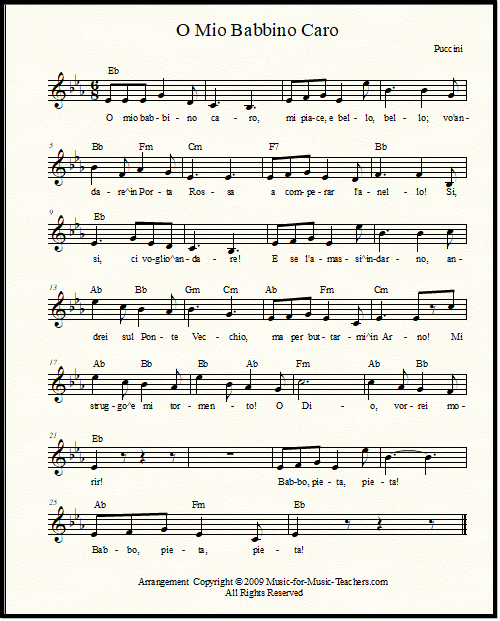
Originally written in the key of Ab, I have it here in that key as well as G, F, and Eb. The song is much more accessible for young girls in the lower keys!
Accessible - and safer
Don't let them force their voices to sing in a mature-sounding way.
The lead sheets
Please scroll down the page for the download links.
My simple melody-with-chord-symbols lead sheet is what I use for most singers, even at performances.
The standard arrangement - let's not fool ourselves - the standard arrangement is a handful, with its long harp-like broken chords and filled right hand octaves.
A too-heavy accompaniment?
But the difficulty of the accompaniment is not my primary objection to using it with young singers.
My primary objection is that it can be heavy with some pianists, and on some pianos!
You don't want accompanists all tangled up in a thicket of ponderous chords and big leaps when their eyes should be on the vocalist!
The key of Eb
Please scroll down the page for the download links.
The voice is the thing here, not the piano, so stay out of the way!
If you really want to play the regular accompaniment, many books of Italian favorites and opera music include it, or go here to download it from my website.
Piano accompaniment arrangements, for sale:
I also have several arrangements with piano accompaniments which I use, from simplest to most elaborate.
The easiest For-Sale arrangement, page one:

This easiest arrangement of O Mio Babbino for voice and piano is available as a set in the keys of Ab, G, F, and Eb (8 pages total) for $4.00 for the entire collection. Only four dollars!
So much beauty, so much musical joy... only $4, from PayPal. (The pdf document is delivered by E-Junkie.com.)
Buy O Mio Babbino, $4.00
Easiest Arrangement Four Keys Collection:

The next version has some right hand chords. These are most beautiful if lightly rolled like a glissando, however, I did not mark them glissando.
This arrangement is also for sale for $4 USD, as a collection with the keys of Eb, F, G, and Ab (the original key) - eight pages of music.
Easy left hand & thicker right hand arrangement, page two:
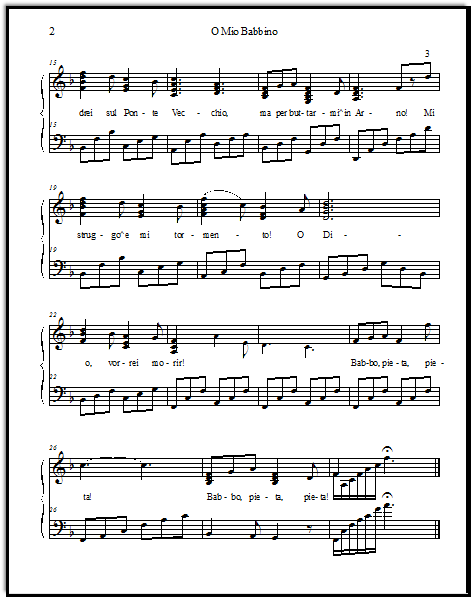
This easy/fancy collection of the keys of Eb, F, G, and Ab (the original key) is eight pages of music.
Buy O Mio Babbino, $4.00
Easy Left Hand & Fancy Right Hand
Four Keys Collection:
The third accompaniment version doubles the speed of the left hand chords.
They can be a stretch for some hands, and careful, planned fingering is necessary to make it work, unless playing chords like these is second nature to you.
Doubled speed in left hand, page one:
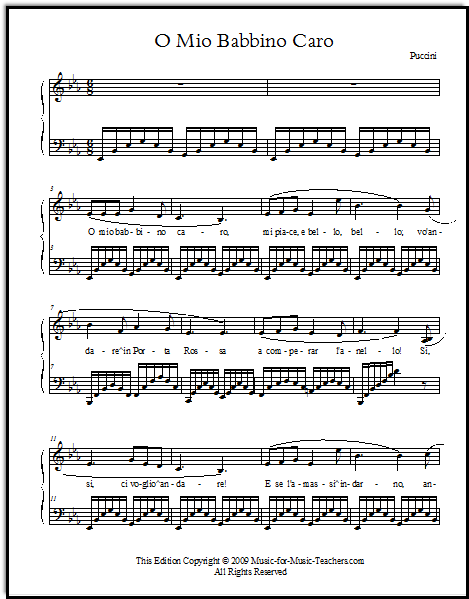
This fancy/easy collection of the keys of Eb, F, G, and Ab (the original key) is eight pages of music.
Buy O Mio Babbino, $4.00
Fancy Left Hand & Easy Right Hand
Four Keys Collection:
My 4th version of O Mio Babbino Caro, shown below, combines the full-sounding right hand with the faster-moving left hand. This is my preferred arrangement when accompanying young singers in a recital.
It is still easier than the standard arrangement which would overwhelm young voices:
Arrangement four, page two:
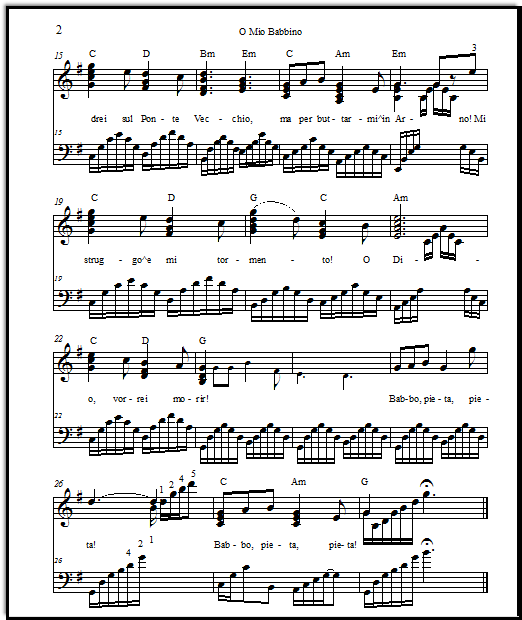
Buy fanciest arrangement of O mio babbino, with flowing left hand and full right hand, $5.00 for 3 keys (Ab, G, & F):
Or, you can buy all 4 arrangements - in 4 keys - plus the standard accompaniment (also in 4 keys) with the right to make unlimited copies for your students, for just $18!
Buy all FIVE arrangements in 4 keys:
So why should you buy one or all of these "O mio babbino" arrangements from me?
I give you permission to make UNLIMITED COPIES, for YOUR STUDENTS ONLY.
O mio babbino is available immediately as a digital download onto your computer.
You don't have to download any new software into your computer in order to download this PDF. I don't know about you, but I hate clogging up my computer with yet another program I didn't know I needed. You just need a version of Adobe Acrobat or another PDF reader, which all computers come with. If you DON'T have Adobe Acrobat or a similar program, then you couldn't download any of my other PDFs either.
The notes and lyrics are a little bigger than the copies currently available in music stores, making reading easier!
Speaking of reading the music, you can print this music on any kind of paper you want, and thus avoid the glare of shiny pages (so irritating for accompanists!).
Write and make notes all over these copies, in red and other colors, without feeling you are spoiling your music for posterity. I dislike messing up my music books, but learning the piece is always the first priority. These printouts will make great working copies.
Do you need a letter of permission in order to use this music at a competition? Write me through the Contact Me form, and I will email you a personal letter.
I give you permission to make unlimited copies legally (for your students only). When you need music, you usually need it NOW. Your accompanist, your soloist-student... let them have this music without fear of copyright infringement.
Paypal, the payment system I use, is a secure and recognized payment system. You can pay by credit or debit card, or your bank account. E-Junkie delivers the PDF document, working as a partner with PayPal...your purchase is guaranteed.
O Mio Babbino Caro is an EXCITING way to encounter Italian for the first time... I like to go over the meaning of each word so my students know what they're saying. Look up Gianni Schicchi if you don't know the story.
It's actually a comedy with a happy ending, in spite of poor Lauretta singing to her "dear Daddy" that she wants to die!
If you don't know how to pronounce Italian, for goodness' sake, get yourself some books or an Italian course! Or if you are able, enroll in an "in-residence" course for singers (and others) such as "Lingua e Canto," and see Italy at the same time!
Listen to Italians singing Italian. You need to be able to sing Italian decently for the sake of your students. (In older times, vocal teachers wanted more than just good pronunciation; they recommended personally translating each word of a foreign language song.)
This aria is a good workout for phrasing and breathing. You will probably need to write all over the music to remind your student or yourself where to breathe. On the long note, "Di-o," work with them to swell or crescendo, to put expression in.
Go here to find the standard (difficult!) piano accompaniment for O mio babbino...
The links to the FREE PDFs of vocal lines with no piano accompaniment:
Download free opera sheet music O Mio Babbino in Ab
Download melody of O Mio Babbino in G
Download melody of O Mio Babbino in F
Download melody of O Mio Babbino in Eb
Dianna:
Your website is a light in the darkness. THANK YOU for all you do in helping to spread the love of music. It matters!
Recent Articles


-
I'll Love My Love Piano/Violin Duet Sheet Music PDF
 A gorgeous piece from Gustav Holst's Second Suite for Band, arranged for two violins. Perfect for players learning 3rd position, wanting a lovely song. Free PDF
 -
Free Blank Guitar Chords Charts for Your Own Chords!
 Free guitar chord chart blanks for guitar teachers: fill in these printable blank chord charts for your guitar students.
 -
The Wellerman Sea Shanty Sheet Music: Piano & Leads!
 The Wellerman sheet music: tabs, chords & lyrics for piano, guitar, & lead! A fun sea shanty to sing & play - 7 versions, including one with note names.
 -
My singer is not properly caring for their voice
Hi, I’m Ms. Edinbourough, and I have a beautiful singer who is promising, and a star, but who isn’t taking care of her voice. She is not even able to sing -
Free & Easy Beginner Piano Songs Sheet Music PDFs
 This free piano sheet music PDF for beginners is really a fiddle tune! But don't tell your piano players, as it makes a rambunctious, easy piano duet!
Interested in songs from the Bible for your students or church? Check out my other website, SingTheBibleStory.com!
All the first-year material I give my beginner students.
Piano keyboard sheets, scales, chords, note-reading exercises, and over 256 pages of music!
Music-for-Music-Teachers.com is a participant in the Amazon Services LLC Associates Program. As an Amazon Associate I earn from qualifying purchases.
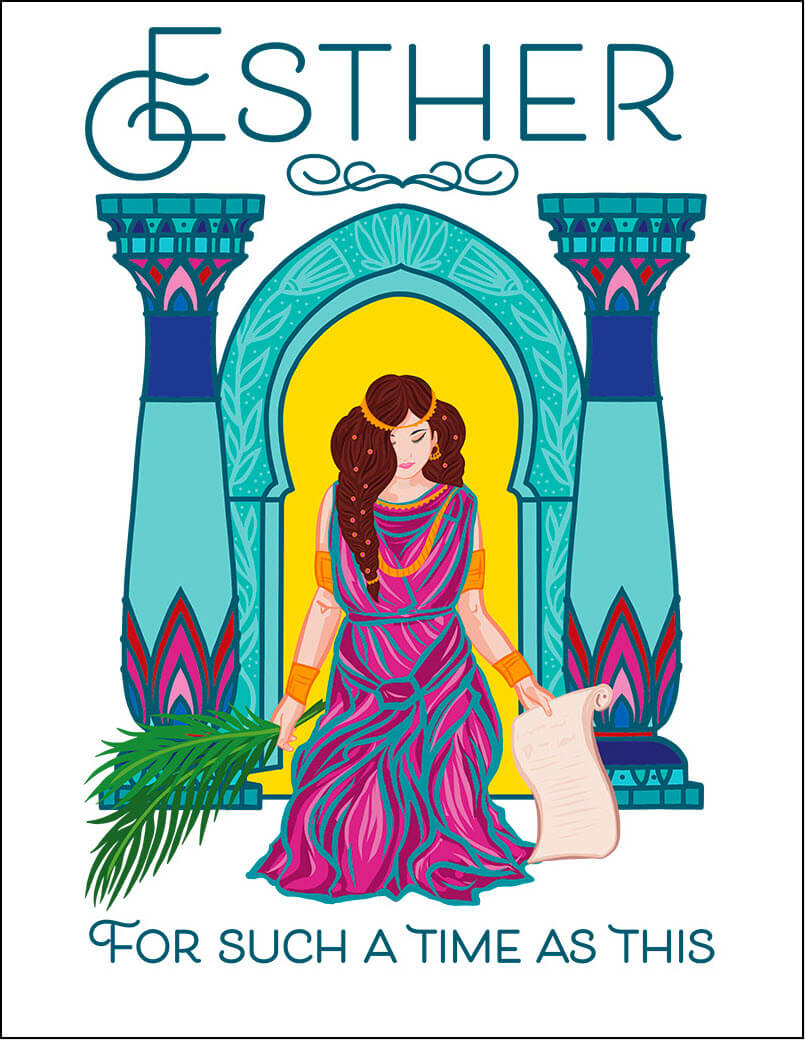
This beautiful song book for piano & voice "Esther, For Such a Time as This", available as a digital download, tells the riveting story of the time when Jews in ancient Persia faced a foe named Haman, and how a brave young queen risked her life to save her people.
A good choice for a singing story-teller, an operatic group, a short theater production, or a class of children!
This book is also available from Amazon as a paperback.
Music-for-Music-Teachers.com is a participant in the Amazon Services LLC Associates Program. As an Amazon Associate I earn from qualifying purchases.

This book is available as a digital download from this site. Visit this page to see some free examples from the book.
It is also available from Amazon as a paperback!
This is the perfect easy start for little pianists.
And when they start reading white-key notes on the staff, this is a fun easy resource to say each week, "Choose a new black-key song at home this week and figure it out to show me next lesson!" They will be spending more time at the piano.
Music-for-Music-Teachers.com is a participant in the Amazon Services LLC Associates Program. As an Amazon Associate I earn from qualifying purchases.
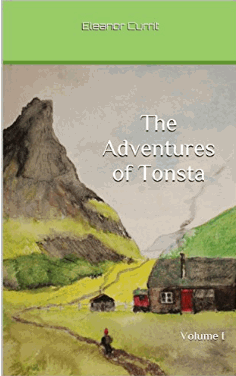


A perfect read aloud storybook
for little boys or girls.
The Adventures of Tonsta highlight the travels of a very young boy with a good heart, who goes about helping folk in trouble.
With a red cap on his head and a sack of tools slung over his shoulder, Tonsta seems to meet people in distress wherever he goes.
Lots of trolls in this book - including one who gives him a Christmas gift!
Music-for-Music-Teachers.com is a participant in the Amazon Services LLC Associates Program. As an Amazon Associate I earn from qualifying purchases.
Ben:
Hi Dana! I am just starting out teaching voice lessons and I have found so many invaluable resources on your website. Thank you so much!
Carrie,Voice and Piano Teacher:
This site is FABULOUS.
For all the reasons you explain on the site itself--this is exactly what piano teachers need! (I still need to go look at the vocal music). Wow. THANK YOU SO MUCH!
Comments
Do you have a funny story about this music, or does it remind you of something you'd like to share with other readers? Do you have a question? I'd love to hear it!
Please note that all comments are moderated, and will not appear until I have approved them. Also, IF YOU ARE ASKING FOR MUSIC THAT IS NOT IN THE PUBLIC DOMAIN, YOUR REQUEST WILL BE IGNORED. That's pretty much any music written in the last 75 years...
What Other Visitors Have Said
Click below to see contributions from other visitors to this page...
Practicing and Entering the World of Classical Music.
I a seventeen year old student who was recently taken in by a music conservatory to learn the arts of opera singing. It has been less than a year that …
Some girls sing it easier in high key
I just want to remark that for some very light voices songs are easier sung in a high key.
As a young girl I constantly had to fight the perception …
Stomach Pain When Singing
Rose:
My question is one of my students is having stomach pains on her right side while she is singing. Please tell me why is that happening, because …
About the Author

Hi, I'm Dana! (Say that like "Anna".) I'm the owner of Music-for-Music-Teachers.com, and a newer site, SingTheBibleStory.com.
Like some of you, I've been playing the piano since early childhood, and have added a few other instruments along the way, plus an interest in arranging and composing music.
You can find out more about me and the reason for this website at my About Me page.

Recent Articles
-
I'll Love My Love Piano/Violin Duet Sheet Music PDF
A gorgeous piece from Gustav Holst's Second Suite for Band, arranged for two violins. Perfect for players learning 3rd position, wanting a lovely song. Free PDF -
Free Blank Guitar Chords Charts for Your Own Chords!
Free guitar chord chart blanks for guitar teachers: fill in these printable blank chord charts for your guitar students.