My Favorite
Broadway Musicals List
My favorite Broadway musicals list (and Hollywood movie music too!) features the Broadway songs I have personally found to be most singable, easily learned, and beloved among my own students.
A couple of the mentions, I admit, are MY favorites that I keep pushing on them hopefully, but you will see which ones those are.
My commentary also points out a few pitfalls and special challenges I have encountered with some of these Broadway books...
For those of you who are new at teaching voice, just beginning to feel your way with young voice students, or who are pondering which Broadway books will give you the most value for your dollar -- you will find this page helpful!
ANNIE
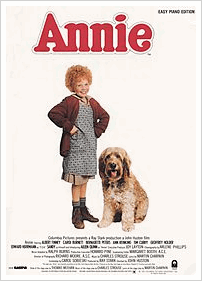
Annie, greatly beloved by little girls, has a couple of songs I like much better than "Tomorrow".
"It's the Hard-Knock Life" is really fun, with great lyrics, lots of energy, and fresh-sounding chord progressions.
"Maybe" is slow, thoughtful, and very pretty, but the unusual sudden key changes, which make the song so interesting and fresh-feeling, also make the melody a bit difficult to sing for kids with any kind of pitch-memory problems.
Both songs go below Middle C, so a successful performance requires a voice that has some volume down there. I will give the songs to students who like them, regardless of the volume problem, and we will just keep working at projecting in the lower register... CAREFULLY.
I like both the Easy Piano/Vocal Edition and the regular book -- one thing to keep in mind with young girls is that too full and heavy a piano accompaniment does no favors to the performance or the performer.
The bigger, fancier arrangements sometimes drown the voice of your newer, younger, just-getting-started voice student. Go light on the pedal, too!
ANNIE GET YOUR GUN
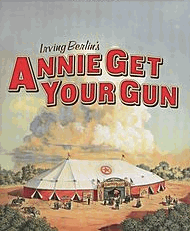
Annie Get Your Gun will interest older students. It is just full of singable Broadway songs... "I've Got the Sun in the Morning," "There's No Business Like Show Business," "You Can't Get a Man With a Gun," "Doin' What Comes Naturally," the famous guy/girl duet, "Anything You Can Do, I Can Do Better," and even more.
Wow! That's a lot of great music! Most of them are pretty energetic and just plain fun, but two are slower, and very pretty: "They Say That Falling in Love is Wonderful," and "Moonlight Melody."
So there's something in this book for almost everyone.
CINDERELLA
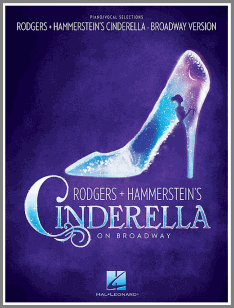
Cinderella is one of the best Broadway shows for kids I know, since it has a number of good choices for beginning girl singers.
Younger girls adore "In My Own Little Corner" and "Impossible"...there is lots of scope for the imagination in those songs.
"A Lovely Night" and "Ten Minutes Ago" are very lovely for older girls.
There are even two songs for guys: "Do I Love You" (so beautiful), and "Ten Minutes Ago," which works as a solo or as a duet between a guy and a girl.
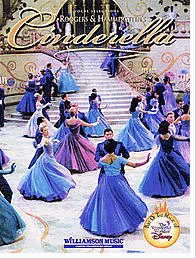
The newest Rodgers & Hammerstein Cinderella movie (with Brandi) has three additional songs in the songbook, from other Rodgers and Hammerstein Broadway productions.
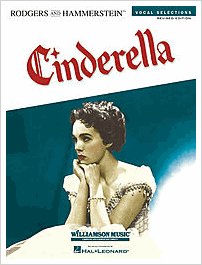
For some reason, this book is less expensive than the previous one with Julie Andrews on the cover, and it also has some nice archival photos of previous Cinderella productions.
The VERY NEWEST Cinderella movie, starring Lily James, isn't Broadway nor a musical at all; however, it showcases a very pretty traditional song (Lavender's Blue) that is delightful to sing and play, and very easy for beginning singers. I've got free arrangements of it in several keys as well as recital-worthy vocal accompaniments!
"Stepsisters' Lament," a duet, is great fun, and friends who sing it together love to work out a routine. It gives them a great opportunity to act bratty at a performance.
Students will learn a lot about enunciation, emphasis, and poise in front of a crowd, if you give them the chance to perform this at a recital.
(N.B.: the piano accompaniment to Stepsisters' Lament is rather difficult to play with ease...but it is worth putting in the effort for all of the enjoyment your students, and the audience, will get out of it.
I have seen two different accompaniments: the standard one in the Cinderella Vocal Selections book, and a shorter, very similar one in Musical Theatre Anthology for Teens, Duets.
The "Duets" arranger must have figured she or he was simplifying things a bit by leaving out the standard version's introduction, which starts in the key of Eb and modulates quickly to the key of C over four rather tricky measures.
However, the rest of the piece is larded up with fast-moving right-hand filled octaves -- a little heavy-handed as an accompaniment for young voices, besides being no fun to play at the appropriate tempo!
So I prefer to use the arrangement in the regular vocal book and cut out one whole page of solo piano playing in the middle, a long page where Cinderella and the prince are evidently dancing, but your two duet singers will be looking at each other awkwardly and waiting to jump back in!
THE FANTASTICKS
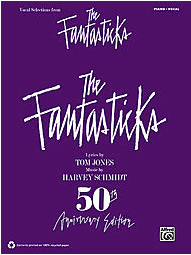
The Fantasticks may be the least well-known of all these musicals.
I believed until recently that it had never been made into a movie, despite having the distinction of - once - being Broadway's longest-running play ever.
But it turns out (thank you, Alert Reader Charity) that in 1995, The Fantasticks was made into a movie. (Check out the preview!)
The Fantasticks is also available at Amazon.com.
It has one very well-known piece, "Try to Remember," and a couple other ones with very beautiful melodies -- "Soon It's Gonna Rain," "Much More," and the lovely "They Were You." I give that one to a lot of my students.
There are also a couple of humorous songs in which parents bewail the miseries of raising troublesome children: "Plant a Radish," and "Never Say No." Not surprisingly, I can never interest kids in singing these songs... but they would be fun for adults!
FIDDLER ON THE ROOF
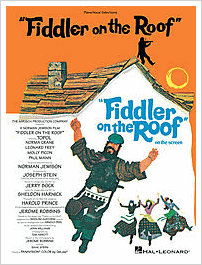
Fiddler On the Roof features one of my students' favorite Broadway duets, "Matchmaker".
Though the piano accompaniment is great fun, it has some fast-moving octave jumps which make it a bit of a tour-de-force (for the pianist!). However, it SOUNDS harder than it really is, and with a bit of practice, these spots are doable.
Girls love this fast-paced waltz about hoping for the perfect bridegroom, and though it is a duet, there is no harmony (unless you care to write a bit in).
I have recently written a piano interlude (free!) to bridge verse 1 and verse 2; it calls for a bit of acting on the part of your singer(s), and promises to be fun!
"Sunrise, Sunset," is sweet but kind of sad, with poetic lyrics about seeing childhood disappear, and the child become a bride or groom. It is very well-known, and sure to inspire a tear or two from an audience (and maybe from the music teacher as well!).
There are other great songs from this musical ("If I Were a Rich Man," "Tradition," and others) but I have felt they were too long to work with unless we actually planned some kind of stage production involving a number of performers.
Last year one of my voice students sang "Far from the Home I Love" while another (advanced) piano student accompanied her. That was a successful piece!
THE GREATEST SHOWMAN
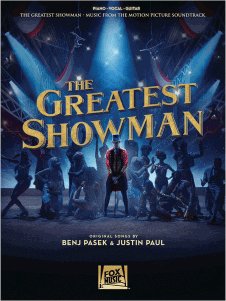
The Greatest Showman has some unforgettable music, and some of my students started singing numbers from the movie with their buddies at school before I got a chance to see it or hear it.
Now that I have seen it and bought the book, I'm sold too! In fact, I can't get "Never Enough" and "A Million Dreams" and the duet "Rewrite the Stars" out of my head. (Think "EARWORM.") Thank goodness the songs are beautiful.
Rhythmically, they are somewhat difficult, but kids who listen over and over to music will not have too much of a problem with that.
Part of the charm of the musical numbers is the unexpectedness of some of the rhythms, and the melodies too. I'm still learning this music, so I can't offer any insights about performing the songs yet.
THE KING AND I
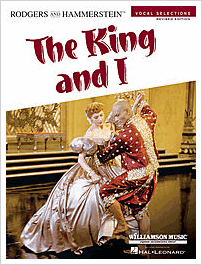
The King and I has two songs I've used a lot with beginners... I love all the music, but these two have proven to be the most useful:
With "Getting to Know You," I omit the introduction (which no one can remember how to sing) and start right at the familiar part.
Doing this song with a new student is kind of fun, and also very telling about their "ear" and pitch-matching. The half-step, whole-step, fourth melody of "Getting to know you....." is tricky in and of itself.
Then the intervals change in the next phrase...SLIGHTLY. This is a very good way to get beginners to start listening carefully.
It is also fun to sing together the lyrics, "Getting to know you... getting to know all about you...getting to like you...getting to hope you like me," with a new student, underscoring our new teacher/student relationship in a lighthearted way.
"I Whistle a Happy Tune" can provoke some laughs with a shy student, because at the end of the song comes a couple of lines where the singer must pucker up and whistle -- impossible to do if you are smiling -- which seems to be exactly what the whistling makes you do!
The melody itself is rather subtle; again, some of the steps and half-steps are tricky to hear.
LES MISERABLES
Les Miserables is back on the front burner again with the 2012 film production. Take a look at the book, or at these digital downloads, available instantly at Sheetmusicplus.com.
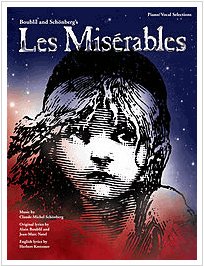
Les Mis has two beautiful but problematic songs which my students have sung, "Castle on a Cloud" and "I Dreamed a Dream".
Castle on a Cloud is set in a key I feel is too LOW for little girls, who invariably are the ones who want to sing it.
However, if they open their throats, try to place the sound forward, and don't press hard, it is good practice for going from middle voice down into chest voice. I don't let them sing it loudly.
"I Dreamed a Dream" (made more famous by Susan Boyle) has a different problem -- like many Broadway songs, it is a "belting" song. At least, it is most effective when belted.
Belting is a potentially harmful technique (it can be a little like yelling as you sing), and so it is best to learn all you can about it, and know how to do it yourself before asking students to try it.
Pamelia Phillips, DMA, in her book Singing for Dummies, wisely cautions singers to first develop a strong SPEAKING voice and middle range singing voice before attempting belting.
In chapter 14 of her book, she gives excellent advice and a step-by-step approach for easing into belting... she suggests one year for beginners to work on their singing voice, and an additional six months to a year to belt successfully!
"Stars" and "Empty Chairs at Empty Tables" are both beautiful and dramatic, for those students who crave drama.
MARY POPPINS
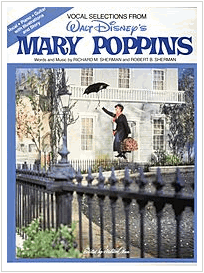
Mary Poppins has some lovely slower songs such as "Feed the Birds" and "Stay Awake".
Both of those are pitched too low for younger singers, I think, but I have had older singers who enjoyed them.
"Chim-chim-inee" is set in a decent range, is easy to sing, and has a sweeping, beautiful melody besides.
Younger singers will enjoy the words and the chance to do a Cockney-like accent like Burt, but teenage girls may not wish to sing it at a recital!
With the faster-moving songs, "Spoonful of Sugar" and "Super-cal-i-fra-ji-lis-tic-ex-pi-al-i-do-cious," groups of little girls are likely to spontaneously burst into song. These Broadway songs are really fun.
MY FAIR LADY
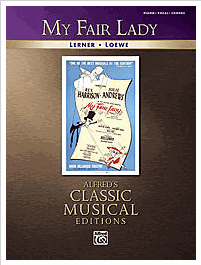
My Fair Lady has some wonderful music. "Wouldn't It Be Loverly," sung by the character of Eliza Dolittle, presents a grand opportunity to practice a pseudo-Cockney accent.
Shy voice students need just this kind of prodding! Having to attempt sounding a little silly, perhaps, and carrying it off will pay big dividends when they have to present a confident demeanor in front of an audience.
"I Could Have Danced All Night" is a favorite with starry-eyed teenagers.
If you have male vocalists, "On the Street Where You Live" and "I've Grown Accustomed to Her Face" are definite possibilities.
OKLAHOMA!
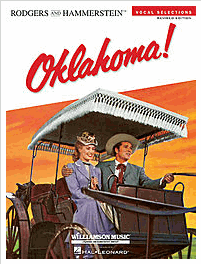
Among my favorite Broadway books in this Broadway musicals list is Oklahoma!
Both guys and gals can sing "Oh, What a Beautiful Morning," which is frequently one of the first songs I give a beginner. It can teach a lot about breathing and phrasing!
"The Farmer and the Cowman" and "Oklahoma" are two more songs both male and female singers can do, as well as the duet "People Will Say We're in Love." (Those two songs require strong piano playing.)
"Kansas City," "Surrey With the Fringe on Top," and "Pore Jud is Daid" (not found in all the short collections) are good songs for guys, with a lot of humor.
More beautiful are "Out of My Dreams" and "Many a New Day" for female vocalists. "Out of My Dreams," a waltz with sweeping, lilting lines, has many long held notes -- a challenge for breathing.
"Many a New Day" has a twisty melody line that jumps down and back up over and over, while still being lovely. It may take extra work to match pitch on this song.
And don't forget "I Cain't Say No!" Even if a young girl can't belt yet, she can still get a lot of fun nasal edginess in her tone for this song.
OLIVER!
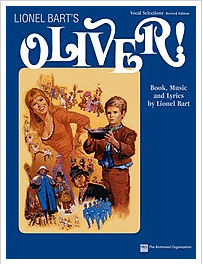
Oliver! has some really cute songs in it -- "I'm Reviewing the Situation," "You've Got to Pick a Pocket or Two," "Food, Glorious Food," "Consider Yourself at Home" -- and some pretty ones -- "As Long As He Needs Me," and "Who Will Buy."
I will admit that I've had a hard time interesting many students in any of the songs. Perhaps this is because they're not familiar with the story? I don't know.
It does seem to be a truism that music students want to sing (or play on an instrument) songs they already know. I'm going to keep trying!
PHANTOM OF THE OPERA
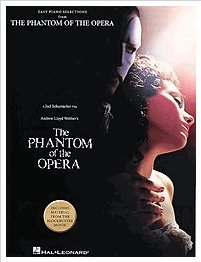
Phantom of the Opera seems evergreen in its popularity, especially since the making of the movie. "Think of Me" has always been my students' favorite.
From the newer book published since the movie came out, "Learn to Be Lonely" is very popular, and pitched lower than all the other solos. Even an alto (or a timid soprano) can sing its range.
But this Broadway musical has other very beautiful pieces. My students have really enjoyed "All I Ask of You", "Angel of Music", and "Wishing You Were Somehow Here Again."
Some time ago I had a group of girls sing Prima Donna as a choir. With its sweeping waltz-like melody, it sounded ENCHANTING with young voices.
However, I had to change the key for them - and a line or two of the lyrics! It wasn't written for the voices of young girls (and the words were risqué.)
We had a skit worked out, one young girl refusing all offers of flowers and adulation...the choir appealing to her again and again.
Perhaps the most exciting pieces are the Phantom of the Opera theme, and "The Music of the Night," but as mesmerizing as those pieces are, I stay away from them.
If kids want to sing along with them at home, I can't stop them, but I'm not going to have middle school and high school kids singing openly seductive Broadway pieces at family recitals.
Flirtatious, fine. Sexy, no - at least not in my studio.
SEVEN BRIDES FOR SEVEN BROTHERS
Seven Brides for Seven Brothers is a surprisingly good source of fun songs.
Not many people are familiar with this great and funny musical set in Oregon Territory, but it is a great favorite among our acquaintances: the plot goes like this:
Seven "scruffy backwoodsmen", all brothers on their mountain land far from the comforts of town (Adam, Benjamin, Caleb, Dan, Ephraim, Frank, and Gideon) grow lonesome for the girls they met at a barn-raising.
Their oldest brother, happily married himself, talks them into getting brides the same way the ancient Romans did... by kidnapping them!
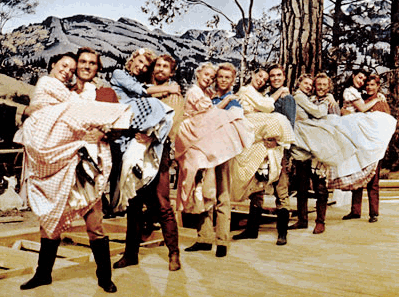
But, as he tells them, "This bein' Oregon, and God-fearin' territory, you'll have to bring the parson too!" What follows makes for a very fun, quote-able movie.
"Sobbin' Women" makes a fun group piece, for girls or guys.
All the songs -- Bless Your Beautiful Hide, Goin' Courtin', June Bride, Lonesome Polecat -- are very singable and just plain fun -- they almost seem to sing themselves.
THE SOUND OF MUSIC
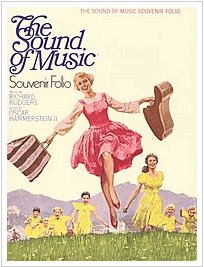
The Sound of Music is in a class by itself, in my opinion -- there's nothing quite like it.
Perhaps its the feeling of being transported into the Austrian Alps and the seeming innocence of another time (I know; Cabaret portrays the same time period), as Captain Von Trapp says, "...a world that's disappearing," and indeed is gone.
Or maybe it is because my mother bought this recording (an LP!) for our family and we listened to it over and over again.
Love songs, duets, group pieces, and great solos... it has them all, but in my opinion, most of them don't work outside of the musical's story, or on a piano.

"Edelweiss" (ever a favorite), is a good one for beginners... there is lots to be learned from the long drawn-out vowels of "weiss" in the word "edelweiss."
(My students start to believe that every vowel sound is an "ah"!)
"My Favorite Things" has a great chromatic line at the climax, rather hard, but good practice, ending with the difficult word "thi-i-i-ings!" They have to really listen to themselves. It is also a LOT of fun for a group of kids to sing together.
"Sixteen Going On Seventeen" is great for a couple of teenagers, boy and girl, although it is mostly unison singing - first one, then the other.
"Sound of Music" is very pretty and singable.
But the rest -- "Do-Re-Mi" and "So Long, Farewell," need groups to be effective, and like most musical numbers, benefit from a little bit of staging.
Oh, yes, I nearly forgot -- "Climb Every Mountain."
No thank you, it is not a favorite of mine.
Not to sing, and not to play (think crashing octaves - I played this along with a fellow student at our high school graduation, she on flute and I on piano - the placement of the graduation cap on my head was precarious every moment and made for an unforgettable experience).
Not to listen to either, except in the choral/orchestral version during the end credits as the Von Trapp family triumphantly makes their way over the mountain paths.
Then I love it, and even hum along.
SOUTH PACIFIC
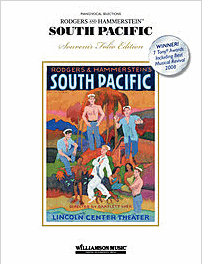
South Pacific has such beautiful music.
I mean it, such beautiful music.
Like The Sound of Music, the harmonies and melodies are evocative of another place... a land of "coconut palms, and banyan trees, and coral sands and - Tonkinese!"
Also, "standing on a hillside, looking at an ocean beautiful and still."
"Bali Hai," "Some Enchanted Evening," "Younger Than Springtime," "This Nearly Was Mine," "Dites-Moi" (short as it is). All beautiful.
South Pacific also has rousing, energetic, and funny songs -- "There is Nothing Like a Dame," "Gonna Wash That Man Right Outta My Hair," "A Wonderful Guy," "Honeybun"...
All of these high-energy songs are fun to sing.
A couple of years ago I arranged "There is Nothing Like a Dame" for a set of girls by moving it into the key of F -- they sang it at a recital with sailor-type outfits (striped shirts, white pants & hats) and choreographed some movements.
It was a blast!
"Honeybun", very jazzy, is for a girl who is not afraid to be a little silly and maybe even get some "Grrr..." into her voice. Very singable tune.
The standard arrangements of the piano accompaniments are pretty tricky... be prepared to work a little on the piano parts if you play any of the fast songs, and "Some Enchanted Evening."
I haven't checked out an easier version, but it might be worth looking into, as there are some fast octave jumps toward the end.
WEST SIDE STORY
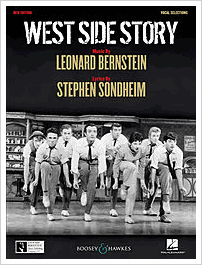
West Side Story has a song that is a perennial favorite for teenage girls -- "I Feel Pretty."
Girls love this song! It is high energy, with a staccato feeling.
The high notes can be a challenge for less-experienced singers not to mangle because of the vowel -- "such a pretty MEEEEE!" But a worthy challenge.
Also beautiful, but slower, is "One Hand, One Heart."
Long held notes make this one good practice for newer singers. If your singers master this song, they may be asked to sing it for a wedding.
"Tonight" pulses with irresistible energy -- you and your singer will feel as one if you can play the piano part well.
"Somewhere" is beautiful and sad... it is a duet, but can be sung as a solo by a girl or boy. "Maria" is a lovely solo piece for a guy.
WHISTLE DOWN THE WIND
Whistle Down the Wind is a new discovery for me, and my students are having fun with some of its songs.
Another musical by Andrew Lloyd Webber, I first discovered its title song, "Whistle Down the Wind," in The Singer's Musical Theatre Anthology Volume 3, for Soprano. I have placed a video of it here to show you just how singable this song feels:
Yes, that is Andrew Lloyd Webber playing the piano.
This song is available as a single sheet download at Musicnotes.
SONG COLLECTIONS
Great Songs from Musicals for Teens, Young Women's Edition, contains
- Diamonds are a Girl's Best Friend
- I Enjoy Being a Girl (fun!)
- Honey Bun
- I Got the Sun in the Morning
- I'll Know (from Guys and Dolls)
- Much More, and a few others.
The Singers' Musical Theatre Anthologies are an almost undiscovered country for me; I just purchased two of them recently and am meeting so many new songs!
If you go to Sheetmusicplus (by clicking the link to Singers Musical Theatre Anthologies) you will be able to look at any of the many books, and check out the song lists.
Don't be fooled by the price -- it is only expensive if you buy it with an accompanying CD (which is optional).
Popular Solos for Young Singers has got songs beloved by a certain age group:
- Rubber Duckie
- Zip-a-Dee-Doo-Dah
- Candle on the Water
- The Bare Necessities
- Ballad of Davy Crockett
- Bibbidi-Bobbidi-Boo
- Be Kind to Your Parents
- The Chipmunk Song
- Count Your Blessings
- On the Good Ship Lollipop (very fun)
- In My Own Little Corner
- Spoonful of Sugar
- Supercalifrajilisticexpialidocious
- Rainbow Connection,and more!
Kids' Broadway Songbook is another terrific collection:
- three good songs from Annie: "It's the Hard-Knock Life," "Maybe," and "Tomorrow."
- I Whistle a Happy Tune from The King and I,
- "My Best Girl" from Mame,
- "Castle on a Cloud" from Les Miserables,
- "Where is Love" and "Who Will Buy" from Oliver!
- "I Won't Grow Up" from Peter Pan,
- "Dites-Mois" (Tell Me Why) from South Pacific. The newest edition has got a fun song from
The newest edition has got a fun song from "A Christmas Story" called (what else) "Red Ryder Carbine Action BB Gun." It is by the same composers/lyricists who wrote The Greatest Showman, so it is catchy and fun!
I'm sorry for your disappointment if you were looking for free Broadway sheet music. Here are my suggestions for those cases when you just know you can't ask parents to buy the Broadway books:
Not make copies! (Unless you have ordered it for them and it's on the way.)
If you always give your students photocopies of published music, you are encouraging them to disregard the rights and intellectual property... of other musicians. Such as yourself.
But you already knew that. Enough of the lecture. My solutions:
Let them borrow your book until they have the song memorized.
Tell them to find the lyrics online from one of those fly-by-night websites, then go listen to YouTube for the tune.
Even better, find the lyrics for them so you KNOW they will have it during the week in between lessons (though if you always do everything for your singer, you are fueling the codependent relationship which is all too likely to develop between a voice teacher and a voice student).
Buy a single sheet (if available) of the one song they want to do. Then charge their parents for it!
Get digital music for less than a printed book from a source such as Musicnotes.com. Fast and easy. I have bought a lot of music from them, and now my favorite sheet music source, Sheetmusicplus.com, is starting to offer digital downloads as well.
Make a recording of their lessons. Do it with whatever technology works for both you and your student. Currently, it is their own iPhone, tablet, iPad, whatever... These are the best solutions right now.
Again, let me say that I am very sorry I cannot offer free Broadway sheet music.
If you find a site that DOES offer free Broadway sheet music, they are breaking copyright law.
Occasionally, the copyright holder (Hal Leonard, Warner Brothers or some other big name that handles the publishing end of the business for the writer) will offer a tiny portion of the real thing at one of their own sponsored sites.
This is just a teaser, offered to hook you into purchasing the whole piece of music. And why wouldn't you, if you can afford it?
Broadway books tend to be a very good bargain for the amount of music in them; still, I don't ask parents to buy a book unless I know the student will sing two or more songs in it.
If not, and just one song is very much desired, I let them borrow my book until they know it well enough.
But another good option is letting them borrow a page or two from my own copy of a Musicnotes arrangement (instant digital download), and if they decide they like the piece, insist they buy it or watch and listen to the song on YouTube!
The price of a single download is very reasonable; $4.25 - $5.95, usually.
And... MUSICNOTES HAS STARTED A NEW THING (2018) - they are allowing customers to download a sample page of many of their offerings! Hooray!
See all the great vocal book offerings at Broadway Sheet Music at Sheetmusicplus.com.
Don’t feel bad if you don’t know all the Broadway music out there…
Even my sometime-voice teacher WHO SANG BACKUP for one of the seven brothers in the movie Seven Brides for Seven Brothers HAD NO RECALL of the great tunes in this old musical when I brought it to his studio once. (I was so looking forward to hearing him sing “Sobbin’ Women,” but no luck.)
Some of my students definitely know and will tell me what they want to sing, and frequently round up the book or sheet music for themselves. Wow - I love that initiative, even if I don't always like their musical choice!
Others, however, don't have much of a repertoire, so it is fun with these kids to sightread a new Broadway song every week or so, if there is time at the end of the lesson.
A few of my students like REAL oldies, such as "When It's Twilight on the Trail," "Along the Santa Fe Trail," etc. Those songs do have a sweet feeling about them -- but they're not Broadway!
Dianna:
Your website is a light in the darkness. THANK YOU for all you do in helping to spread the love of music. It matters!
Recent Articles


-
Unchained Melody Piano Sheet Music, Chords & Lyrics
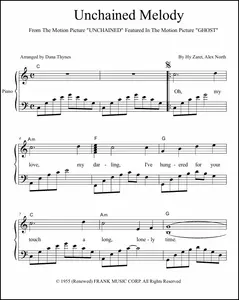 Unchained Melody: an intermediate-level arrangement that captures the beauty & power of this song, in a version suited to piano. What do I mean? No triplets!
 -
Thank you so much for the rounds!
Hi Dana, I am just writing to thank you for the free rounds for singing -- I have put up my hand to lead folk songs and hymns for my Christian homeschool -
Teacher
 I stumbled upon this site by accident, and am very glad I did. As a bumbling untrained music teacher, I like your hints about how to teach - although I
 -
Auld Lang Syne Sheet Music PDFs: for All Instruments & Singers!
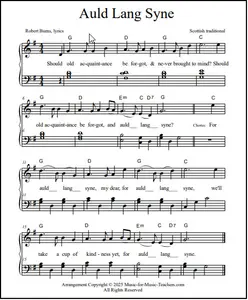 Auld Lang Syne sheet music for New Year's Eve & other gatherings! Piano arrangements, guitar tabs, & lead sheets with chords in many keys, for all singers.
 -
Favorite Christmas Songs: Duet Vocal Sheet Music
 The best duet Christmas songs are those ones you knew & loved as a child! This set of 14 "a capella" carols arranged for 2 voices is just right for caroling!
Interested in songs from the Bible for your students or church? Check out my other website, SingTheBibleStory.com!
All the first-year material I give my beginner students.
Piano keyboard sheets, scales, chords, note-reading exercises, and over 256 pages of music!
Music-for-Music-Teachers.com is a participant in the Amazon Services LLC Associates Program. As an Amazon Associate I earn from qualifying purchases.
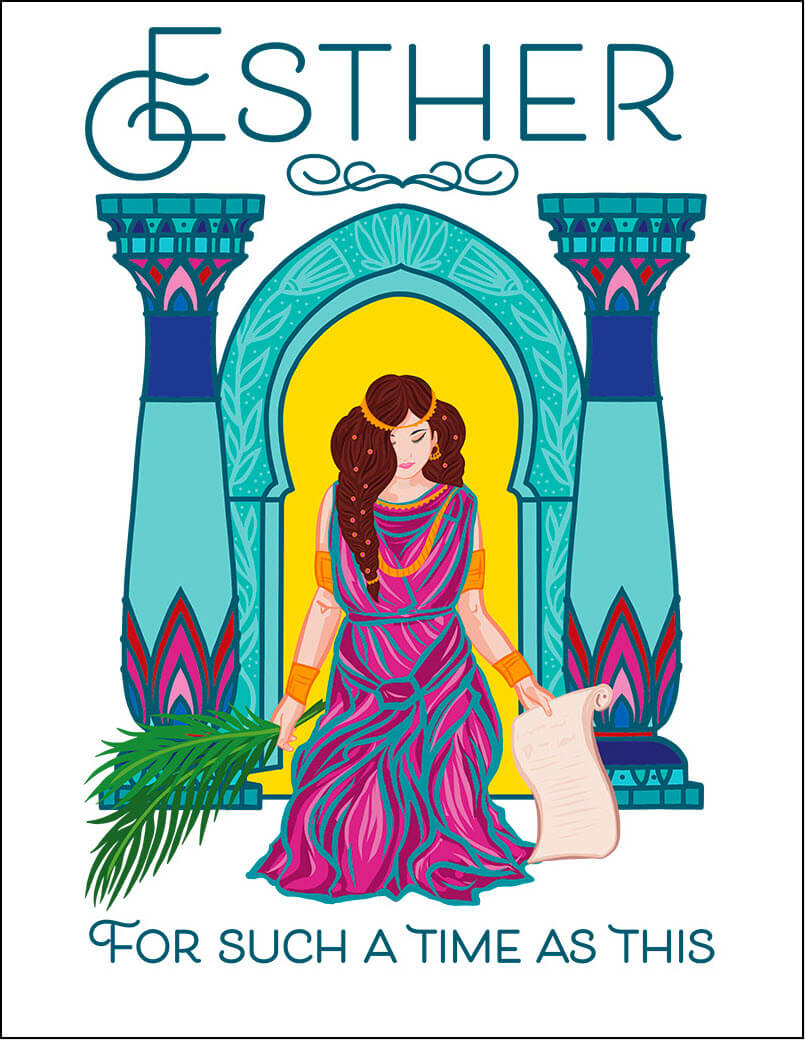
This beautiful song book for piano & voice "Esther, For Such a Time as This", available as a digital download, tells the riveting story of the time when Jews in ancient Persia faced a foe named Haman, and how a brave young queen risked her life to save her people.
A good choice for a singing story-teller, an operatic group, a short theater production, or a class of children!
This book is also available from Amazon as a paperback.
Music-for-Music-Teachers.com is a participant in the Amazon Services LLC Associates Program. As an Amazon Associate I earn from qualifying purchases.

This book is available as a digital download from this site. Visit this page to see some free examples from the book.
It is also available from Amazon as a paperback!
This is the perfect easy start for little pianists.
And when they start reading white-key notes on the staff, this is a fun easy resource to say each week, "Choose a new black-key song at home this week and figure it out to show me next lesson!" They will be spending more time at the piano.
Music-for-Music-Teachers.com is a participant in the Amazon Services LLC Associates Program. As an Amazon Associate I earn from qualifying purchases.
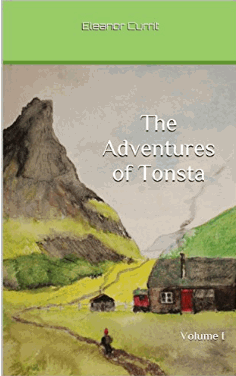
A perfect read aloud storybook
for little boys or girls.
The Adventures of Tonsta highlight the travels of a very young boy with a good heart, who goes about helping folk in trouble.
With a red cap on his head and a sack of tools slung over his shoulder, Tonsta seems to meet people in distress wherever he goes.
Lots of trolls in this book - including one who gives him a Christmas gift!
Music-for-Music-Teachers.com is a participant in the Amazon Services LLC Associates Program. As an Amazon Associate I earn from qualifying purchases.


Audrey:
I just wanted to tell you that I have found your website EXTREMELY helpful!
I have a young group of children that I have started a youth choir with and I was searching for music ideas and I came across your website. THANK YOU SO MUCH!!
Carrie,Voice and Piano Teacher:
This site is FABULOUS.
For all the reasons you explain on the site itself--this is exactly what piano teachers need! (I still need to go look at the vocal music). Wow. THANK YOU SO MUCH!
Comments
Please fill out the form below:
What Other Visitors Have Said
Click below to see contributions from other visitors to this page...
Looking for a Broadway Song for an 11-year Old 
I'm looking for a Broadway tune for an eleven year old to sing. She has a wonderful voice and a great range so I'm looking for something challenging yet …
Inexpensive way to Email/Share files
If you upload an original file to a free MediaFire account you can link your students to the URL for downloading or if you have a web page for your students. …
I Need an Age-Appropriate High-Energy Song for a 9-Year-Old to Sing
I have a 9 year old, and we need a piece for pageant. She has a great range for a young child that we want to show off, she prefers to sing classical, …
Time-saving list! Not rated yet
Thank you so much for this list! You saved me a great deal of time for me, not to have to reinvent the wheel!
I’m going to teach a beginning singing …
Phantom of the Opera Not rated yet
If you want to put the openly seductive songs from Phantom of the Opera together, Past the Point of No Return is much worse than any of the rest. Comparatively, …
Is This Song from Man of La Mancha Child-Appropriate? Not rated yet
Question:
How difficult is it for young girls to sing "The Impossible Dream" from the musical Man of La Mancha?
Dana's opinion:
Hi -- Well, …
Recording lesson material Not rated yet
I use a "Super Scope" with RW Cds that record at normal speed. At my own studio I can plug my digital piano in one input and my microphone into another …
Where Can I Find a Simplified Version of The Indian Love Call? Not rated yet
Mary asks:
My sheet of "The Indian Love Call" by Rudolph Frimhl is rather complicated for my students. Is there a way I can get it in a simplified …
About the Author

Hi, I'm Dana! (Say that like "Anna".) I'm the owner of Music-for-Music-Teachers.com, and a newer site, SingTheBibleStory.com.
Like some of you, I've been playing the piano since early childhood, and have added a few other instruments along the way, plus an interest in arranging and composing music.
You can find out more about me and the reason for this website at my About Me page.

Recent Articles
-
Unchained Melody Piano Sheet Music, Chords & Lyrics
Unchained Melody: an intermediate-level arrangement that captures the beauty & power of this song, in a version suited to piano. What do I mean? No triplets! -
Thank you so much for the rounds!
Hi Dana, I am just writing to thank you for the free rounds for singing -- I have put up my hand to lead folk songs and hymns for my Christian homeschool