I Love the Mountains for Guitar
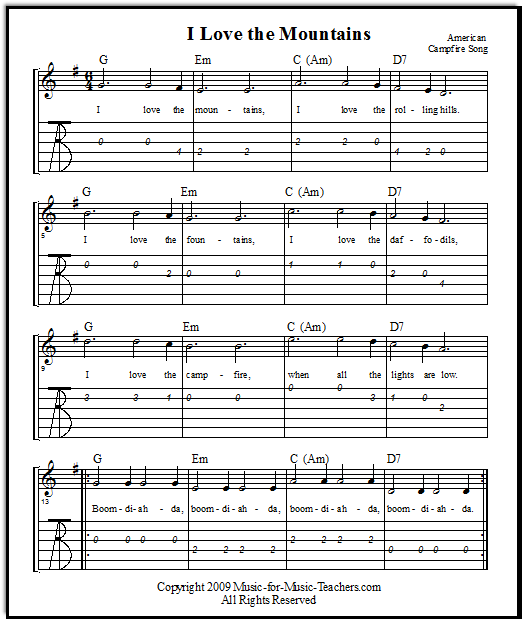
I Love the Mountains is a traditional "singing around the campfire song"... it seems like every American child was born knowing the tune of this song!
I can guarantee that this free guitar tablature sheet music with lyrics will be one of your beginning students' favorite songs for beginner guitar.
This is a familiar tune
For one thing, it seems that every child already KNOWS this melody and FEELS the way the chords need to go, and as soon as they realize that playing the song is within their grasp, they just have to work on it.
Please scroll down the page for the download links.
A circular chord progression to practice
And that makes this song PERFECT for my devious plan: make them practice the transition from the G chord to the Em chord to the C chord to the D7 chord until they can do it with their eyes closed!
This is frequently the song that gets my guitar students over the hump of changing chords without stopping in-between.
Here is this old camp song favorite in two keys:
- the key of G, with the chords G, Em, C (Am), and D7, and
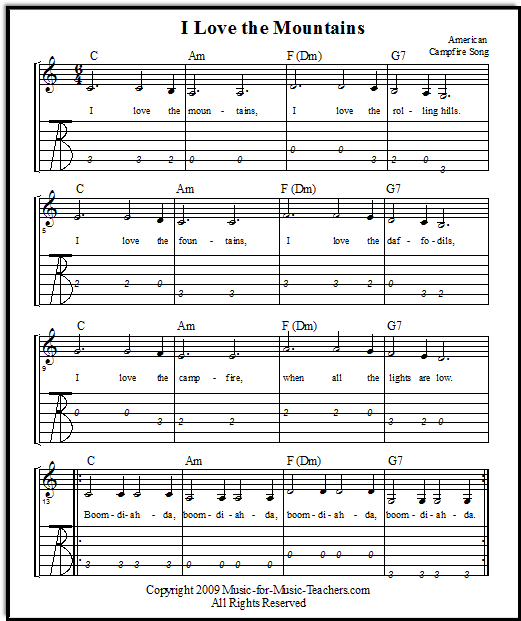
- the key of C, with the chords C, Am, F (Dm), and G7. Believe it or not, this is a great song for beginners. I like to start with the key of G version.
I chose the easiest time signature
You may say, "This song should be written in 4/4 time, not 6/4!"
It doesn't matter. We are trying to get beginners to count, and notes with 1, 2 or 3 beats are much easier to count than dotted quarters and eighth notes.
Understanding is our goal...the dotted rhythms can come later. I really feel that this is a weakness of too many beginning guitar books, introducing hard-to-count rhythms to students just starting out.
Easily learned without sheet music
I actually teach I Love the Mountains by rote to beginner guitar players, writing the guitar chords' names on kids' lesson sheets.
What I like about the chords of I Love the Mountains (in the key of G only) is that you can move from one chord to the next without lifting your hand completely off the guitar neck. So...
Push them to change chords without looking
It is a fun skill, and pushes kids to really lock in these chords, for I make it a goal to be able to play this chord progression with closed eyes.
The Plan of Attack:
- The G chord. For "I Love the Mountains", I recommend the fingering that puts finger 1 on string 5 fret 2, and finger 2 on string 6 fret 3.
- When it's time to move to the Em chord, you leave the 1 finger on string 5, and pull the 2 finger up next to it (on fret 2 of the D string).
- Then, to move to the C chord, leave your 2 finger in place on the D string, swivel your hand to bring finger 3 close to you on string 5 fret 3, then plant finger 1 in its usual place on string 2 fret 1.
- Moving to the D7 chord, leave the 1 finger on string 2 fret 1, and let the other fingers set down on either side of it on fret 2 of the G and high E strings.
- Preparing to go back to chord G again, it is the turn of finger 3.
- Letting the other fingers go, slide finger 3 down one fret to fret 3, string 1.
- Arch the other two fingers across the neck, like a couple of birds stretching their necks.
- Land them on strings 5 and 6, where they began.
Doing the song this way, your left hand is always in contact with the guitar neck and you can learn to play these chords while looking away from the guitar.
Transposing I Love the Mountains
When your beginning guitar students know I Love the Mountains well, have them switch to the key of C.
NOT as much fun.
But excellent practice, and a good introduction as to just what transposing is all about! This might also be the time to introduce the capo, and a discussion about high voices and low voices, and choosing a key that most people can sing in.
The F chord... and a substitute!
You might let them struggle with the F chord for a couple of weeks in order to lose some of their fear of it, then ask if they'd like to try the substitute chord Dm. Dm will seem so easy after F!
Please scroll down the page for the download links.
But another good idea is to let them substitute an FM7 chord for the small F; exactly like a 4-string F chord, but leaving off the first fret on string one. String one stays open.
In this way, the chords of the song have almost identical hand shapes; C to Am to FM7 differ from each other by just one finger change or so. Your guitar student may actually be intrigued.
The chord fingering doesn't work out quite as neatly as in the key of G, but the key of C chord hand positions are still very close.
Why bother with the key of C?
For most people, I Love the Mountains is easier to sing in the key of C, something a guitar player needs to consider.
Also, the kids' piano-playing friends surely know this song in the key of C, if they know it at all! So teach both versions...your guitar students need to be comfortable changing keys, thinking "up" or "down" a 4th or a 5th, or any interval.
Teaching beginners to strum
At first, I like to have beginners play a simple "Down - Down - Down - Down." Although this song moves too fast for 4 beats per measure, we do slow it down for the first month (or two or three), taking 4 beats on each chord.
The arm never stops
For good strumming, KEEP THE ARM MOVING.
Your strumming hand is always moving Down (up) Down (up); even when you start doing a more complicated pattern such as quarter eighth-eighth, there will always be an "up" stroke after every down stroke -- it's just that sometimes you will brush the strings for an audible "up" and other times it will be silent.
This camp song will be your guitar student's favorite guitar chords warmup for a long while!
The links to the guitar tabs:
Download free guitar tabs I Love the Mountains in key of G
Download free guitar tablature sheet music in key of C
Recent Articles


-
When He Cometh "Jewels" Hymn: Piano, Guitar, Vocal
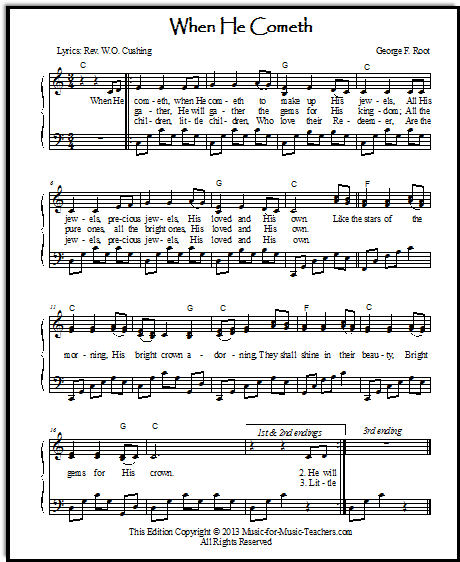 When He Cometh or "Jewels" is an old-timey sounding hymn. Very sweet & very simple, this is one your piano students & vocalists can learn from!
 -
Moonlight Sonata: How to Play This Piece Full of Black Keys & Triplets
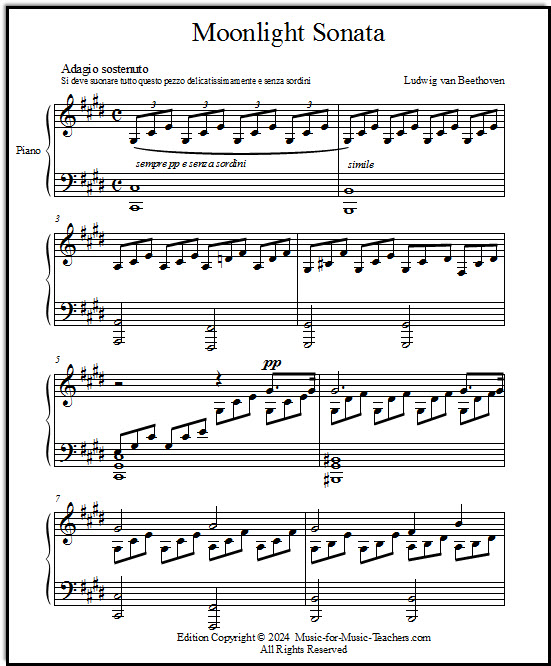 Moonlight Sonata: How to play this difficult piece full of black keys & triplets? Use large notes, lots of white space, & letters inside the note heads - easy!
 -
Bach Well-Known Pieces for Piano: the Musette in D, a Crowd-Pleaser!
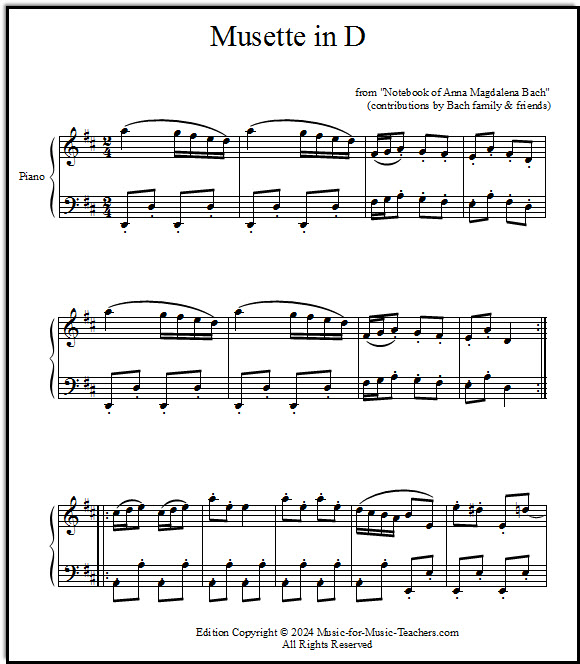 Some of the best Bach well known pieces include those from the "Notebook for Anna Magdalena Bach." Among piano pieces, "Musette" is perhaps the most joyous!
 -
Christ Arose Sheet Music: Resurrection Day Song for Piano or Guitar
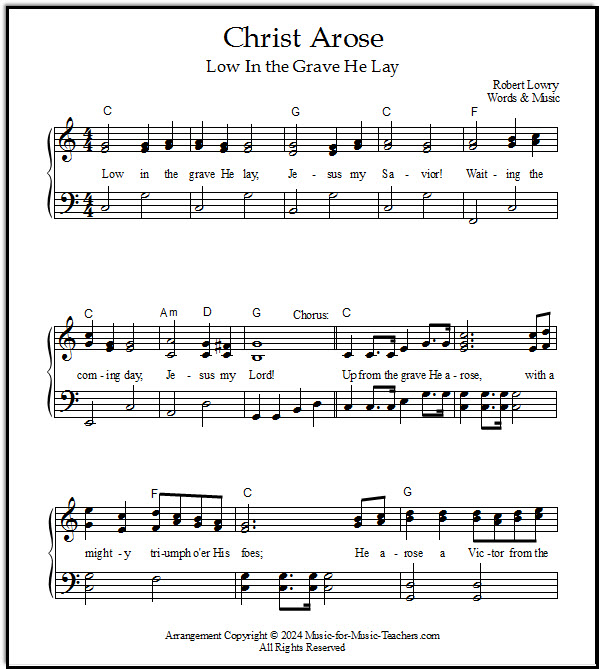 "Christ Arose" sheet music is perfect for Easter, or as many Bible believers say, "Resurrection Sunday." Mixing somberness & triumph, this song explains Easter.
 -
Sweet Hour of Prayer Hymn Sheet Music for Late Elementary Piano
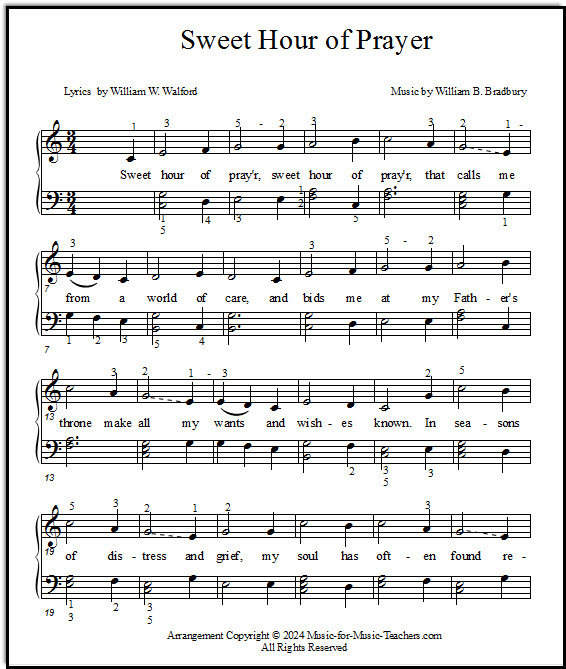 Sweet Hour of Prayer hymn music has been around a long time, and is greatly loved still. Check out 4 arrangements for beginning to elementary piano, & guitar!
Interested in songs from the Bible for your students or church? Check out my other website, SingTheBibleStory.com!
All the first-year material I give my beginner students.
Piano keyboard sheets, scales, chords, note-reading exercises, and over 256 pages of music!

This beautiful song book for piano & voice "Esther, For Such a Time as This", available as a digital download, tells the riveting story of the time when Jews in ancient Persia faced a foe named Haman, and how a brave young queen risked her life to save her people.
A good choice for a singing story-teller, an operatic group, a short theater production, or a class of children!
This book is also available from Amazon as a paperback.

This book is available as a digital download from this site. Visit this page to see some free examples from the book.
It is also available from Amazon as a paperback!
This is the perfect easy start for little pianists.
And when they start reading white-key notes on the staff, this is a fun easy resource to say each week, "Choose a new black-key song at home this week and figure it out to show me next lesson!" They will be spending more time at the piano.


A perfect read aloud storybook
for little boys or girls.
The Adventures of Tonsta highlight the travels of a very young boy with a good heart, who goes about helping folk in trouble.
With a red cap on his head and a sack of tools slung over his shoulder, Tonsta seems to meet people in distress wherever he goes.
Lots of trolls in this book - including one who gives him a Christmas gift!
Comments
Do you have a funny story about this music, or does it remind you of something you'd like to share with other readers? Do you have a question? I'd love to hear it!
Please note that all comments are moderated, and will not appear until I have approved them. Also, IF YOU ARE ASKING FOR MUSIC THAT IS NOT IN THE PUBLIC DOMAIN, YOUR REQUEST WILL BE IGNORED. That's pretty much any music written in the last 75 years...
Sign up for "Take Note!" to see what's new every month.
About the Author

Hi, I'm Dana! (Say that like "Anna".) I'm the owner of Music-for-Music-Teachers.com, and a newer site, SingTheBibleStory.com.
Like some of you, I've been playing the piano since early childhood, and have added a few other instruments along the way, plus an interest in arranging and composing music.
You can find out more about me and the reason for this website at my About Me page.

Recent Articles
-
When He Cometh "Jewels" Hymn: Piano, Guitar, Vocal
When He Cometh or "Jewels" is an old-timey sounding hymn. Very sweet & very simple, this is one your piano students & vocalists can learn from! -
Moonlight Sonata: How to Play This Piece Full of Black Keys & Triplets
Moonlight Sonata: How to play this difficult piece full of black keys & triplets? Use large notes, lots of white space, & letters inside the note heads - easy!