Sheet Music Printable and Free!
Mignonne allons voir si la rose
Sheet music printable and free from the Renaissance for your vocalists, guitarists, and pianists - three versions!
Mignonne allons is a mesmerizing song from the French Renaissance. If you don't know if your students would like Renaissance music, have them listen to the YouTube videos on this page...
Isn't that beautiful? This lute-vocal duo has a number of albums available at their website, Mignarda. This particular song is also available at Amazon on an album by the name of Divine Amarillis: Airs de Court 1570-1640


No, I have not written up sheet music printable for the lovely lute accompaniment, though Ron and Donna, the Mignarda duo, say you can find it at their website.
Here is the lead sheet, in one of three keys:
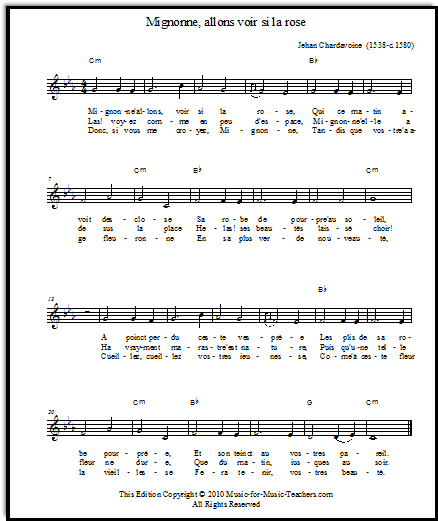
Please scroll down the page for the download links.
The song is much more stirring if you understand what is actually being sung.
Knowing just a little bit of French, a person can see that the translation is very good indeed, in fact, almost word for word. The song speaks of the briefness of beauty, shown by the fading hue of the rose, which is like his lovely mistress's cheek...
There is only a breath of a moment in which those who are young can enjoy their youth. Therefore, seize the moment -- seize it!
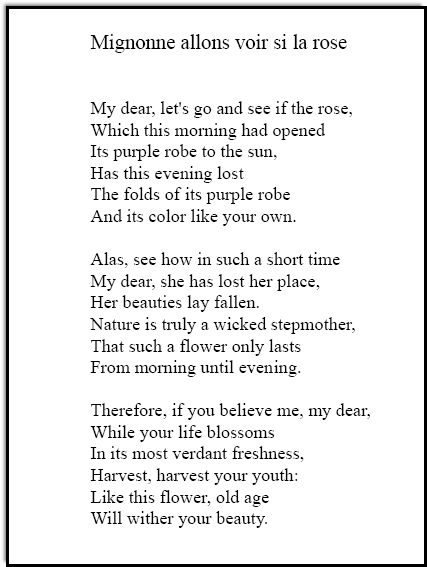
Sorry - I don't have a downloadable PDF for the lyric translation.
The translation above is from the site Society for Creative Anachronisms.
If you want a 4-part arrangement of this piece, go to a page associated with The Society for Creative Anachronisms where there is much great early music transcribed and downloadable for free. (You will have to hunt around a bit.)
A fellow named Steven Hendricks, along with several others, took the time to write up nice arrangements of this and many other popular Renaissance pieces. The site is a wonderful resource for public domain music, music that has been in the public domain for hundreds of years!
I did notice, after my students and I had done some floundering with the lyrics, that Steve's sheet music printable version didn't fit the notes exactly. Therefore, I re-wrote the PDFs of this song, but haven't got to the graphics yet. (There are only four very minor changes.)
The printable sheet music I have here is the melody line (treble clef, and also guitar tablature), plus chord suggestions, and also a piano arrangement.


A very simple guitar chord, plucked and never varying, can give a good impression of a lute accompaniment. I think a guitar accompaniment is all that was used in this recording.
To duplicate it, use the notes of an "open" Em chord (that is, the notes "E" and "B" only, without the third of the chord, "G").
E, B, High E, B, and repeat. That is, fret 2 E on the D string, string B, high string E, back to string B, back down to fret 2 E on the D string.
The key of Dm also works: use open string D, followed by fret 2 A on the G string, then fret 3 D on the B string.
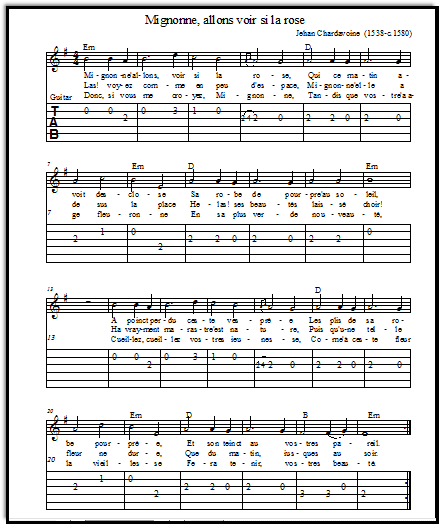
Please scroll down the page for the download links.
You may not agree with the measure of rest, the feeling of pause, at measure 13. Well, I fell in love with it, listening to Mignarda. But take it out if you like the flow better without it.
Here is a sheet music printable arrangement for piano. This does not use all the chords heard in the first video, but I like the simplicity of my arrangement here, as I didn't want too much heaviness from the piano:
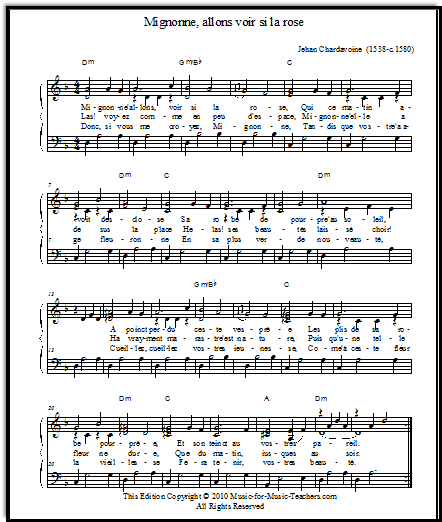
Please scroll down the page for the download links.
The first version I ever heard of this moving Renaissance song was from a recording given to me by my daughter called La Rocque 'n' Roll - Popular Music of Renaissance France / The Baltimore Consort.
It is a fun recording, mostly with vocals by this soprano heard in the recording linked below, but also drums, pipes, and viols of some sort. Very energetic - Renaissance rock music! I can listen to it over and over again.


Big question: How do you pronounce the French words?
If you have no background in French, get thee to a library and check out all the books and recordings you can! Show your music students how a self-starter does it!
French looks very daunting... a "slippery sort of language," as Jo March says in Little Women (which lack of appreciation cost her a much-coveted trip to France with her Aunt Josephine). Use the books and CDs that work for you, and return the rest!
Personally, I have really enjoyed the recordings of Michel Thomas, who was a French Resistance fighter in World War II. But it is an audio course, not text-based, so you also need a guide that will help you look at a cluster of letters and derive the correct pronunciation from them.
One of the best helps is to listen to native French singers, of course... and there are many to be found on Youtube (though I do not think any of the singers among my Youtube examples on this page are native French speakers).
Be aware that although in everyday speech French words are usually shortened, with final "s" and other consonants and vowels, too, not pronounced, yet in singing, those one-syllable words will frequently turn into two syllables, like Spanish and Italian.
The word "chante," for example (sing), ordinarily pronounced "shahnt," becomes "shahn - tuh." Why? "Tradition!" according to my sometime-teacher John D'Armand of Juneau, Alaska.
Perhaps they were once pronounced that way even in everyday speech - and are preserved that way in songs of the period? That's just a guess on my part.
Lastly, the description of "Mignonne allons" given by Mignarda says that it is "a song of seduction," and the lovely lyrics ARE that, but so much more than that!
In the Renaissance, CHANGE and DEATH were common themes. Poets, thinkers, and everyday people were deliberately conscious of mortality... some carried pocket-watches shaped like a skull. This was partly a result of the Black Death, and the nearness of death everyday, which changed society.
All that lies beneath the sphere of the moon, they believed, is subject to change, to death, to decay, and therefore the time we have must be grasped and lived with urgency. As Andrew Marvell's poem, "To His Coy Mistress," says:
"Then let us sport us while we may, and now, like amorous birds of prey, rather at once our time devour than languish in his slow-chapped power...
Thus, though we cannot make our sun stand still, yet we will make him RUN."
The download links for the lead sheet music arrangements:
Download Mignonne allons lead sheet in Am
Mignonne allons lead sheet in Cm
The guitar tablature version links:
Download sheet music printable for Mignonne allons in Am, with guitar tablature
Guitar Tablature for Mignonne allons in Dm
Mignonne allons for guitar in Em
The links to the piano arrangements:
Download Mignonne allons with piano arrangement in Cm
Printable sheet music Mignonne allons with piano arrangement in Dm
Printable piano music Mignonne allons in Em
Recent Articles


-
When He Cometh "Jewels" Hymn: Piano, Guitar, Vocal
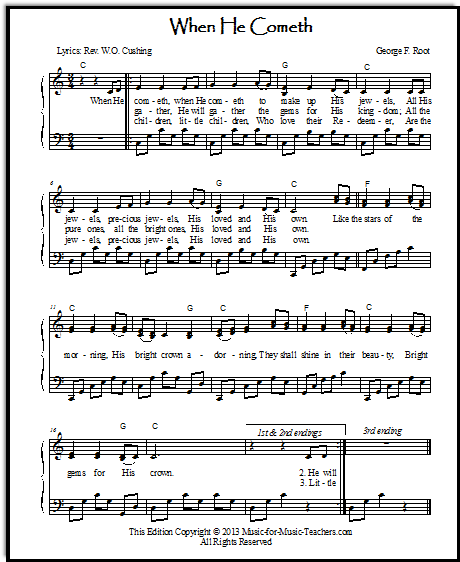 When He Cometh or "Jewels" is an old-timey sounding hymn. Very sweet & very simple, this is one your piano students & vocalists can learn from!
 -
Moonlight Sonata: How to Play This Piece Full of Black Keys & Triplets
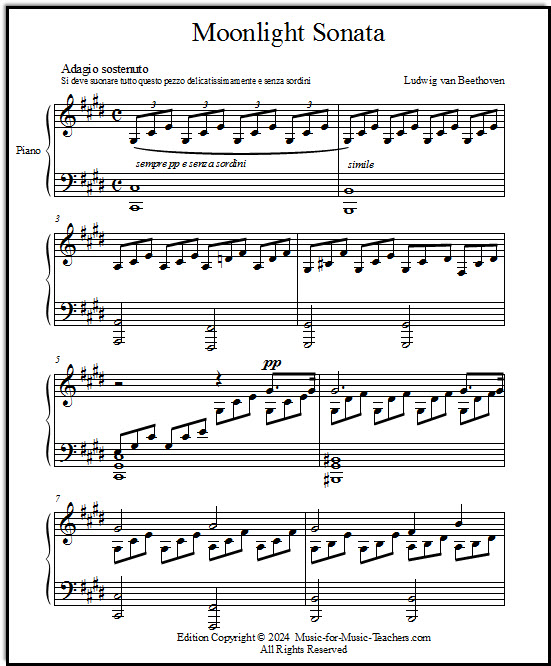 Moonlight Sonata: How to play this difficult piece full of black keys & triplets? Use large notes, lots of white space, & letters inside the note heads - easy!
 -
Bach Well-Known Pieces for Piano: the Musette in D, a Crowd-Pleaser!
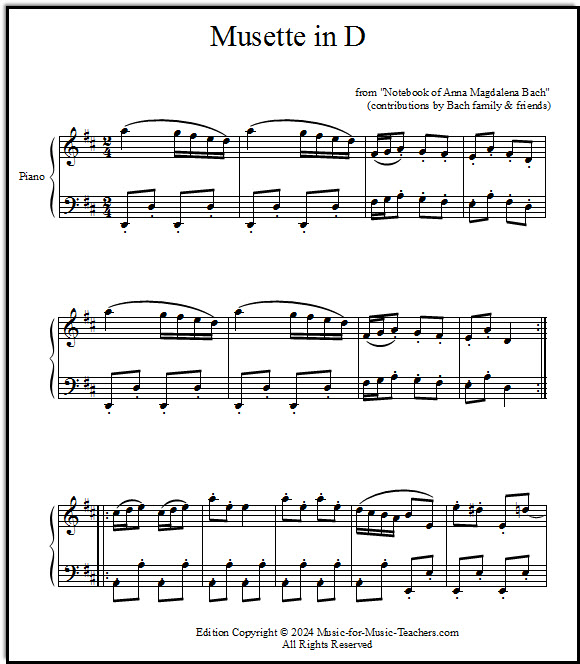 Some of the best Bach well known pieces include those from the "Notebook for Anna Magdalena Bach." Among piano pieces, "Musette" is perhaps the most joyous!
 -
Christ Arose Sheet Music: Resurrection Day Song for Piano or Guitar
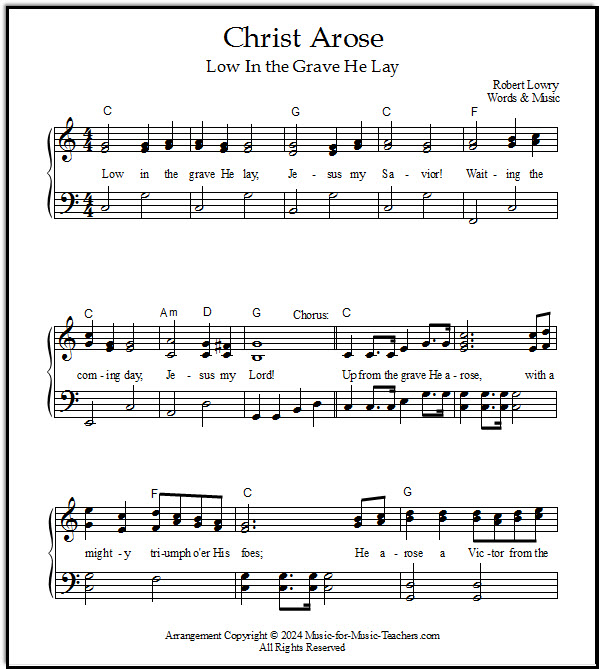 "Christ Arose" sheet music is perfect for Easter, or as many Bible believers say, "Resurrection Sunday." Mixing somberness & triumph, this song explains Easter.
 -
Sweet Hour of Prayer Hymn Sheet Music for Late Elementary Piano
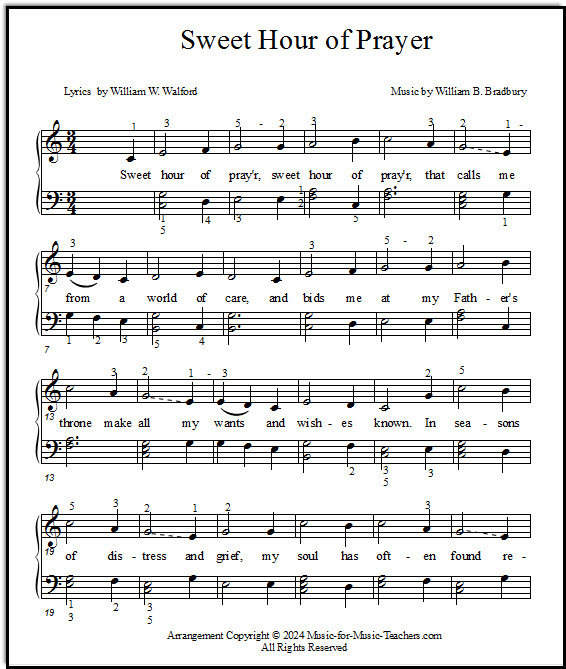 Sweet Hour of Prayer hymn music has been around a long time, and is greatly loved still. Check out 4 arrangements for beginning to elementary piano, & guitar!
Interested in songs from the Bible for your students or church? Check out my other website, SingTheBibleStory.com!
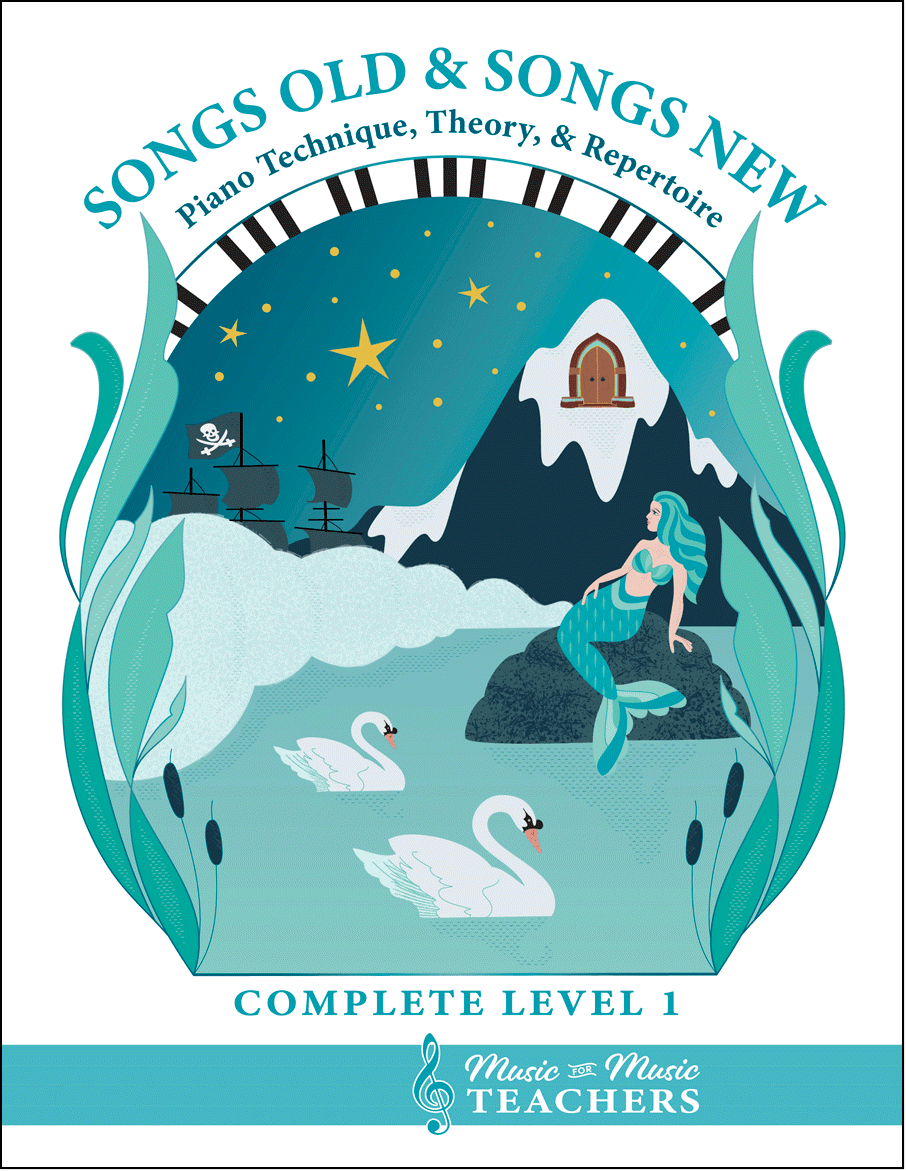
All the first-year material I give my beginner students.
Piano keyboard sheets, scales, chords, note-reading exercises, and over 256 pages of music!

This beautiful song book for piano & voice "Esther, For Such a Time as This", available as a digital download, tells the riveting story of the time when Jews in ancient Persia faced a foe named Haman, and how a brave young queen risked her life to save her people.
A good choice for a singing story-teller, an operatic group, a short theater production, or a class of children!
This book is also available from Amazon as a paperback.

This book is available as a digital download from this site. Visit this page to see some free examples from the book.
It is also available from Amazon as a paperback!
This is the perfect easy start for little pianists.
And when they start reading white-key notes on the staff, this is a fun easy resource to say each week, "Choose a new black-key song at home this week and figure it out to show me next lesson!" They will be spending more time at the piano.
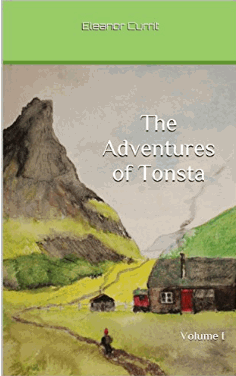


A perfect read aloud storybook
for little boys or girls.
The Adventures of Tonsta highlight the travels of a very young boy with a good heart, who goes about helping folk in trouble.
With a red cap on his head and a sack of tools slung over his shoulder, Tonsta seems to meet people in distress wherever he goes.
Lots of trolls in this book - including one who gives him a Christmas gift!
Carrie,Voice and Piano Teacher:
This site is FABULOUS.
For all the reasons you explain on the site itself--this is exactly what piano teachers need! (I still need to go look at the vocal music). Wow. THANK YOU SO MUCH!
Marta:
Thank you for the free downloads! I'm a private teacher and I teach piano and beginner voice as well. :)
I've been running my studio for about a year and I've come across the same issue; I don't want my students to have to purchase an entire supplemental book for only a couple of songs. So thank you for this site...some great downloads!!
Stasi: Because I have such a diverse group of students I spend SO much time making supplemental material and I feel like I have to pick through other websites, to only find one or two useful things.
I am so thankful for the wealth of supplement that you have offered here! And it's all SO user friendly!! THANK YOU THANK YOU THANK YOU!!!!
Comments
Do you have a story or even a question about this vocal piece? Share it!
Please note that all comments are moderated, and will not appear until I have approved them. Also, IF YOU ARE ASKING FOR MUSIC THAT IS NOT IN THE PUBLIC DOMAIN, YOUR REQUEST WILL BE IGNORED. That's pretty much any music written in the last 75 years...
Sign up for "Take Note!" to see what's new every month.
About the Author

Hi, I'm Dana! (Say that like "Anna".) I'm the owner of Music-for-Music-Teachers.com, and a newer site, SingTheBibleStory.com.
Like some of you, I've been playing the piano since early childhood, and have added a few other instruments along the way, plus an interest in arranging and composing music.
You can find out more about me and the reason for this website at my About Me page.

Recent Articles
-
When He Cometh "Jewels" Hymn: Piano, Guitar, Vocal
When He Cometh or "Jewels" is an old-timey sounding hymn. Very sweet & very simple, this is one your piano students & vocalists can learn from! -
Moonlight Sonata: How to Play This Piece Full of Black Keys & Triplets
Moonlight Sonata: How to play this difficult piece full of black keys & triplets? Use large notes, lots of white space, & letters inside the note heads - easy!