Johnny Has Gone for a Soldier
Johnny Has Gone for a Soldier is the kind of song young girls love to sing.
Haunting, plaintive, and beautiful, it has a strong melody with a melancholy story which seems to take you back to earlier times, the sad days of the Civil War, or "The War Between the States".
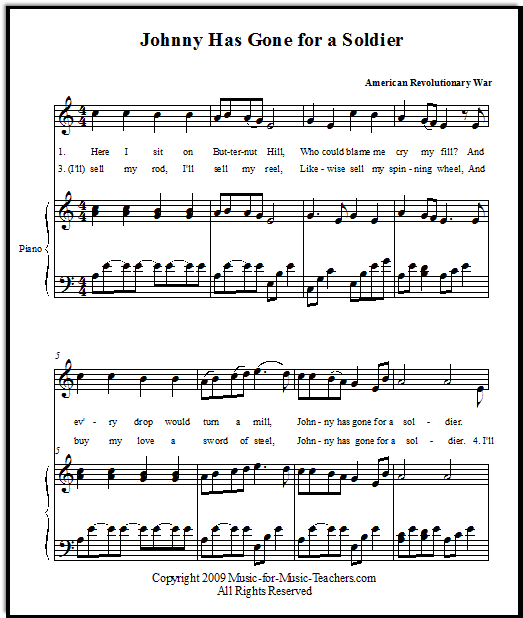
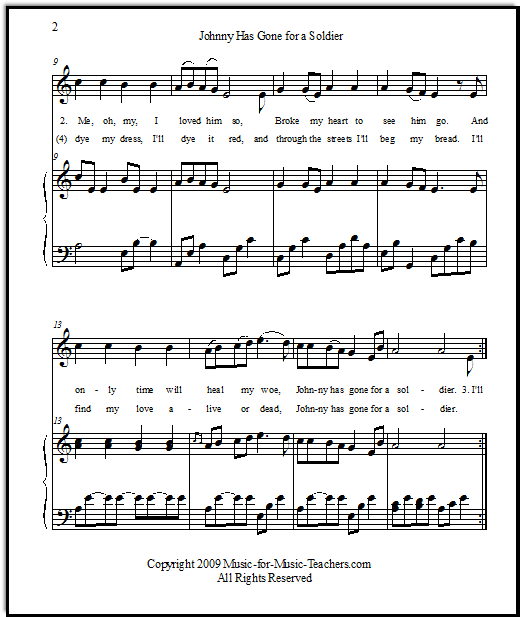
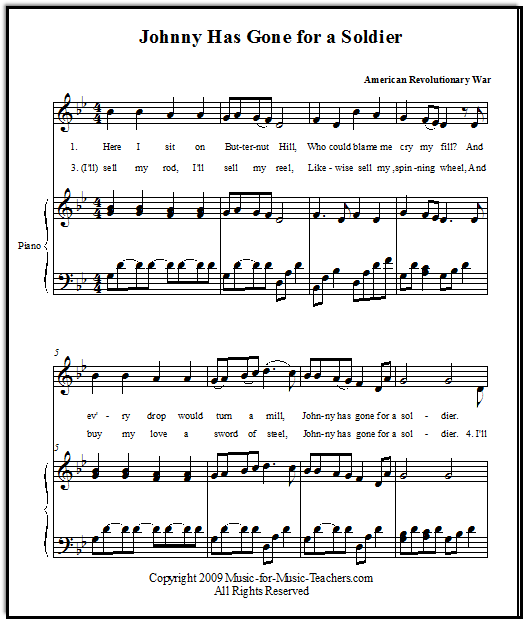
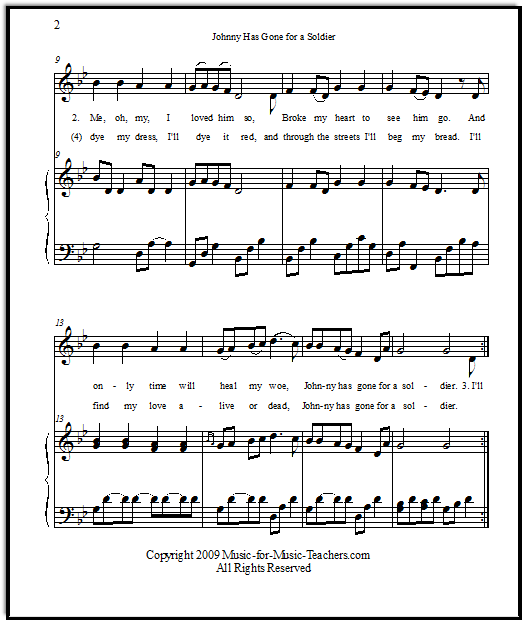
Here is an arrangement in 4 keys: Am, Gm, Fm, and Em.
Please scroll down the page for the download links.
The song actually dates from the American Revolution, with possible roots in Ireland (it is similar to a tune called "Shule Aroon"). Because it is such an old song, you'll find lots of different versions of the tune and the lyrics.
Years ago film-maker Ken Burns produced a moving documentary about the Civil War.
Prominent among the music in the background was this song, Johnny Has Gone for a Soldier. Again and again this theme came back, growing in poignancy with each repetition.
I loved the arrangement used in the movie so much that I tried to duplicate it, and this was the result.
Please scroll down the page for the download links.
Watch for where the music changes
Please notice that verses 1 and 3 are not exactly the same tune as verses 2 and 4. Only one measure is different (the 3rd measure of each verse), by only a couple of notes, but it is enough to throw singers off if they are not prepared well.
Not just a pretty face - there's lots of substance here
This song has lots of opportunities for beginners to improve basic technique. Even the very first word, "Here," presents difficulties for many singers. I love to use this piece to encourage long vowels..."hih" for "here," and "ah(ee)" for "I".
Watch out for "Ho-ho's"
Another challenge in Johnny is keeping the "h's" out of the syllables with two or more notes.
You know what I mean: instead of "tu-urn a-a mill," students want to sing "tu-HURN a-HA mill." There are lots of those spots in this song!
Please scroll down the page for the download links.
How do you climb higher without tightening the throat?
The ascending phrase toward the end of each verse FEELS higher than it really is, and some students may start to tighten their throats.
Help them relax their throats on that phrase by singing the line with such syllables as "Yah-yah-yah-yah-yah," "Lah-gah, lah-gah, lah" without moving their jaw, sirens on those notes, and other such singing warm ups.
You need to help them open up expressively and make a slight crescendo as they ascend. A gesture that may be helpful:
As the two of you sing the phrase TOGETHER, slowly drop one hand in an expansive movement, like a conductor, and encourage your student to envision OPENING UP and making MORE SPACE, instead of PUSHING HIGHER.
Vowels are much easier than words
I like to take the words out temporarily, so students sing the melody on "ah", "oh", "ee", "oo", "lah," etc. When the notes come easily, we put the words back in.
Please scroll down the page for the download links.
Breathing for singing - it's not the same as speaking!
This free vocal sheet music also helps teach good breathing for young singers.
The difference in regular breathing, and breathing for singing makes itself plain in Johnny Has Gone for a Soldier.
I remind students that they wouldn't take a breath in the middle of a sentence if they were speaking the words to another person, and so, to make themselves understood, their goal in singing a phrase -- ideally -- is to sing the whole thing with no breaths chopping it up.
But singing takes so much more breath than just talking, and careful, measured release. Students will learn a lot as they make phrases long and smooth in Johnny.
Sometimes you want to emphasize a word
I make an exception to singing the whole phrase in verse one after the word "drop." I want the word "drop" to sound like a drop, with an audible "p" sound ...perhaps this could be seen as an affectation, but making singing expressive involves making personal choices such as this.
Help us understand you
Singers must remember that they are telling a story. Making pretty sounds is not enough. When I listen to people singing, I want to know what they are saying!
Enjoy this beautiful piece of history, Johnny Has Gone for a Soldier.
The links for the printable PDF downloads:
Download free vocal sheet music Johnny Has Gone for a Soldier in Am
Printable free vocal sheet music "Johnny Has Gone" in Gm
Printable Johnny music Fm version
"Johnny" for voice and piano in the key of Em
More Folk Songs to Sing:
Ae Fond Kiss - a love song about saying goodbye, from Scotland
All the Pretty Little Horses - a soft and repetitious lullaby, quite pretty
Ash Grove - a famous and lovely song from Wales
Auld Lang Syne - the New Year's Eve song!
Colorado Trail Song - an American tune written by a real cowboy
Come By the Hills - another popular Irish melody
Down By the Salley Gardens - a famous and pretty song, very sweet
Green Bushes - a brisk little song that is pretty while being good for breath control training
Grenadier and the Lady - my favorite folk song of all. Find out why
I Gave My Love a Cherry - the "Riddle Song" is very pretty
Loch Lomond - the famous and sad song about never meeting again
Mari's Wedding - a singable tune with bouncy chords that is fun to play or sing
Minstrel Boy - a lovely and patriotic song about a warrior-poet
Molly Bawn - a sad story of a young hunter who thought he was shooting at a swan
Morning Has Broken - a beautiful melody made famous again by Cat Stevens
Once I Had a Sweetheart - "but now I have none!" Very pretty, and little-known.
Parting Glass - a well-known Irish tune which my singers always love
Raggle-Taggle Gypsies - a story about a young bride who abandons her wealthy new husband to go off with the gypsies. A catchy melody!
Scarborough Fair - an old and famous tune of lost love
Shenandoah - a famous and lovely American tune with ambiguous lyrics
Skye Boat Song - a pretty song from Scotland about the escape of Bonnie Prince Charlie over the sea
Spanish Ladies - a minor key sea chanty that swings energetically along - BOYS like singing it too!
The Spanish Lady - Upbeat and energetic, this Irish song is fun to perform with a group
Star of the County Down - LOTS of fun to sing and play! An excellent ensemble piece
The Wellerman - a sea chanty that is very singable, and very fun!
Recent Articles


-
Moonlight Sonata: How to Play This Piece Full of Black Keys & Triplets
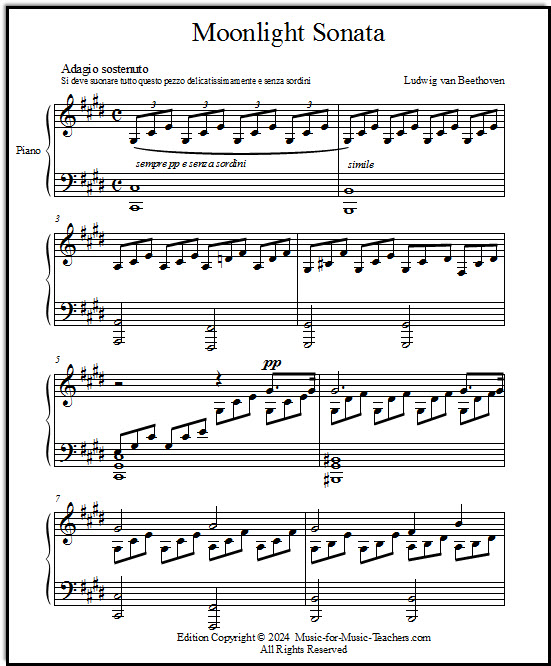 Moonlight Sonata: How to play this difficult piece full of black keys & triplets? Use large notes, lots of white space, & letters inside the note heads - easy!
 -
Bach Well-Known Pieces for Piano: the Musette in D, a Crowd-Pleaser!
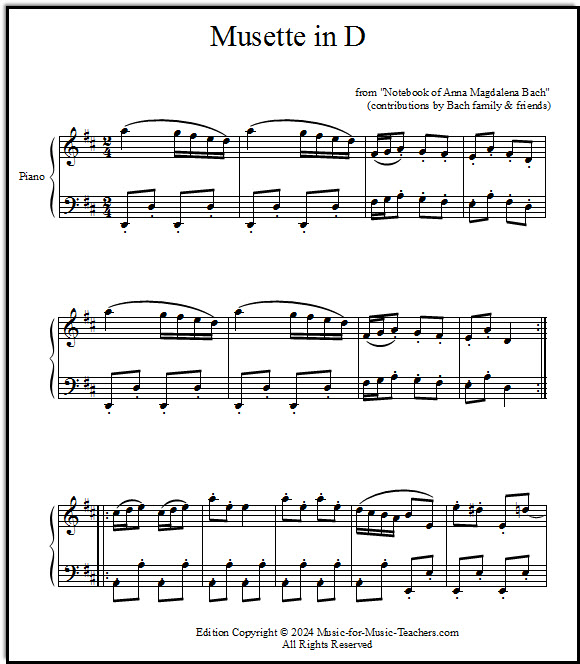 Some of the best Bach well known pieces include those from the "Notebook for Anna Magdalena Bach." Among piano pieces, "Musette" is perhaps the most joyous!
 -
Christ Arose Sheet Music: Resurrection Day Song for Piano or Guitar
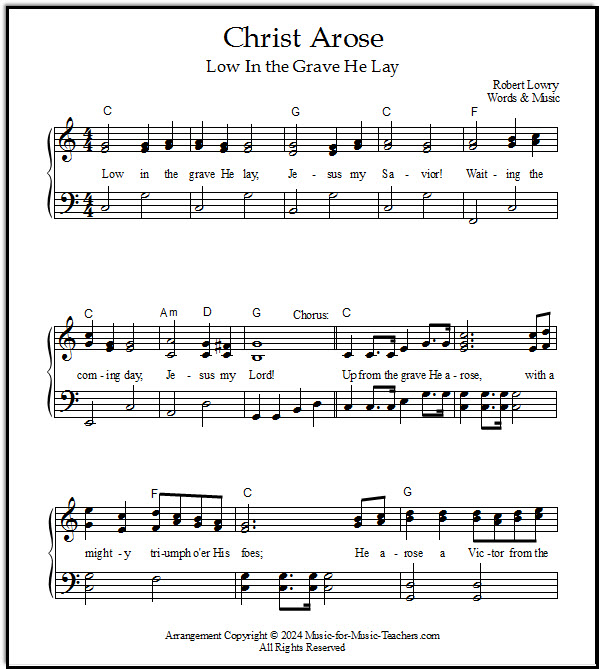 "Christ Arose" sheet music is perfect for Easter, or as many Bible believers say, "Resurrection Sunday." Mixing somberness & triumph, this song explains Easter.
 -
Sweet Hour of Prayer Hymn Sheet Music for Late Elementary Piano
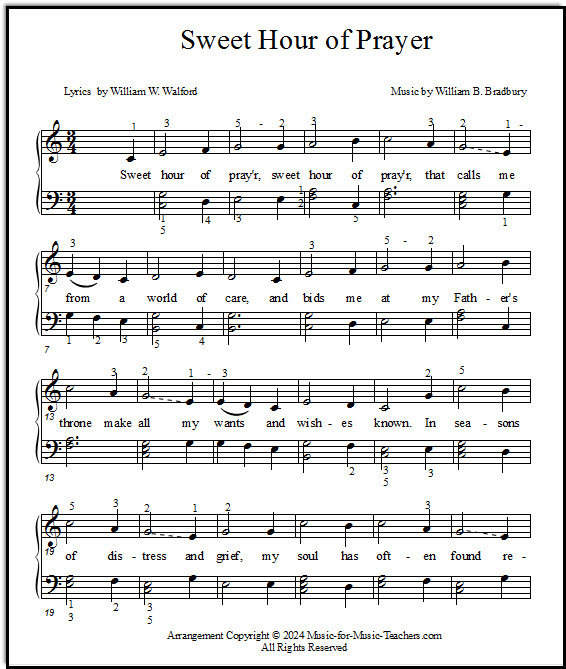 Sweet Hour of Prayer hymn music has been around a long time, and is greatly loved still. Check out 4 arrangements for beginning to elementary piano, & guitar!
 -
Vivaldi "Spring" Piano Sheet Music for Elementary Piano
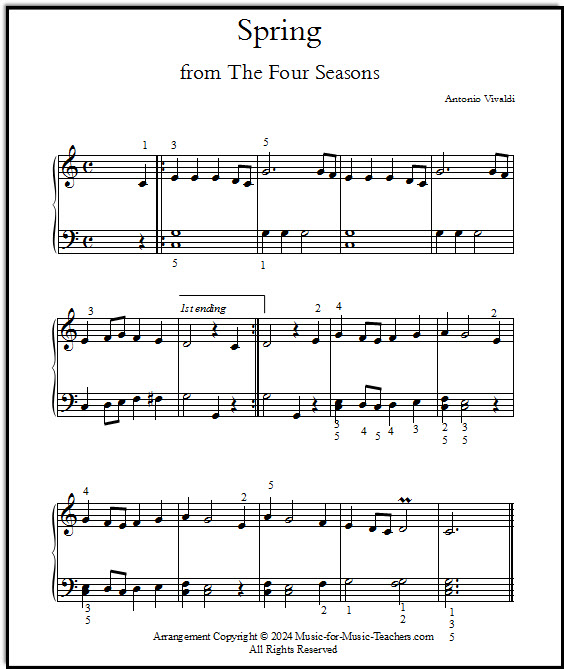 Vivaldi Spring piano sheet music in two versions for early students, with and without note names. A nice introductory piece to the classical repertoire!
Interested in songs from the Bible for your students or church? Check out my other website, SingTheBibleStory.com!
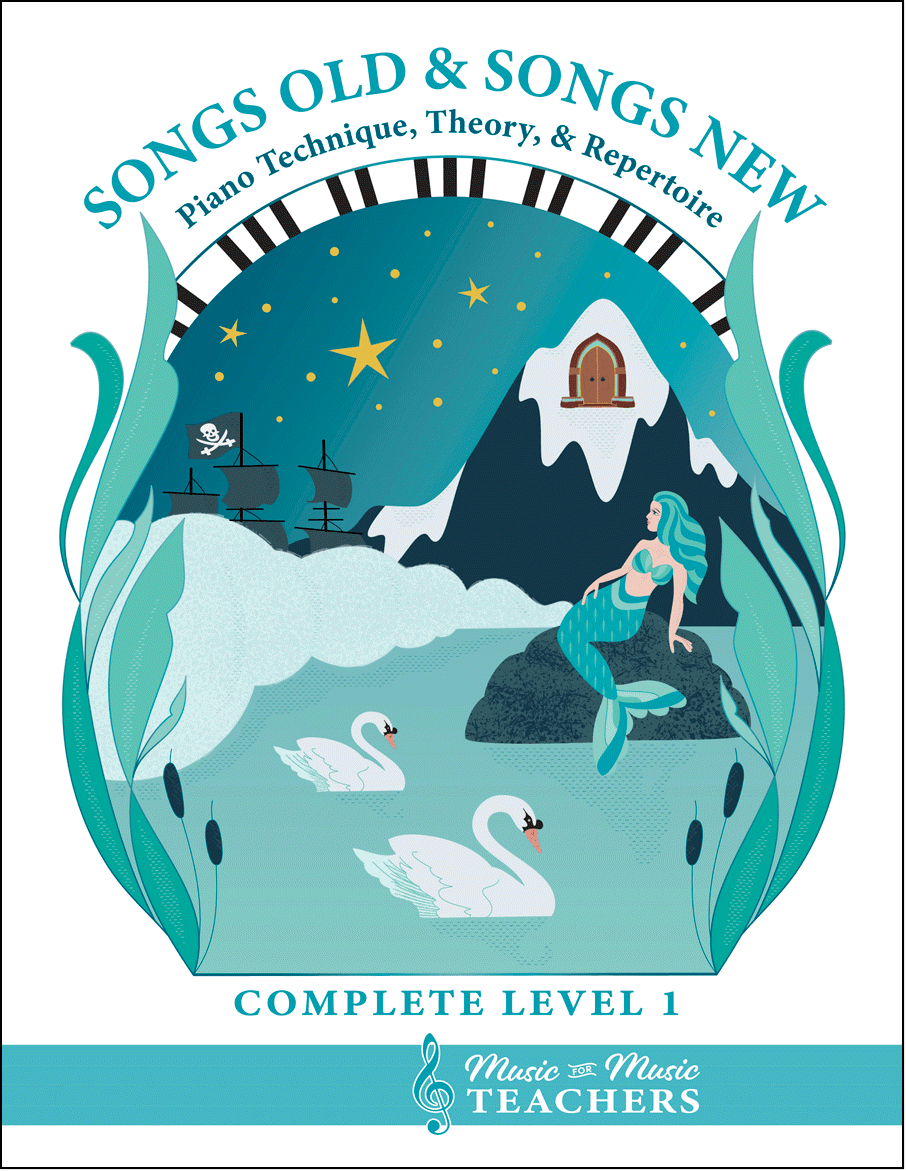
All the first-year material I give my beginner students.
Piano keyboard sheets, scales, chords, note-reading exercises, and over 256 pages of music!

This beautiful song book for piano & voice "Esther, For Such a Time as This", available as a digital download, tells the riveting story of the time when Jews in ancient Persia faced a foe named Haman, and how a brave young queen risked her life to save her people.
A good choice for a singing story-teller, an operatic group, a short theater production, or a class of children!
This book is also available from Amazon as a paperback.

This book is available as a digital download from this site. Visit this page to see some free examples from the book.
It is also available from Amazon as a paperback!
This is the perfect easy start for little pianists.
And when they start reading white-key notes on the staff, this is a fun easy resource to say each week, "Choose a new black-key song at home this week and figure it out to show me next lesson!" They will be spending more time at the piano.
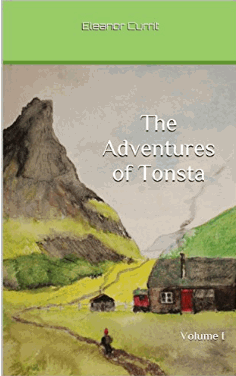


A perfect read aloud storybook
for little boys or girls.
The Adventures of Tonsta highlight the travels of a very young boy with a good heart, who goes about helping folk in trouble.
With a red cap on his head and a sack of tools slung over his shoulder, Tonsta seems to meet people in distress wherever he goes.
Lots of trolls in this book - including one who gives him a Christmas gift!
Comments
Music has such power to move the heart... do you have a story or a question about this music?
Sign up for "Take Note!" to see what's new every month.
About the Author

Hi, I'm Dana! (Say that like "Anna".) I'm the owner of Music-for-Music-Teachers.com, and a newer site, SingTheBibleStory.com.
Like some of you, I've been playing the piano since early childhood, and have added a few other instruments along the way, plus an interest in arranging and composing music.
You can find out more about me and the reason for this website at my About Me page.

Recent Articles
-
Moonlight Sonata: How to Play This Piece Full of Black Keys & Triplets
Moonlight Sonata: How to play this difficult piece full of black keys & triplets? Use large notes, lots of white space, & letters inside the note heads - easy! -
Bach Well-Known Pieces for Piano: the Musette in D, a Crowd-Pleaser!
Some of the best Bach well known pieces include those from the "Notebook for Anna Magdalena Bach." Among piano pieces, "Musette" is perhaps the most joyous!