Free Fiddle Music
Tenpenny Bit for Guitar & Fiddle
Free fiddle music with guitar tabs -- Tenpenny Bit is a driving, rhythmic jig in 6/8 time.
It makes a great ensemble piece or solo for your beginning flat-picking guitar student, with or without a fiddle-player around!
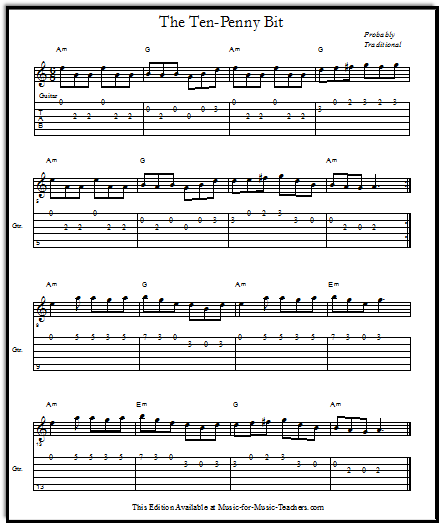
Please scroll down the page for the download links.
A fiddler plays Ten-Penny Bit
What is a "jig?"
For a guitarist used to picking "down-up, down-up, down-up," a jig feels different.
Because the rhythm of a jig divides a measure of six eighth notes into two strong pulses instead of three pulses, the picking needs to emphasize beats 1 and 4 instead of 1, 2, and 3.
Where is the WEIGHT of the rhythm?
So, instead of ONE-two, THREE-four, FIVE-six, the emphasis must be ONE-two-three, FOUR-five-six, to give the melody line proper support.
What this means to the guitar player is (traditionally) DOWN up DOWN, DOWN up DOWN. At least, that should be in the back of your mind as you wield the pick, as an ideal.
However, it isn't practical in all the measures, or even most of the measures, of Tenpenny Bit!
Here is what Doug Sparling says on a page about jigs from GuitarNoise.com:
"Jigs are in 6/8 time, which can take some getting used to if you haven’t flatpicked many jigs or used a lot of triplets in your playing.
"There are a few general guidelines to flatpicking jigs. Jigs are often played with a “lilt” by slightly lengthening the first eighth note of a triplet (on the downstroke) and subsequently shortening the second eighth note (on the upstroke).
"Another item to consider is picking direction.
"Unlike reels, which are normally played using alternating picking, with jigs we’ll use a downstroke on the downbeats to give them emphasis, which in turn helps give the tune a rhythmic drive.
"For example, we’ll pick triplets Down-Up-Down Down-Up-Down (DUD DUD) instead of alternating (DU DU DU).
"This is a guideline, not a rule…you may like the sound of alternating picking better, and in some places, sticking with one picking pattern may be awkward."
Thank you, Doug! What a great resource GuitarNoise.com is, with its free, detailed, informative lessons.
Adding ornaments
And here is Ten-Penny Bit again, with a few added ornaments that sounded right to me after listening to a few videos.
There are other changes that could be added, also, but you can add them yourself! The more I listen to videos of this free fiddle music, the more details I notice.
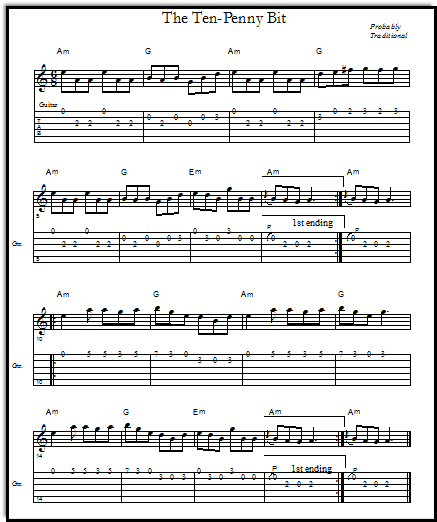
The chords for this free fiddle music are my own suggestion -- you could probably switch the G chords and Em chords around and not really have it sound too different.
I really love this free fiddle music, Ten Penny Bit.
The pdf download links for the fiddle & guitar music:
Download free fiddle music Tenpenny Bit, version 1
Tenpenny Bit free violin sheet music, version 2 with ornaments, for flatpicking guitar or fiddle
Recent Articles


-
When He Cometh "Jewels" Hymn: Piano, Guitar, Vocal
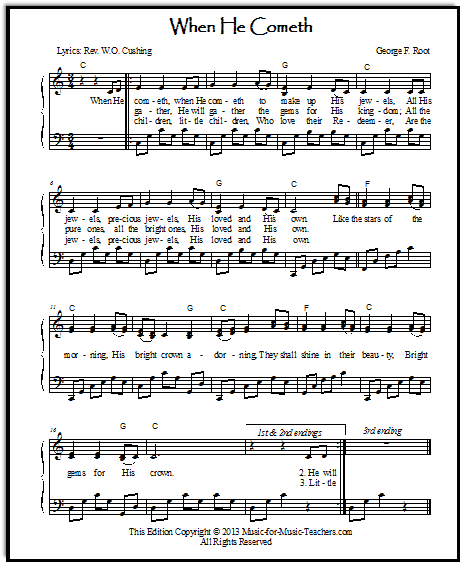 When He Cometh or "Jewels" is an old-timey sounding hymn. Very sweet & very simple, this is one your piano students & vocalists can learn from!
 -
Moonlight Sonata: How to Play This Piece Full of Black Keys & Triplets
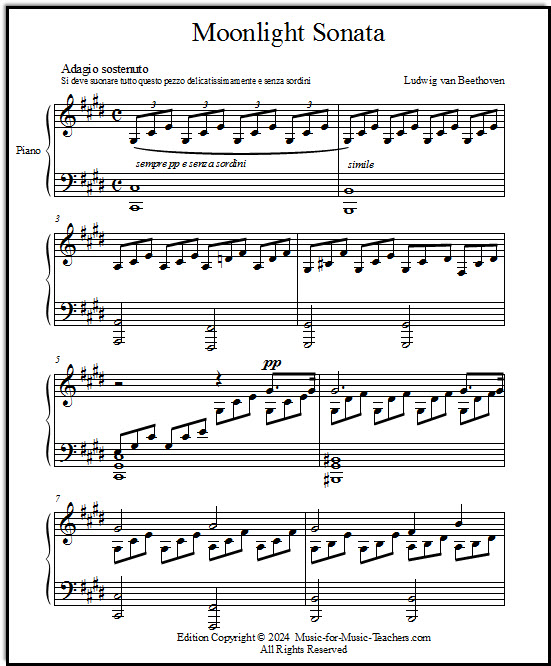 Moonlight Sonata: How to play this difficult piece full of black keys & triplets? Use large notes, lots of white space, & letters inside the note heads - easy!
 -
Bach Well-Known Pieces for Piano: the Musette in D, a Crowd-Pleaser!
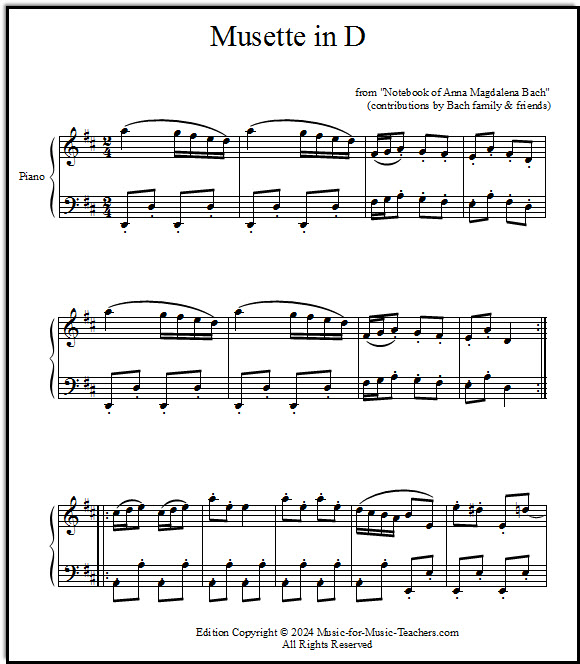 Some of the best Bach well known pieces include those from the "Notebook for Anna Magdalena Bach." Among piano pieces, "Musette" is perhaps the most joyous!
 -
Christ Arose Sheet Music: Resurrection Day Song for Piano or Guitar
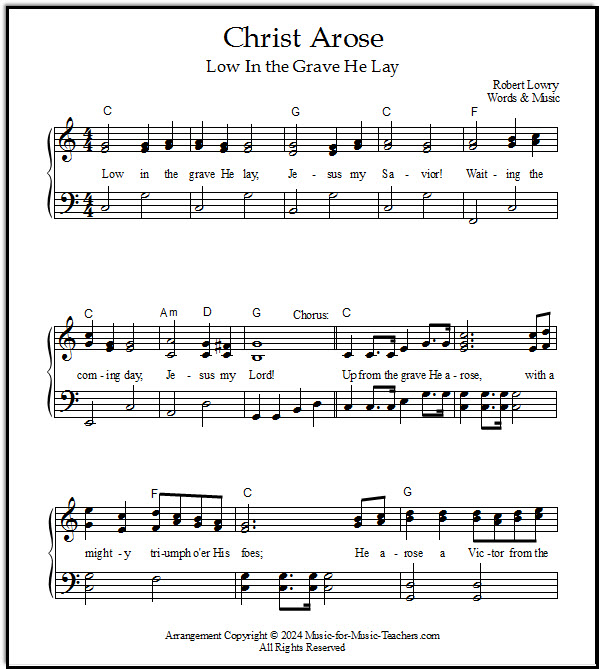 "Christ Arose" sheet music is perfect for Easter, or as many Bible believers say, "Resurrection Sunday." Mixing somberness & triumph, this song explains Easter.
 -
Sweet Hour of Prayer Hymn Sheet Music for Late Elementary Piano
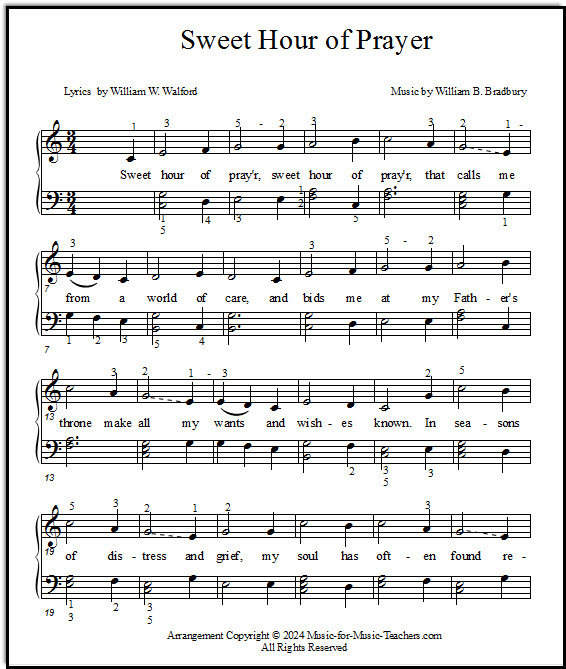 Sweet Hour of Prayer hymn music has been around a long time, and is greatly loved still. Check out 4 arrangements for beginning to elementary piano, & guitar!
Interested in songs from the Bible for your students or church? Check out my other website, SingTheBibleStory.com!
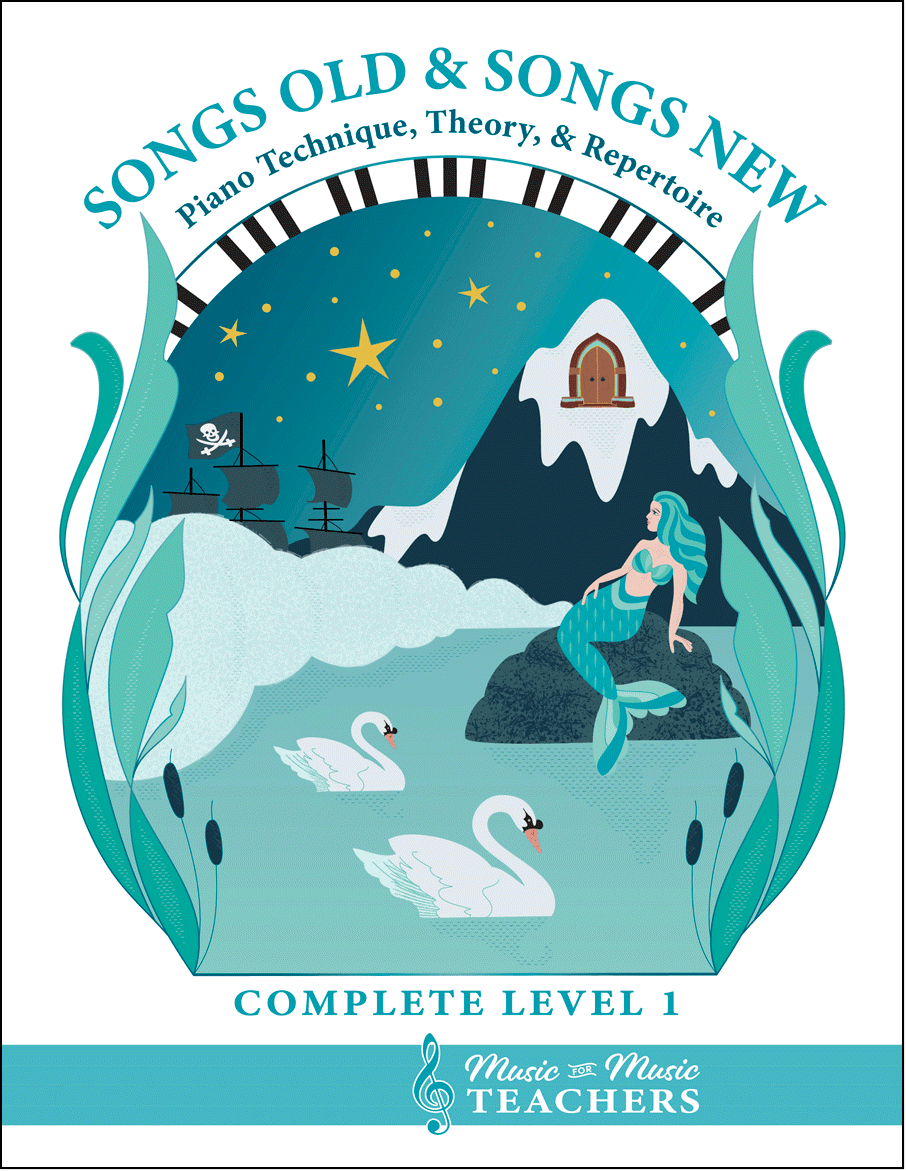
All the first-year material I give my beginner students.
Piano keyboard sheets, scales, chords, note-reading exercises, and over 256 pages of music!

This beautiful song book for piano & voice "Esther, For Such a Time as This", available as a digital download, tells the riveting story of the time when Jews in ancient Persia faced a foe named Haman, and how a brave young queen risked her life to save her people.
A good choice for a singing story-teller, an operatic group, a short theater production, or a class of children!
This book is also available from Amazon as a paperback.

This book is available as a digital download from this site. Visit this page to see some free examples from the book.
It is also available from Amazon as a paperback!
This is the perfect easy start for little pianists.
And when they start reading white-key notes on the staff, this is a fun easy resource to say each week, "Choose a new black-key song at home this week and figure it out to show me next lesson!" They will be spending more time at the piano.
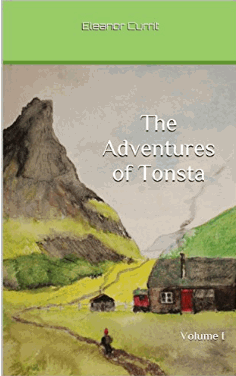


A perfect read aloud storybook
for little boys or girls.
The Adventures of Tonsta highlight the travels of a very young boy with a good heart, who goes about helping folk in trouble.
With a red cap on his head and a sack of tools slung over his shoulder, Tonsta seems to meet people in distress wherever he goes.
Lots of trolls in this book - including one who gives him a Christmas gift!
Comments
Do you have a story or a question about teaching guitar? Do you think it is a hard instrument for beginners, or easy? What have been your challenges?
Please note that all comments are moderated, and will not appear until I have approved them. Also, IF YOU ARE ASKING FOR MUSIC THAT IS NOT IN THE PUBLIC DOMAIN, YOUR REQUEST WILL BE IGNORED. That's pretty much any music written in the last 75 years...
Sign up for "Take Note!" to see what's new every month.
About the Author

Hi, I'm Dana! (Say that like "Anna".) I'm the owner of Music-for-Music-Teachers.com, and a newer site, SingTheBibleStory.com.
Like some of you, I've been playing the piano since early childhood, and have added a few other instruments along the way, plus an interest in arranging and composing music.
You can find out more about me and the reason for this website at my About Me page.

Recent Articles
-
When He Cometh "Jewels" Hymn: Piano, Guitar, Vocal
When He Cometh or "Jewels" is an old-timey sounding hymn. Very sweet & very simple, this is one your piano students & vocalists can learn from! -
Moonlight Sonata: How to Play This Piece Full of Black Keys & Triplets
Moonlight Sonata: How to play this difficult piece full of black keys & triplets? Use large notes, lots of white space, & letters inside the note heads - easy!