Down in the Valley
for Beginner Guitar
Down in the Valley is a great foundational guitar tune that teaches some guitar basics, such as walking bass and fingerpicking (VERY EASY 3-finger approach).
Check out this free guitar tab music, in two versions...
Just 2 chords? Perfect!
Talk about easy guitar songs! Only two basic guitar chords, and an easy melody, but it can be played so many ways.
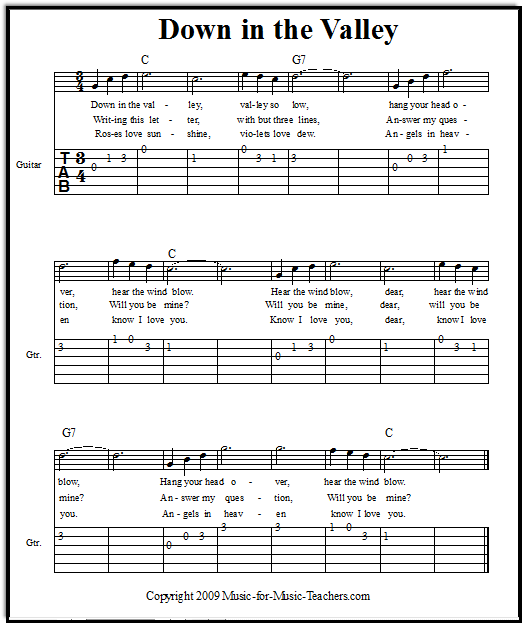
Please scroll down the page for the links to the PDF music
The tiny form of the C chord
The first chords I teach a beginner are simple 1-finger chords -- "Little" C and "Little" G. Both use only three strings.
Little C uses strings 1, 2, & 3 (the high-sounding E, B, & G strings), pressing Left Hand finger 1 on the first fret of the B string.
Voila -- the three strings now "spell" the three notes of a C chord, C, E, and G! (But a little scrambled up: G, C, & E.)
A small version of the G7 chord
To change to G7, all you need to do is lean that first finger back on to the first fret of the E string (and get OFF the B string). Suddenly the strings become G, B, & F: the necessary sounds of a G7 chord.
From strumming to finger-picking
After strumming these small chords with a pick or fingernail - or even brushing with the thumb for a couple of weeks, I like kids to switch to finger-picking.
No, I don't use the flat-pick exclusively with this arrangement of Down in the Valley.
Personal preference. I want the kids to be able to feel where the strings are under their hands.
We'll go back and forth from pick to fingers, depending on what we're doing in the accompaniment.
Get them in "touch" with the strings
The contact with the strings is so much better using fingers, that even if they struggle at first learning to use their fingers, the accuracy at plucking the right string is worth it.
Others may disagree with me -- that's fine! (Why are musicians more like cats than sheep? You can't herd 'em.)
Perfect for the very first picking song
With only three strings to worry about, the chords of Down in the Valley are easy for a first picking song.
Push the thumb AWAY, pull the fingers TOWARD you. I have my students use "Thumb, index, middle; thumb, index, middle," while we sing the words and I play along on a second guitar.
If they have trouble, practice the plucking pattern with open strings until they get the hang of it, then go back to the little chords.
Watch out for a held finger on the guitar face
I used to counsel students to "anchor" their RH (right hand) pinky (that's the small finger for you non-American English speakers, or finger 5 for pianists) on the guitar close to the sound hole.
It's a common habit among guitarists, but now I avoid it, because it is a habit that must be broken when they go on to classical music...
This "simple" skill isn't really so simple
Did I mention that beginning guitarists might go home from the lesson and become fainthearted about this new finger-picking skill? Or completely forget what you were talking about?
New things are always hard to do; you need to creep up on them sometimes, and just take it slowly. Don't worry about it if they come back and can't do it, just start over again. Lots of repetition is the key.
What about walking bass?
Some time later on, when they've gotten good enough to play full C & G7 chords, we come back to Down in the Valley again, and do our first WALKING BASS.
On the sheet below, the measures just before the chord changes show the bass notes walking up or down to join the new chord. (The melody notes are still on the strings, above the walking bass, although they are not meant to be played simultaneously -- play EITHER the chords and walking bass tab, OR the guitar tablature for the melody.)
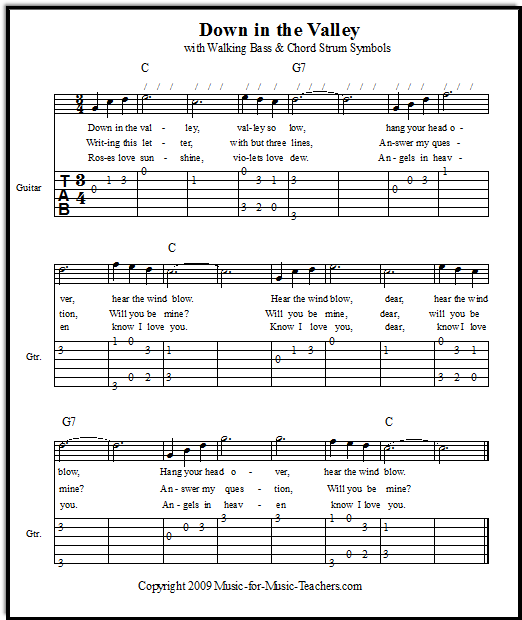
Please scroll down the page for the download links.
But before we do WALKING bass, we experience bass notes in general.
Instead of just a plain strum, we do "Thumb-strum-strum, thumb-strum-strum." (Later, we will do it with the flatpick, when they are so familiar with the expected sound that they will know immediately if they have picked the wrong string.)
What's a "rest stroke"?
I have the kids use a REST STROKE, pushing the chord's bottom string (bass note) away from them with the thumb into a stopped position on the next string, followed by two strums of the rest of the strings.
This gives a solid "feel" to the first beat, while the 3/4 time -- waltz time -- encourages a strong bass note.
You will be a better musician if you can sing along
Singing as you play an instrument seems easy to some guitarists, but is a real big step for some children.
I would encourage it bit-by-bit. Have them count the rhythm aloud with you: "1,1,1, 1-2-3, 1-2-3, 1,1,1, 1-2-3-hold-2-3," etc. If you sing and count aloud as you play, they'll gradually catch the habit.
Down in the Valley is a great piece to play with a group -- singers and other instrumentalists can get into the act so easily!
The links to the guitar music:
Download free guitar tab music Down in the Valley
Download beginner guitar tabs with walking bass
Recent Articles


-
Moonlight Sonata: How to Play This Piece Full of Black Keys & Triplets
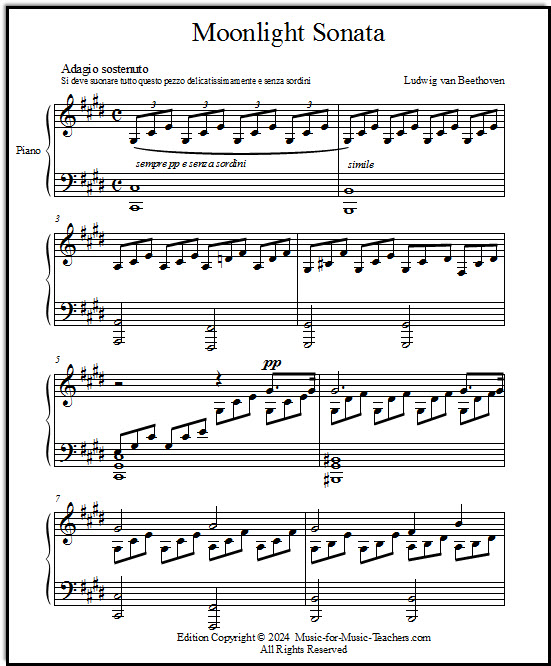 Moonlight Sonata: How to play this difficult piece full of black keys & triplets? Use large notes, lots of white space, & letters inside the note heads - easy!
 -
Bach Well-Known Pieces for Piano: the Musette in D, a Crowd-Pleaser!
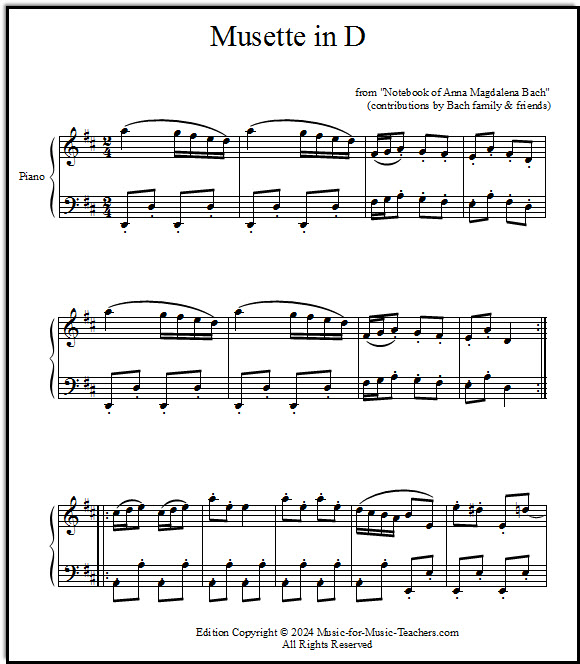 Some of the best Bach well known pieces include those from the "Notebook for Anna Magdalena Bach." Among piano pieces, "Musette" is perhaps the most joyous!
 -
Christ Arose Sheet Music: Resurrection Day Song for Piano or Guitar
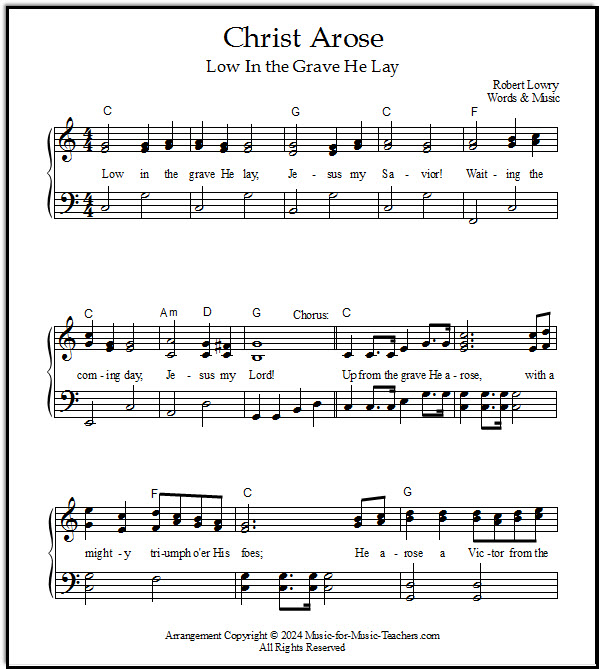 "Christ Arose" sheet music is perfect for Easter, or as many Bible believers say, "Resurrection Sunday." Mixing somberness & triumph, this song explains Easter.
 -
Sweet Hour of Prayer Hymn Sheet Music for Late Elementary Piano
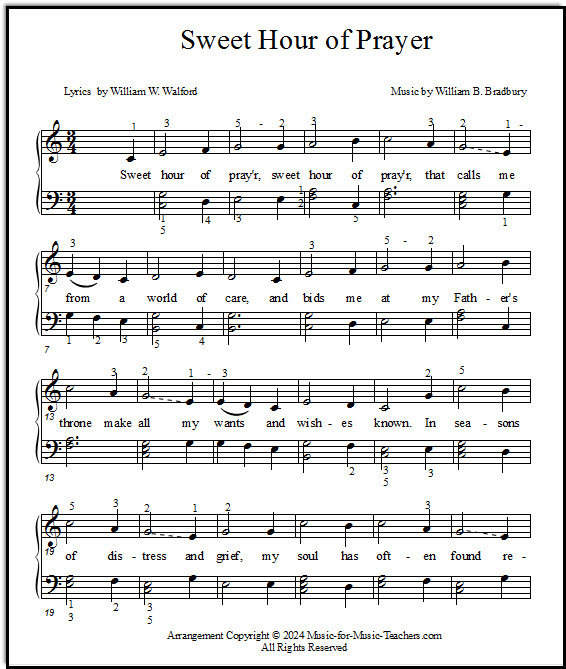 Sweet Hour of Prayer hymn music has been around a long time, and is greatly loved still. Check out 4 arrangements for beginning to elementary piano, & guitar!
 -
Vivaldi "Spring" Piano Sheet Music for Elementary Piano
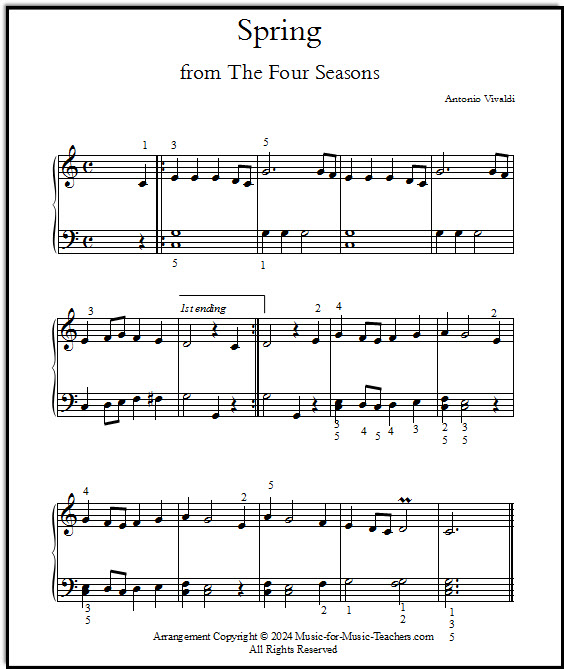 Vivaldi Spring piano sheet music in two versions for early students, with and without note names. A nice introductory piece to the classical repertoire!
Interested in songs from the Bible for your students or church? Check out my other website, SingTheBibleStory.com!
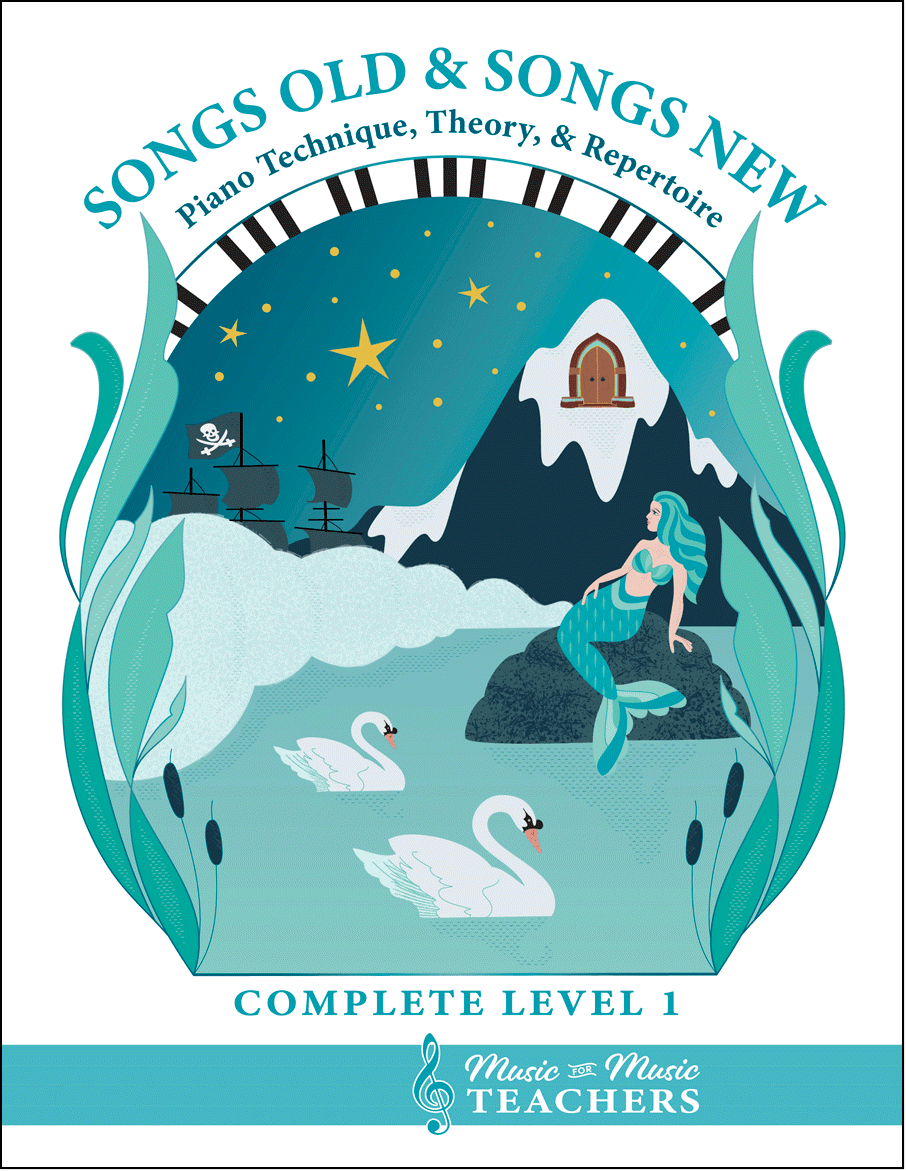
All the first-year material I give my beginner students.
Piano keyboard sheets, scales, chords, note-reading exercises, and over 256 pages of music!

This beautiful song book for piano & voice "Esther, For Such a Time as This", available as a digital download, tells the riveting story of the time when Jews in ancient Persia faced a foe named Haman, and how a brave young queen risked her life to save her people.
A good choice for a singing story-teller, an operatic group, a short theater production, or a class of children!
This book is also available from Amazon as a paperback.

This book is available as a digital download from this site. Visit this page to see some free examples from the book.
It is also available from Amazon as a paperback!
This is the perfect easy start for little pianists.
And when they start reading white-key notes on the staff, this is a fun easy resource to say each week, "Choose a new black-key song at home this week and figure it out to show me next lesson!" They will be spending more time at the piano.
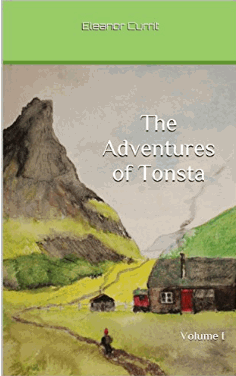


A perfect read aloud storybook
for little boys or girls.
The Adventures of Tonsta highlight the travels of a very young boy with a good heart, who goes about helping folk in trouble.
With a red cap on his head and a sack of tools slung over his shoulder, Tonsta seems to meet people in distress wherever he goes.
Lots of trolls in this book - including one who gives him a Christmas gift!
Comments
Do you have a story or a question about teaching guitar? Do you think it is a hard instrument for beginners, or easy? What have been your challenges?
Please note that all comments are moderated, and will not appear until I have approved them. Also, IF YOU ARE ASKING FOR MUSIC THAT IS NOT IN THE PUBLIC DOMAIN, YOUR REQUEST WILL BE IGNORED. That's pretty much any music written in the last 75 years...
What Other Visitors Have Said
Click below to see contributions from other visitors to this page...
Little Light of Mine Not rated yet
I am desperately searching for a sheet music title, "Little Light of Mine". Can you please help me find it ???
I would greatly appreciate it. Thank you …
Sign up for "Take Note!" to see what's new every month.
About the Author

Hi, I'm Dana! (Say that like "Anna".) I'm the owner of Music-for-Music-Teachers.com, and a newer site, SingTheBibleStory.com.
Like some of you, I've been playing the piano since early childhood, and have added a few other instruments along the way, plus an interest in arranging and composing music.
You can find out more about me and the reason for this website at my About Me page.

Recent Articles
-
Moonlight Sonata: How to Play This Piece Full of Black Keys & Triplets
Moonlight Sonata: How to play this difficult piece full of black keys & triplets? Use large notes, lots of white space, & letters inside the note heads - easy! -
Bach Well-Known Pieces for Piano: the Musette in D, a Crowd-Pleaser!
Some of the best Bach well known pieces include those from the "Notebook for Anna Magdalena Bach." Among piano pieces, "Musette" is perhaps the most joyous!